

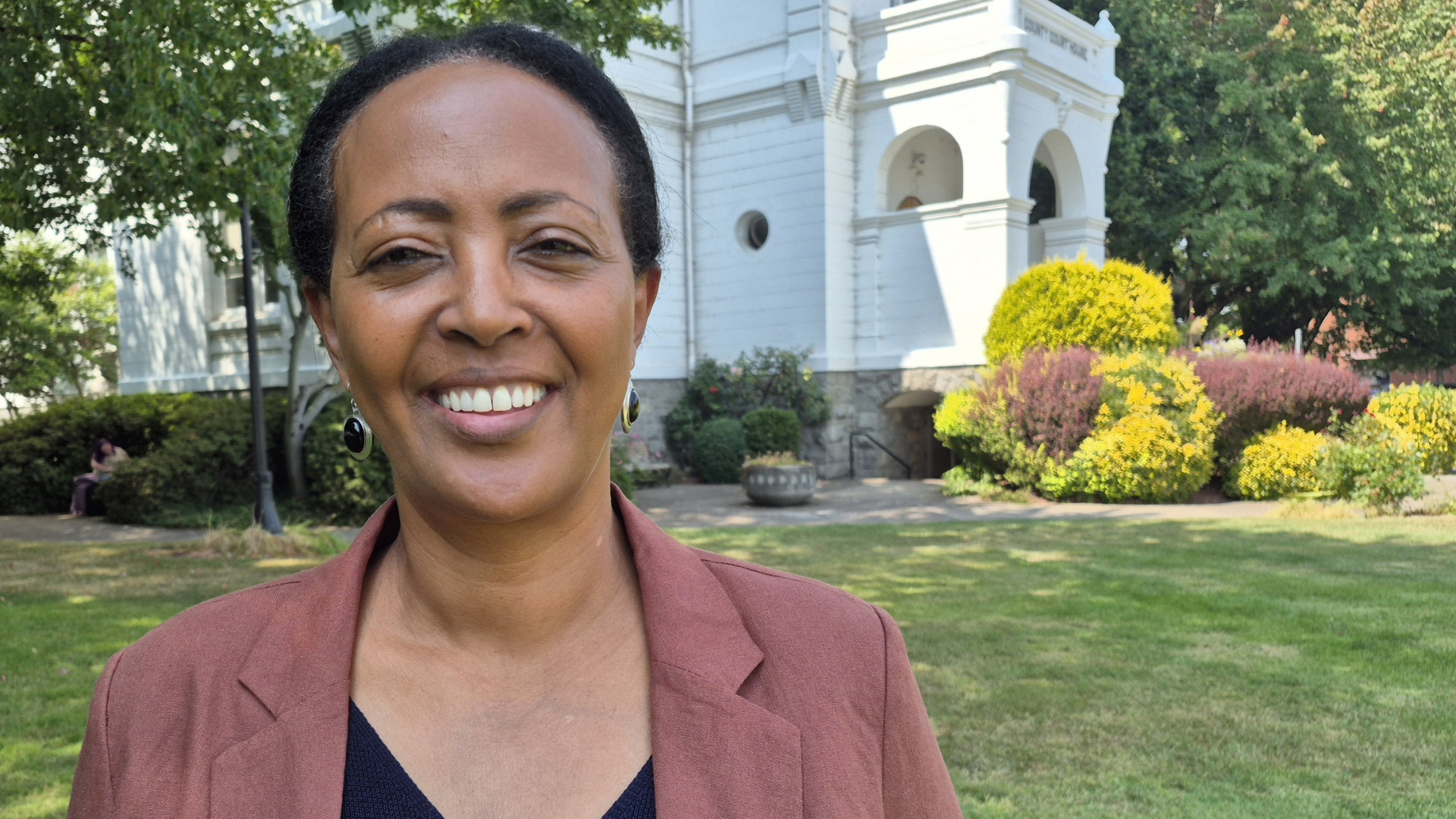
 When Yema Measho is sworn in as Benton County’s new circuit court judge Jan. 4, there will be a twinge of sadness.
Her late parents won’t be there to see what she has done with her education.
“It would have meant so much for my parents,” Measho told the Corvallis Advocate. “My father valued education. That was drilled into us, how important it is to get an education.”
Measho has been an immigration attorney in Corvallis for the past 18 years. When she follows in the path of retiring Circuit Court Judge Joan Demarest, she won’t have far to walk. Her law office is across from the Benton County Courthouse on Northwest Monroe Avenue.
However, the path to the 21st Judicial District Circuit Court of Oregon actually took 8,560 miles from Ethiopia. She followed her siblings to the United States in 2001 when she was in her early 20s. She enrolled at the University of Washington in Seattle where she earned a degree in journalism.
“I felt there were so many stories to be told, and I felt I could tell them in a different voice,” Measho said. “Being an immigrant myself, I knew that certain professions were not pursued in the immigrant community. You go to nursing school, maybe you become a doctor. Journalism was not really encouraged, but that’s what I wanted to do.”
She wrote stories for a variety of newspapers in Oregon and Washington, including the Portland Observer – an African-American newspaper founded in 1970 by the Rev. Alfred Henderson.
Law school was not a foregone conclusion. “When I was an undergraduate, I wasn’t considering going to law school,” she said.
Nonetheless, she began to think about the people she could help as a lawyer. Those thoughts didn’t naturally gravitate toward immigration law. After graduating from Willamette University’s School of Law in 2003, she moved with her husband to Corvallis where he was the manager of IT services for the city government.
She took time off to start a family but then began pondering her next career move.
“When I was ready to go back to work, there weren’t many options available,” Measho said. “I thought, ‘I am an immigrant and have studied immigration law and understand the immigration process, why don’t I open my own immigration practice?'”
‘You Help People Through Scary Times’
Measho created a niche for herself among local legal services. She became the only lawyer who specialized in immigration law in Corvallis after a couple of others came and left. Her practice served Benton and Linn counties as well as the coast.
“Doing immigration work is complex and extremely technical,” Measho said. “I’ve worked with people from different backgrounds. I decided I could take those skills and those experiences to serve the community in a different role.”
Immigration law has only become more complicated over time, especially with the Trump administration’s attitude toward immigrants in general. The administration’s policies have not only been hostile, Measho said, but also chaotic and often completely unpredictable.
“What I advise clients on two weeks ago may not be applicable or true today,” she said. “That’s how fast the changes come.”
However, Donald Trump didn’t invent the current wave of xenophobia – particularly against countries perceived to be Muslim nations. Ethiopia is one such country, but that perception is wrong.
It is a secular state with a religiously diverse population. Christianity (primarily Ethiopian Orthodox) is the majority religion. Islam is the second-largest religion, followed by roughly 31% to 34% of the population.
“Given 9/11, there were a lot of changes because of what happened,” Measho said. “Immigration is an area of that law that changes regularly and frequently, mostly in terms of the policies on how they’re enforced. It’s difficult at times, but it’s something I’ve done and love to do.”
Although she didn’t envision herself as an immigration lawyer, Measho said she just got lucky.
“I feel fortunate,” she said. “Some people go into what they’ve planned to do in life. In my case, I somewhat stumbled on to the practice of immigration law, but it’s been the most rewarding thing I’ve done professionally in my life. It’s been extremely meaningful to me because you make a difference in people’s lives. You keep families together. You help people through scary times.”
And the times, they are scary.
“For some people, there’s always suspicions about the system,” she said. “I can help navigate the system with them. It’s been an amazing opportunity for me to do that.”
The practice stays busy, but it’s not because Corvallis has seen more immigrants coming to the community in recent years.
“It’s not because I’m handling more cases,” Measho said. “I’m handling a healthy amount of cases, but it’s because things are changing. We’re having to change strategies and the way things are done. That takes a lot of time and effort and energy. I’m busy in that sense.”
Trump has made a lot of threatening noise on immigration – from vowing to end birthright citizenship under the 14th Amendment to the U.S. Constitution to attempts to strip foreign-born Americans of their citizenship rights.
The U.S. Supreme Court upheld the 14th amendment from administration challenges June 30 in a 6-3 decision. Trump has since issued an executive order to skirt around the decision, but legal scholars and the courts widely agree that a president cannot change the constitutional guarantee of birthright citizenship unilaterally.
As for revoking people’s citizenship rights, the administration can initiate civil or criminal proceedings to do so. However, this requires proving in federal court that the individual committed naturalization fraud or willful misrepresentation during the application process.
Trump may just be trying to scare people. It’s working, Measho said.
“It is a scary time for a lot of people,” she said. “At the beginning of last year, I was consulting a lot of new naturalized citizens because they’re concerned about what’s going to happen. That used to be unheard of in immigration law because once you’re a U.S. citizen, you’re a U.S. citizen. For a lot of people, it’s very concerning to have to think about how things might change.”
‘It’s Hard Not To Feel For People’
Her clients are also nervous about something else. What happens to local immigration legal services when she moves across the street?
“That’s the big question,” Measho said. “When I was running for the bench, a lot of people were asking that. It’s not definite yet, but we may have another person come in and continue the work. I’m talking with someone who has Corvallis roots and has been doing immigration work for the past few years. I’m excited about that.”
She added she doesn’t take leaving her local practice lightly.
“I feel responsible because the community needs an immigration attorney,” she said. “I feel that I have been a resource for the community. When changes came, I would do presentations with groups. I took that as a personal responsibility to serve the community. I’m glad to say I think we might have someone coming in.”
Being an immigrant herself was also helpful, Measho said.
“At least I can relate, having gone through the process myself,” she said. “The person coming in is not an immigrant, but I think there are people who have a certain understanding for people’s circumstances. It takes a certain amount of awareness to work with the community.”
It takes something else.
“The emotional toll it takes on attorneys is challenging,” Measho said. “A lot of immigration lawyers experience a form of second-hand trauma because you’re facing circumstances with your client. Also, clients have certain expectations, and you’re getting pushback from the government. It’s hard not to feel for people.”
Keeping up with changes in immigration law may also have given her the multitasking skills to be a circuit court judge. “What’s challenging is that most of the changes are not there to make things easier for people,” she said. “They are there to frustrate and frighten them.”
‘For Me, It’s About Fairness’
Measho said she was inspired to become a judge for the same reasons that inspired her to go into law in the first place.
“It’s not a life-long dream of mine,” she said. “Things sometimes fall into place. I enjoy serving people. I will be serving in a different capacity, but I will still be serving the community. I owe it to myself, I owe it to my parents, I owe it to the community to pursue it. It’s an honor and privilege for people to believe I can be a service to the community.”
Measho ran for the position in May, marking the first time there has been a contested opening on the circuit court bench in Benton County since the 1970s. Her recent predecessors, including the currently sitting Judge Joan Demarest, were appointed and then ran for re-election unopposed.
That put an interesting twist on campaigning.
“We went out there and met people, and they said this is something they’ve never seen — a person knocking on the door who is running to be a judge,” Measho said. “It’s a very interesting process, and I’m so happy to have been a part of it because you get to meet people and answer questions.”
Some of the questions go unanswered. People often want to know how a judge will rule on cases involving abortion and other hot-button political issues. Of course, judges must decide each case individually based on the facts and evidence provided as well as the restrictions of statutes.
So Measho and the other two candidates had to find other ways to sway voters.
“You had to look at what each of us would bring to the bench,” she said. “For me, it’s about fairness. It’s about making the system accessible to everyone. It’s the preparedness and competence. You can distinguish yourself in that way, but you can’t go out there and say, ‘This is my agenda.'”
‘This Is Our Community’
The circuit court bench will obviously cover a lot more than immigration cases. Measho will preside over civil and criminal cases, landlord/tenant disputes and whatever else comes her way. “I’m expected to get there on Day 1 and handle whatever I’m given,” she said. “As much as possible, I’m getting ready to do so.”
She and her husband, who now works for the State of Oregon, have two children – a son and daughter both attending college. “They really had wonderful childhoods in Corvallis,” she said. “It’s been an amazing experience for us to raise our children here. This is our community. We’ve made Corvallis our home.”
The siblings who preceded her to the United States went into medicine and engineering. Measho said she hopes that, somehow, their parents know what became of their children and how they pursued the educational opportunities they were given.
“Even though neither of our parents had a formal education, my siblings and I came here, and this is what we pursued,” she said. “I wish my parents had lived long enough to see the results.”
By Tom Henderson
Do you have a story for The Advocate? Email editor@corvallisadvocate.com