

One by one, visitors stepped beneath branches draped with lichen and into a shaded passage along Soap Creek.
Zachary Stocks encouraged them to slow down. Notice the plants. Listen for birds. Think about the people who had occupied and cared for this land in the past, those connected to it today and those who would come after them.
Stocks, executive director of Oregon Black Pioneers, called the spot a “fairy portal.” For Kyna Langhorne, who had driven from Springfield that morning, walking through it offered a moment to become present in the landscape.

“You’re taking your time and centering in a space,” Langhorne said, describing the experience as a chance “to acknowledge the land and be acknowledged by the land.”
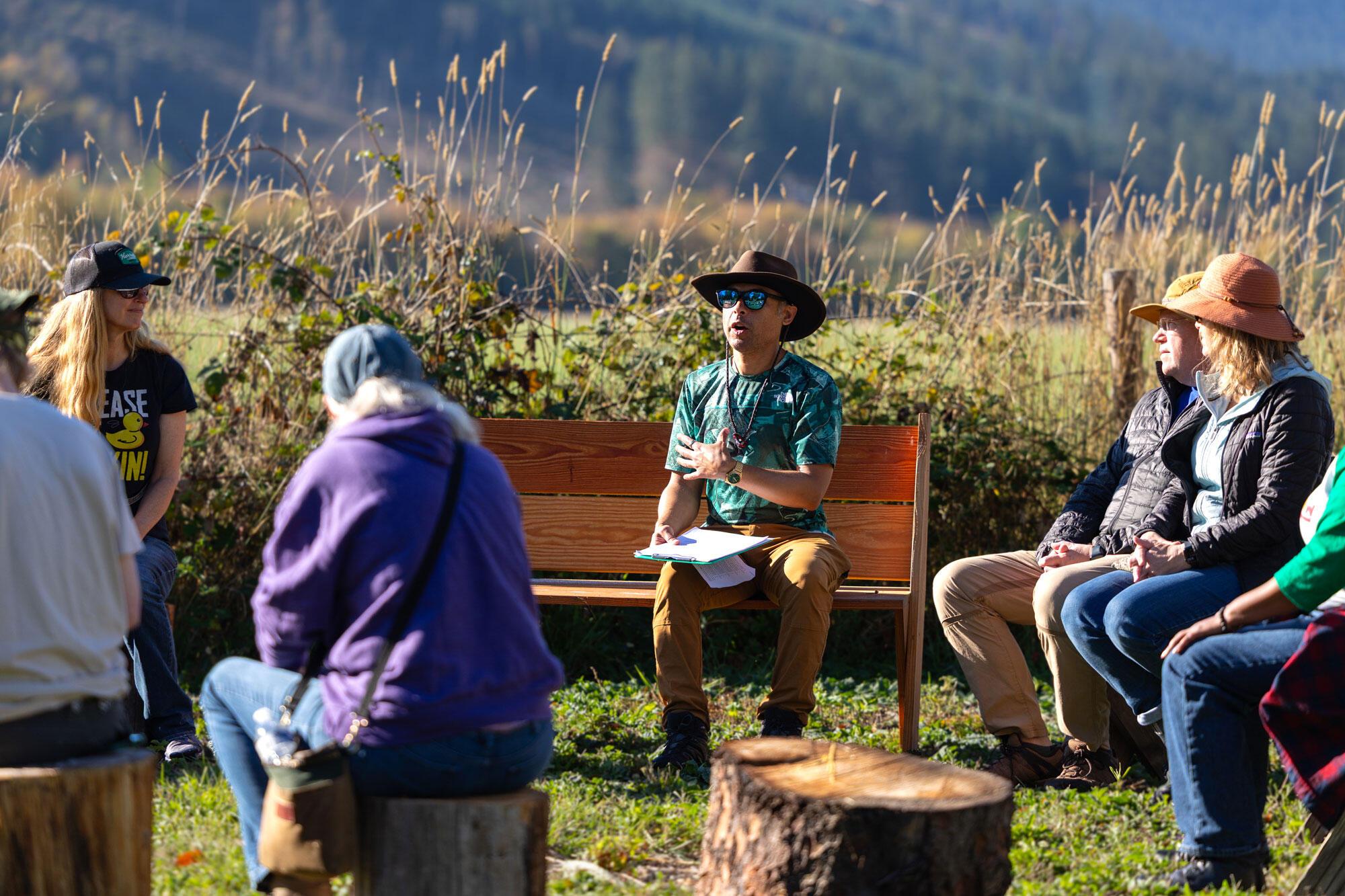
On Oct. 3, the hosted its Fruit & Forage Field Day at Oregon State University’s Soap Creek Beef Ranch north of Corvallis. The project brings visitors onto land where Carson, one of Oregon’s earliest Black pioneers, lived and raised a family in the mid-1800s.
But the story being told there extends far beyond one person.
OSU and four Black-led organizations — , , the and Mudbone Grown — are working together to interpret Carson’s life while exploring the Indigenous history of the land, its continuing agricultural use and its potential for education, research and stewardship.
“This is very much not just history about the past and, ‘Oh, it’s all better now,’” said Lauren Gwin, an OSU Extension community food systems specialist and co-founder of the project. “This is really about what do we learn from the past? How do we tell that story in connection with the story today?”
A story in the landscape
was born into slavery in Kentucky between 1814 and 1818. She traveled the Oregon Trail with David Carson, a white man, in 1845, giving birth to their daughter, Martha Jane, along the journey. The family settled in the Soap Creek Valley the following year and raised cattle, livestock and crops.
After David Carson died in 1852, Letitia Carson and her children were not recognized as heirs to his estate. She was forced from the property but later won two lawsuits, receiving compensation for her labor and for the illegal sale of her cattle.
She eventually settled near Myrtle Creek in Douglas County. In 1863, she filed a 154-acre claim under the federal Homestead Act. She received title to her claim in 1869.
Carson was the earliest known Black person in the United States to receive a homestead patent under the 1862 law. Stocks said Carson’s significance lies not only in what she overcame but in the many roles she held — mother, midwife, cattle raiser, homesteader and land steward.
“She challenged social and legal inequalities within her lifetime, and at a period in Oregon history when Black people had very few opportunities to seek out justice for themselves,” Stocks said.
Yet he said one reaction remains remarkably common when people encounter her story.
“They say, ‘Wow, I never heard any of this before,’” Stocks said. “We hear that every day.”
That includes people who have lived their entire lives in Oregon or Benton County.
Visitors also tell him that being on the land changes their understanding of the history.
“People tell us about how much more connected they feel to the past by getting to come and share these stories here,” Stocks said.
Camas returns to the light
The landscape tells histories that predate Carson as well.
The Soap Creek Valley is part of the homeland of Kalapuya people, who stewarded its prairies and food plants for generations before settlers arrived.
Along the field-day route, the group stopped near an area once choked with invasive blackberry. After crews cleared the vegetation while developing the trail, camas began emerging in abundance.
Luhui Whitebear, an assistant professor of Indigenous Studies in OSU’s School of Language, Culture and Society and an enrolled member of the Coastal Band of the Chumash Nation, has helped guide the project’s work around Indigenous history, tribal relationships and camas stewardship.
Whitebear described the camas not as newly restored but as something that had persisted beneath the overgrowth.
“I feel like it’s more of a reawakening of the camas because it’s been here the whole time waiting for somebody to come back to it,” she said.
Camas depends on relationships among people, plants and soil, Whitebear told the group. Historically, families tended camas patches through harvesting and other practices that helped maintain productive landscapes.
Gwin, a professor in OSU’s Department of Crop and Soil Science, said some bulbs uncovered at the site were unusually large, suggesting a camas patch that had been tended for generations.
The project is now considering how best to care for the area and is keeping local tribes informed as the work develops.
More than restoring a trail
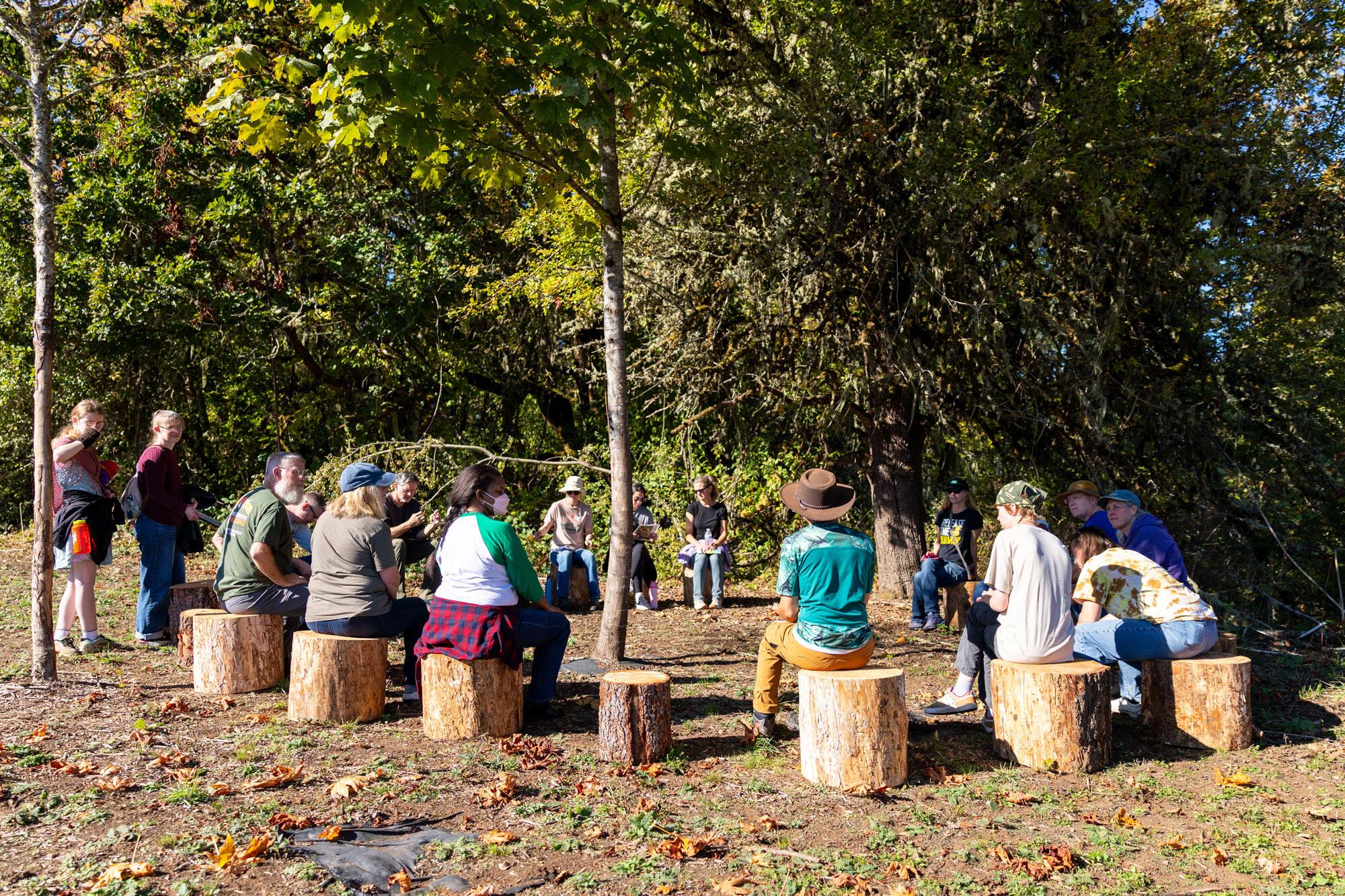
When the project founders first visited the property several years ago, there was no public trail. Reaching parts of the site required driving through pasture, and invasive vegetation covered much of the area now used for tours.
Today, a Memoir Path takes visitors through the Carson Donation Land Claim and past places that illuminate different layers of the landscape.
The project has grown along with it.
Partners have developed a traveling exhibit and digital history collection, hosted annual symposiums, conducted archaeological work, welcomed school groups and university classes and developed an interpretive plan.
Oregon Black Pioneers also created a Letitia Carson Legacy Project coordinator position, now held by Charlotte Epps.
Stocks said he could not have predicted how broadly the work would develop when he became involved near the project’s beginning in 2020.
Gwin, who directs OSU’s in the College of Agricultural Sciences, sees the work as increasingly connected to the university’s larger land-grant mission.
Soap Creek is still an active cattle ranch used for teaching and research. Public access has required coordination with OSU’s Department of Animal and Rangeland Sciences and careful timing around cattle grazing.
At the same time, Gwin sees possibilities for the property to bring together agricultural research, climate-resilient ranching, Indigenous stewardship, historical interpretation and public education.
“It feels to me like that property, that piece of land, is really starting to embody the 21st-century land-grant mission,” she said.
Making history tangible
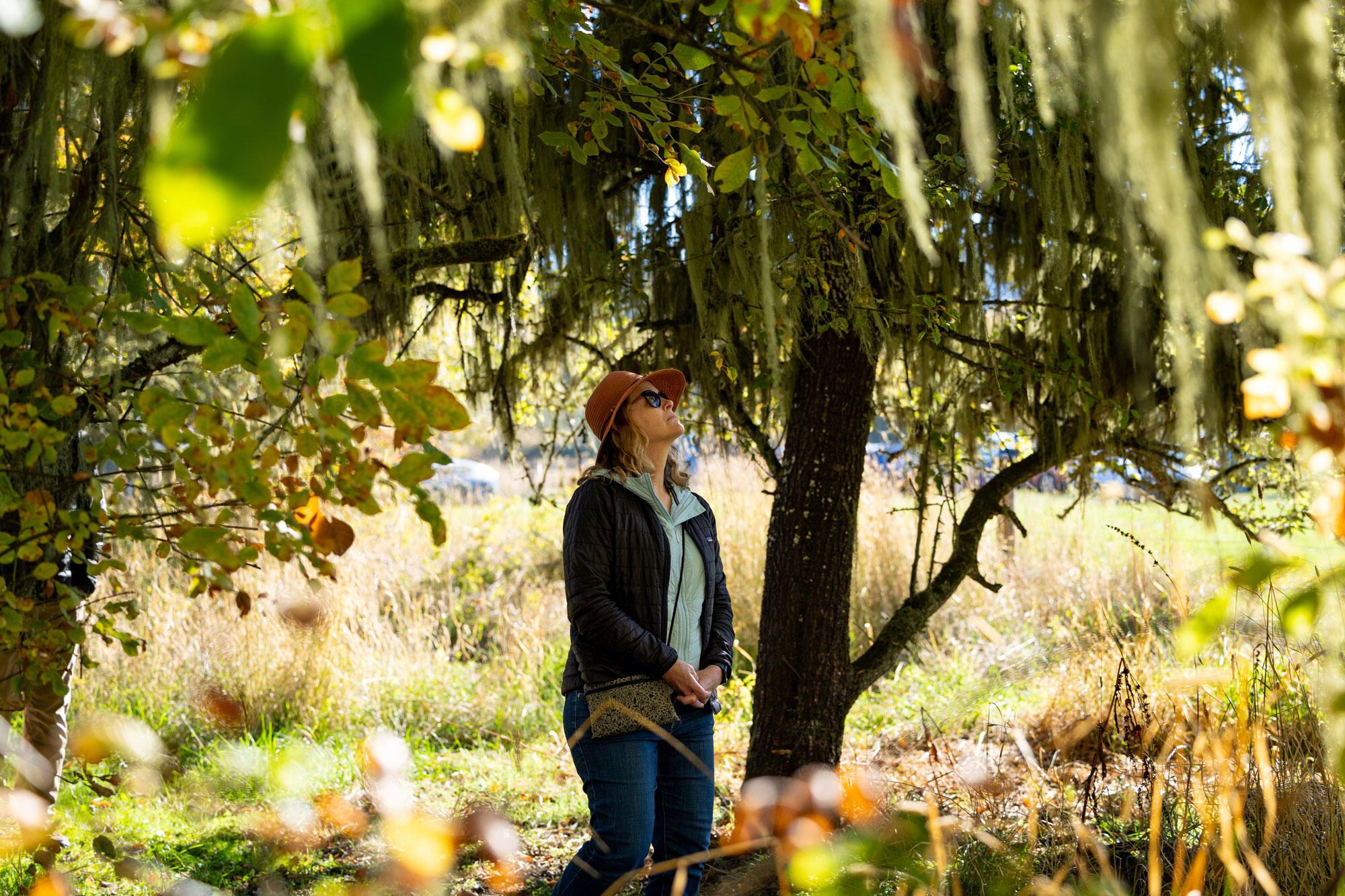
Near another stop on the trail, the group gathered around old apple and pear trees.
Gwin called them the “elder apple” and “elder pear.” Their exact ages are unknown, but they grow on land the Carson family once stewarded and represent the orchards that settlers established as long-term investments in their homes.
Elsewhere, archaeological work has yielded only small traces from Carson’s era. Two years of fieldwork each produced a single ceramic sherd from the period.
Survey notes from the 1850s have provided another clue. With help from a professional surveyor, project leaders recently identified the approximate location of a dwelling recorded after Carson and her children were forced from the property.
The sparse physical evidence is part of what makes bringing people to the landscape important, Gwin said. Much of Oregon’s Black history survives in places where little remains visibly on the ground.
At the final stop, Stocks marked out an area roughly 10 feet by 20 feet — the dimensions recorded for the two-level house Carson later built on her Douglas County homestead.
He asked visitors to imagine fitting daily life into that footprint: meals, beds, a fireplace and a home for Carson and her two children.
Langhorne said the experience worked because the different histories were not presented separately.
“What I’ve liked the most has been this coming together of so many different groups of people,” she said. “It’s not just a Black story. It’s not just a woman’s story. It’s actually not just an Oregon story.”
A Black woman who moved to Oregon from the South nearly 25 years ago, Langhorne said she came to the field day in part because she wanted to learn more about Black women whose experiences had been left out of familiar accounts of Oregon history.
She left thinking as much about the landscape as the history.
“It’s been beautiful,” she said.
Words by Chris Branam, photos by Katterlea MacGregor
Do you have a story for The Advocate? Email editor@corvallisadvocate.com