

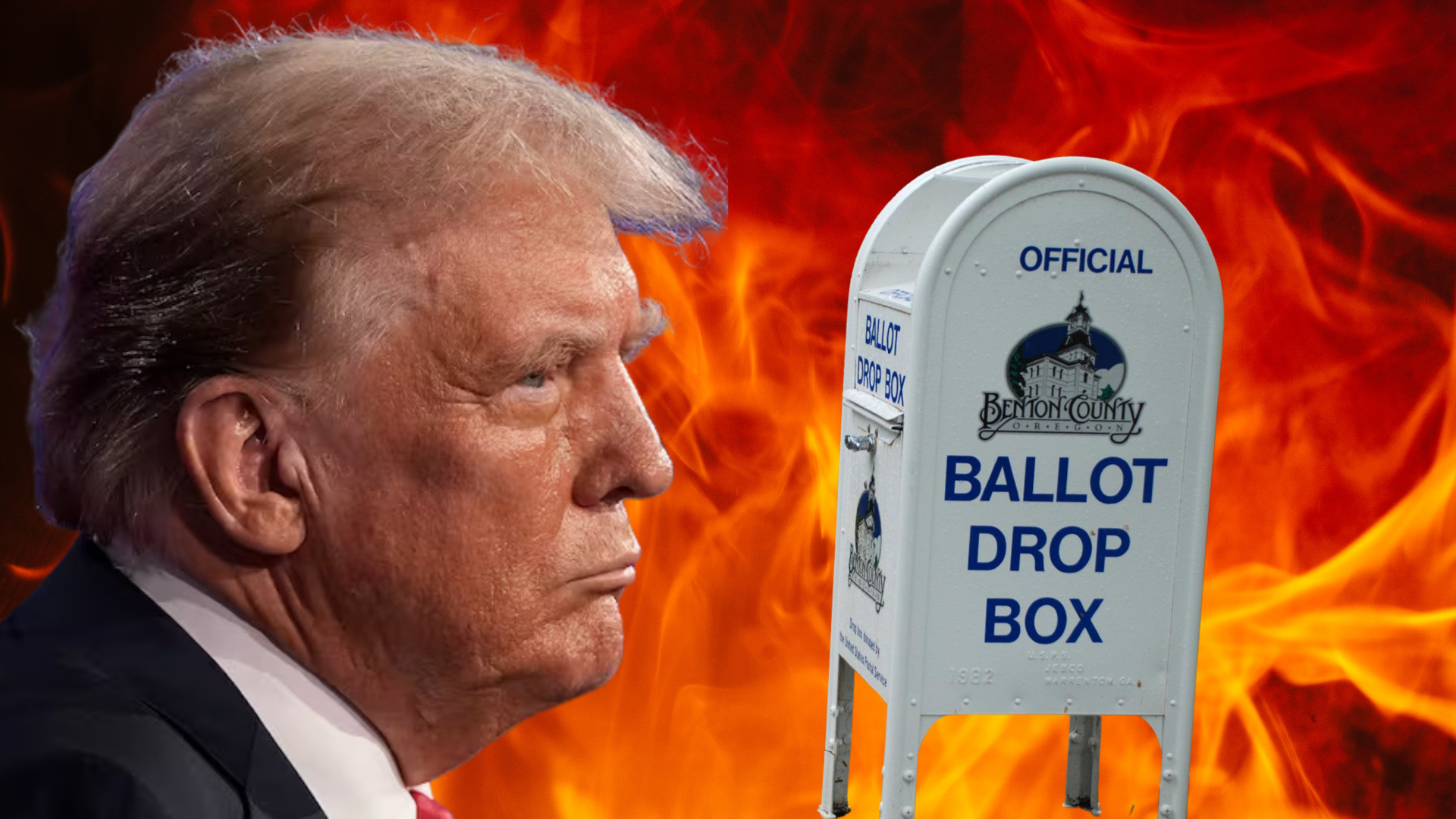
 Just how worried should we all be about Trump targeting mail-in voting. Well, maybe this is an indication, Benton County officials have just issued an advisory on the matter and set a local town hall with Oregon’s top election official.
All of which is pursuant to an executive order signed by the president earlier this week, largely intended to dismantle mail-in voting. This is what prompted the County to issue its statement, which really does read just a little like an advisory of coming weather dangers.
“On April 1, the Oregon Secretary of State Elections Division confirmed that elections will move forward as planned, in accordance with current Oregon law, and the issue will be resolved through the court system,” said the release. “Benton County leaders are closely monitoring the developing situation and remain in contact with state officials.”
These two sentences together could feel jarring, and most especially coming from a bunch of generally staid and understated civil servant types.
But at least the release quickly reverts to something that feels comfortingly boring, saying it is the “Voters’ job is to get their ballots in for the May 19 primary election, either by returning them by mail or dropping them in one of the ballot boxes located throughout the County. Ballots will be mailed to Benton County voters on April 29.”
They also go on to encourage folks to double-check their voter registration and mailing address at OregonVotes.gov before April 28 to ensure they receive their ballot. Again boring, but comforting, and actually, not the worst idea.
The town hall
Anyhooo, whatever anyone thinks of all this. Oregon’s top election official, Secretary of State Tobias Read, will be headlining a local town hall about all of it on Wed, May 6 at 6 pm, in Corvallis. Set for the Benton Center, 757 NW Polk Ave., he will be joined by Sen. Sara Gelser Blouin and Rep. Sarah Finger McDonald.
A little history
Oregon was the first state in the union to decide all its ballots would be mailed. The state legislature approved mail-in voting in 1995, but then Governor John Kitzhaber vetoed it. In 1997, the state senate killed it outright. And then in 1998 voters took the matter into their own hands, passing a ballot measure for the mail-in system we’re all now familiar with.
Republicans have at times served as Oregon’s top election official since. So have Democrats. Every one of those officials has wholeheartedly advocated that the system is efficient and reliable. There has not been even one exception.
How we got here
President Donald Trump signed a sweeping executive order on Tuesday, March 31, that attempts to restrict mail-in voting, a White House priority certain to face significant legal challenges.
The order directs the U.S. Department of Homeland Security along with the Social Security Administration to compile a list of voting-age American citizens in each state and share it with state election officials. The order also requires the U.S. Postal Service to only send and receive ballots that include tracking barcodes.
Trump’s order represents a major escalation in his effort to assert presidential control over elections, which under the U.S. Constitution are administered by the states. Trump last year attempted to unilaterally impose a proof of citizenship requirement to vote in federal elections in an executive order that was blocked in federal court.
The move also reflects a long-held focus by Trump and his allies on noncitizen voters. Studies have shown noncitizen voting is extremely rare.
“I think this will help a lot with elections,” Trump said.
National database of adult citizens
Homeland Security operates the SAVE system, a powerful computer program that can verify citizenship.
DHS has previously invited states to run their voter rolls through SAVE, which flags voters as potential noncitizens. Some election officials criticize the system, saying it wrongly identifies U.S. citizens as possibly ineligible.
The U.S. Department of Justice as recently as last week denied any efforts to create a national voter registration list. While the executive order does not explicitly mandate the creation of a voter list, it essentially marks an effort by the White House to create a national database of adult U.S. citizens.
The order requires Homeland Security to enable states to routinely supplement or suggest changes to each state’s citizenship list. Federal officials would also be required to allow individuals to access their own records and update or correct them ahead of elections.
Under the executive order, the postmaster general must propose rules to require all outbound ballot mail to be sent in an envelope that includes a barcode for tracking. The order also requires that states must inform the U.S. Postal Service at least 90 days before federal elections whether they intend to allow ballots to be sent through the mail.
“Instead of focusing on lowering the cost of energy, groceries, and health care, Donald Trump is desperately attempting to take over and rig our elections and avoid accountability in November,” U.S. Sen. Alex Padilla, a California Democrat, said in a statement shortly after Trump announced the order. “This executive order is a blatant, unconstitutional abuse of power.”
SAVE America Act
Trump has pushed Congress to pass the SAVE America Act, which would require individuals to produce documents, such as a passport or birth certificate, proving their citizenship in order to register to vote. The U.S. Senate is debating the bill, but it appears unlikely to have enough support to overcome a filibuster.
Trump has repeatedly asked Republicans to add three provisions to the bill, including restrictions on mail-in voting, with exceptions for members of the military, people who are ill and those on vacation.
The president has also previously promised to advance voting restrictions, with or without Congress. Earlier this month, Trump voted by mail in Florida.
The executive order directs the Justice Department and other federal agencies to withhold federal funds from non-compliant states and localities “where such withholding is authorized by law.”
Tuesday’s order is certain to face legal challenges. The Constitution gives Congress — not the president by executive order — the power to override state election regulations.
Marc Elias, a prominent voting rights litigator, promised to fight the executive order.
“If Trump signs an unconstitutional Executive Order to take over voting, we will sue,” Elias wrote on social media. “I don’t bluff and I usually win.”
Republican National Committee Chairman Joe Gruters praised the order, saying Trump was restoring voter confidence. “Protecting America’s ballot box isn’t optional – it’s the foundation of our republic,” Grunters said.
DOJ lawsuits against states
The Justice Department has sued 29 states and the District of Columbia for copies of their voter rolls that contain sensitive personal information on voters, such as driver’s licenses and partial Social Security numbers. About a dozen states have voluntarily provided the data, but most are fighting the demands in court.
Three federal judges have so far ruled against the Justice Department. The administration is appealing and in court documents has argued that swift court decisions are necessary to ensure the security and fairness of the midterms.
The Trump administration has said the data is necessary to verify only citizens are registered to vote. Last week, a Justice Department lawyer confirmed in court that voter data would be shared with Homeland Security.
“Some may freak out about this, but honestly, this is hilarious,” David Becker, executive director of the nonpartisan Center for Election Innovation & Research and a former U.S. Department of Justice Voting Section attorney, wrote on social media about the Trump order.
“It’s clearly unconstitutional, will be blocked immediately, and the only thing it will accomplish is to make liberal lawyers wealthier. He might as well sign an EO banning gravity.”
Meanwhile, back in Oregon
Oregon officials quickly slammed the executive order, with Sen. Ron Wyden — a Democrat and the first U.S. senator to be elected in an all-mail election in 1996 — calling it a “desperate last-ditch effort by a failing president to suppress American votes.”
“Oregonians have successfully voted by mail for over 30 years, and we’ll be damned if we let Donald Trump change the way our state runs its elections,” Wyden added. “My message to the White House is this: if you come for Oregon’s vote-by-mail, you’ll have hell to pay.”
Secretary of State Tobias Read, also a Democrat, called the order “another desperate, illegal power grab that shows a total lack of respect for the American people and our Constitution.”
“The Constitution is clear: states run elections,” Read said. “Oregon’s gold standard vote-by-mail elections are secure, fair, and accurate. We don’t need decrees from Washington D.C. My message to the President: We’ll see you in court.”
Attorney General Dan Rayfield, also a Democrat, pledged to use “every legal tool available” to fight the order, noting that even Trump votes by mail.
Oregon and Washington recently won a federal court victory blocking a prior Trump order that sought to require voters prove citizenship and that all ballots be received by Election Day.
And then, back in Benton County
Toward the end of the County release, someone got, shall we say a little cranky, or at least about as cranky as a civil servant might get imagining Donald Trump could find Benton County on a map, writing, “Oregon counties already use barcodes to track every vote, verify signatures to confirm identities and conduct random audits to ensure accuracy. See Benton County’s process from start to finish.”
Was said boring bureaucrat all BIF, BAM, TAKE THAT ORANGE MAN on writing that line – we haven’t had the temerity to ask.
Benton County reporting and mail-in vote history by Mike Suarez and Steven J. Schultz. State and federal reporting from Jonathan Shorman of news partner States Newsroom and Oregon Capital Chronicle.
Do you have a story for The Advocate? Email editor@corvallisadvocate.com