

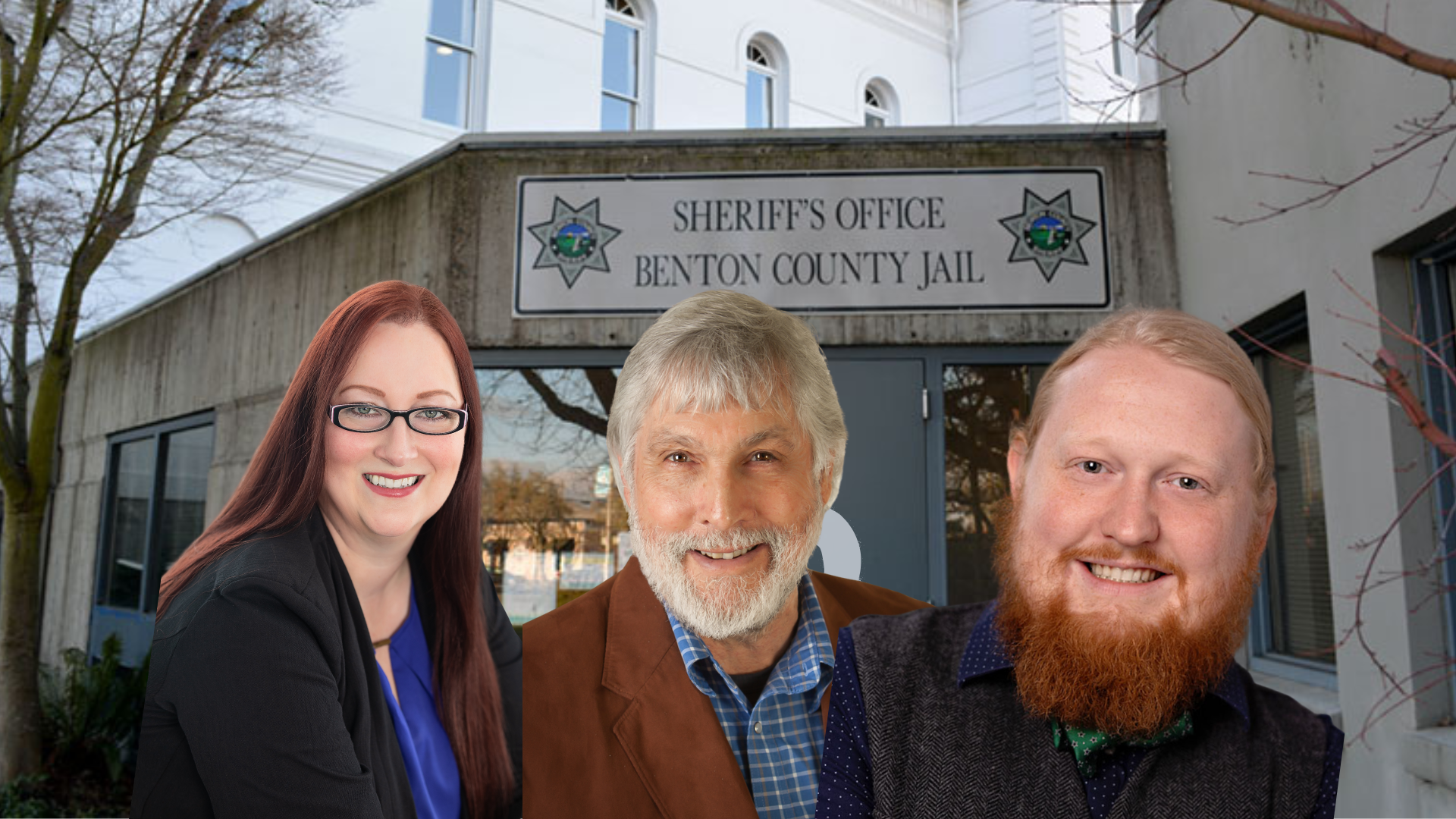
 Our fair burgh’s leaders know two very basic things about the county jail – it’s an utterly inadequate facility physically, and voters will be entirely unwilling to take on more tax burden to pay for a new one anytime soon. Now they have a far clearer understanding of the impacts.
Last week, federally funded consultants toured the county’s justice facilities and visited with local stakeholders. They poured through data, and they centered on the jail.
Then on Thursday, they delivered a presentation to the Benton County Board of Commissioners and the County Administrator.

The findings were presented by Alan Richardson and Roger Lichtman of Justice Planners, working with the National Institute of Corrections, or NIC, a federal agency under the Department of Justice. The pair spent three days in Benton County touring the jail, interviewing roughly 50 local stakeholders, and analyzing arrest and booking data.
A Building “Beyond Its Useful Life”
Richardson and Lichtman found the jail operating well beyond its capacity. They said the facility has accumulated more maintenance work orders than any other county building despite being a fraction of the size of those buildings. They also said the inadequacy of the facility has contributed to the county ranking 35th out of 36 Oregon counties in public safety.
The Benton County Jail, built in 1976, drew a grim architectural assessment. The staff received high praise for keeping it together.
Lichtman, a licensed architect who has worked on jail projects including the $16 billion Rikers Island relocation in New York City, noted that despite the age and condition of the facility, sheriff’s staff had kept it remarkably clean.
“The building is clearly beyond its useful life,” Lichtman said. “Unfortunately, the sheriff’s staff do such a good job that the building doesn’t look as bad as it actually is.”
Among the problems documented: plumbing leaks requiring jackhammering through concrete, a secured vehicle sally port too small for the modern SUVs that law enforcement use nowadays, smoke detectors installed near the floor in cells, asbestos floor tile in at least one room, door locks that are no longer manufactured and must be fabricated by hand, and an emergency generator that produces only enough power to keep the central control room running — leaving life safety systems without backup power.
The jail has logged more than 50 maintenance work orders in 2026 alone — more than any other county building — despite having roughly one-tenth the square footage of a typical county facility.
No Room at the Jail, Catch and Release
With just 40 beds and a ratio of 0.29 jail beds per 1,000 residents — well below the national low-end average of 0.5 — the facility is perpetually over capacity.
When the consultants arrived Tuesday, 28 people were held in the jail itself, while others were housed at Polk County, a contract facility, a state hospital, or were monitored via GPS.
The consequences, Richardson said, ripple through the entire criminal justice system. Approximately 80% of arrests end in cite-and-release because there is no room to hold people. Failure-to-appear warrants are approaching 2,000 annually — the top charge category year after year. One individual, Richardson noted, currently has more than 100 open cases and is walking free; and that’s just the original cases, not the failure-to-appears. Other individuals carry 40 to 60 open charges.
“There’s no teeth in the justice system from a detention perspective,” Richardson said. “We’ve heard story after story about someone getting a citation and tearing it up in front of the officer.”
Property crime in Benton County runs roughly two and a half times the national average — a figure the consultants attributed directly to the inability to detain repeat offenders. On county health and income comparison website countyscore.com, Benton County scored among the highest in the state on health and income metrics, but received a safety score of just two out of 100.
100% Agreement: A New Facility Is Needed
In an outcome Richardson called unprecedented in his career, every survey respondent they polled agreed the county needs a new jail. The consultants talked to mental health workers that couldn’t meet with incarcerated individuals at the jail because of space – they talked with everyone from community members to law enforcement to elected officials.
“I’ve never done one of these where 100% of people were saying, yeah, we know we need to do this,” he said, referring to building a new jail.
Richardson also noted specifically, the critiques were directed at the building, not at the people working inside it. Commissioners and consultants alike praised the sheriff and jail staff repeatedly throughout the meeting.
Commissioners Acknowledge the Problem, Know It’s a Hard Sell
Despite the unanimity among stakeholders, commissioners were candid about the financial and political obstacles ahead.
Commissioner Nancy Wyse said she has supported a new jail for years but was not willing to put another bond measure before voters in the near term.
Notably, voters have rejected similar measures on four separate occasions over the last couple of decades.
“The fact of the matter is that we don’t have the money,” Wyse said. She suggested exploring alternatives to incarceration as a near-term priority, rather than launching a full needs assessment before a funding path is identified.
Commissioner Gabe Shepherd, while agreeing that voters would be unlikely to support a bond measure at this point, took a different view. He argued the county should advance its planning so it would be positioned to act quickly if grant funding or other opportunities emerged. He asked the consultants whether federal grants exist for jail construction. The answer was largely no — most federal and foundation programs focus on diversion and alternatives, not brick-and-mortar detention facilities.
County Administrator Rick Crager noted that previous planning efforts, including town halls in 2018 and 2019, had built real momentum before COVID halted progress. He pointed to a newly established sinking fund as a step toward building matching dollars, and said the county needs to do a better job explaining the problem — and its costs — to a broader public that has largely not raised the issue with elected officials.
Commissioner Pat Malone, however, emphasized the need for a strategic plan before planning and pursuing a new jail again. Wyse dovetailed with comment, saying the county does have other projects that it has completed successfully, and others that are in various stages of work.
Wyse was also candid that public trust was lost in the course of the last campaign and that she believes it needs to be earned back.
Benton County District Attorney Ryan Joslin offered one note of optimistic support for a new jail. He said a former grand juror who had opposed the jail levy reversed her position after serving two months as a juror and touring the facility. “After seeing how the process works and after touring the jail, she said, ‘I am a believer now,'” he recounted.
What Comes Next
Consultants outlined a nine-phase facility development process and recommended a formal needs assessment as a logical next step — one that would analyze alternatives to incarceration, project future bed space needs, and produce data that could position the county for grants or other financing. Even if the grants and financing won’t build another jail, they can help the county.
A zinger at the end
Toward the end of the presentation, the consultants also flagged a looming operational problem: the new courthouse under construction has no central holding area for defendants, a design that assumed an attached jail would be built alongside it. The attached jail voters rejected.
With no such jail coming, deputies will need to shuttle defendants back and forth — a security and logistical challenge given the current sally port cannot accommodate transport vans.
Richardson and Lichtman said they will deliver a comprehensive written report to the county within the coming weeks.
“Every day,” said Crager, “just like the adults in custody, we’re getting older, the facility’s getting older, and it’s not getting better.”
The presentation
The video of the meeting is below. If you haven’t been on a guided visit to the jail, you get what amounts to a narrated photo tour at about the 2:00 minute mark. At about At about 20:30 you get about an hour and half of what this means. You get numbers and graphs and information. You also learn about the impacts on our shared community and what this all means for the folks that are incarcerated.
On several occasions, the consultants referenced FBI Uniform Crime Report data and CountyScore.com data.
To contact Chris Evenson about this story, email office@corvallisadvocate.com.
CORRECTION: A prior version of this story included the wrong first name for Benton County District Attorney Ryan Joslin.
Do you have a story for The Advocate? Email editor@corvallisadvocate.com