

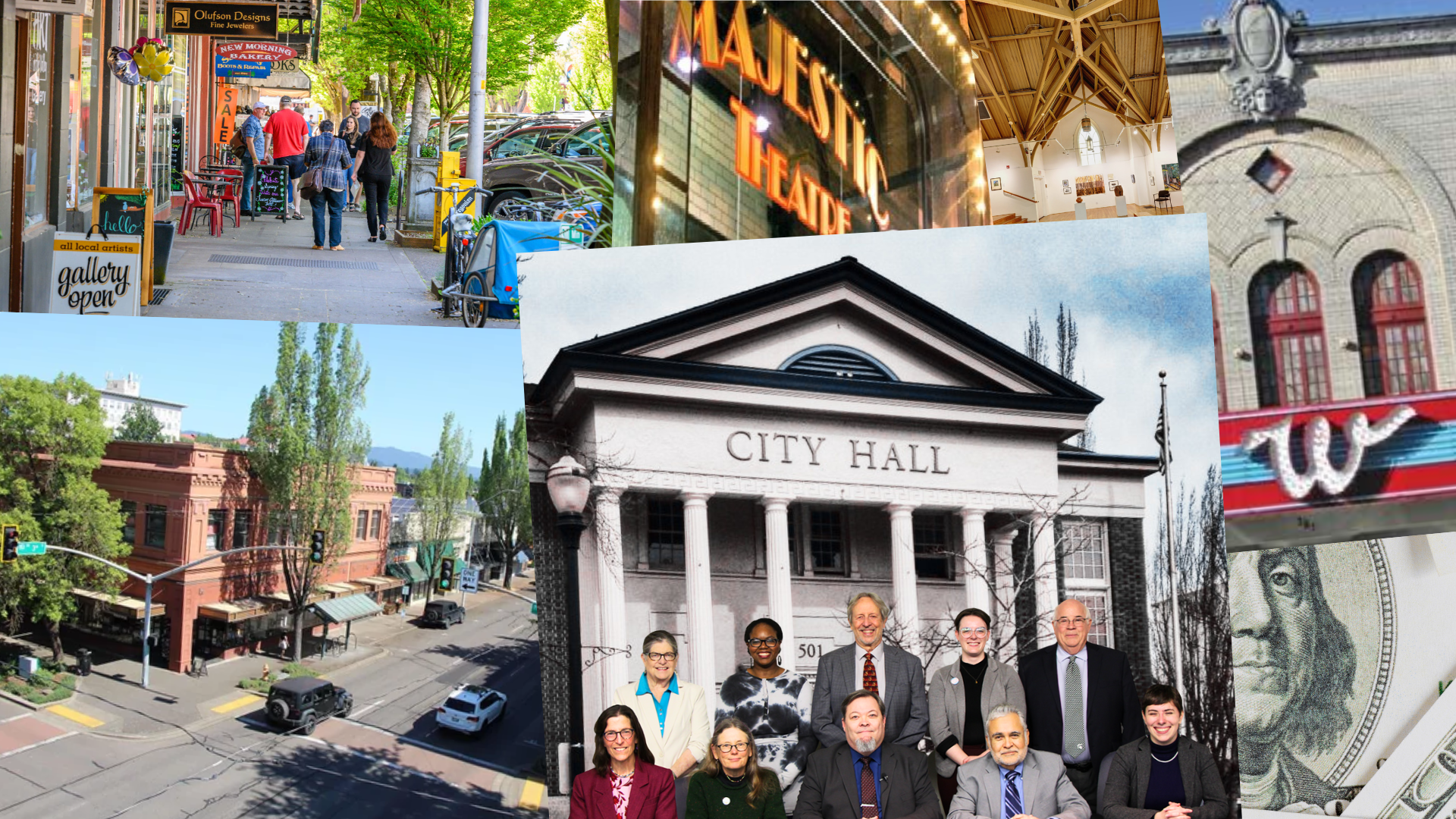
 Money. With all the buzz about new downtown projects and revitalization, one could easily predict what would come next, an ask from local business advocates for City tax dollars. The idea being a vibrant downtown is good for business, and the whole community.
So, last Thursday, the Corvallis City Council signaled they may favor funneling tax dollars toward what is being called downtown revitalization. The proposal, if passed by Council, would also need voter approval. If successful at the polls, a portion of the property taxes that come from downtown would no longer go into the City’s general fund but would be sequestered for special downtown projects.
This would be a Tax Increment Financing, or TIF, district. When a TIF district is created, its then current property tax amounts continue going into the City’s general fund, but the area’s yearly property tax increases don’t. Those increases, and increased assessments from new building, go into a special fund with specific purposes. In this instance, like we’ve said, projects aimed at downtown revitalization.
You may have noticed a TIF District sounds like what was once called an Urban Renewal District. They’re the same animal, just under another name.
What’s next
Exactly what is being envisioned for Downtown Corvallis and how much it will cost is not exactly clear yet. Boundaries for the district aren’t yet decided. Prospective revenues are unknown for now.
These uncertainties have caused some tensions. The Council largely agrees about wanting to put the matter before voters, but the timing is up for debate. Some on the Council are hoping for this year’s November election. Others are concerned that not enough planning and research can be completed by then. Without adequate planning, there may not be enough specifics for voters to say yes. And then, even if the voters could be persuaded, inadequate planning could also mean a less effective TIF District implementation.
At last Thursday’s City Council work session, Ward 3 Councilor Jim Moorefield described the current state of the proposal as, “Specific light at the moment.”
“We got a ways to go, I think before we have something that says this is what the plan would be. This is how, you know, how the money will be spent, by, you know, major category.”
Moorefield has experience in this arena. He was instrumental in both planning and campaigning for the South Corvallis Urban Renewal District.
Ward 8 Councilor Carolyn Mayers, noting that a November election timeline apparently does not permit the feasibility study customary to getting a TIF District started, echoed Moorefield’s concerns, asking City staff, “With a feasibility study being usually done, what’s the downside of not doing a feasibility study?”
Christopher Jacobs from Corvallis’ Economic Development Office replied, saying, “It may show that the taxable revenues you could potentially generate within the district aren’t suitable. They hey aren’t suitable [large enough] for the types of projects that you wanna do.” He also said a feasibility study would examine the political realities of seeking public approval.
Mayers, who is unabashedly supportive of a downtown TIF District, expressed concern that voters may be unwilling to approve a plan that isn’t specific enough or been rigorously vetted.
So, what’s the rush. Well, the Obie Companies Gordon development is a large downtown hotel, apartment and retail complex currently being built on 1st Street. Once the project is completed, or at some stage of completion, the County will reassess the property’s new post-improvement value. If a TIF district is in place before that happens, the pursuant property tax increase would accrue to the TIF District.
During Thursday’s discussion, City staff said the County has declined to offer a specific timeline for when the property will be reassessed.
Analysis
This is our analysis. Voter approval for a TIF District will be an uphill battle. It appears the Council may be underestimating that reality. The potential for approval will be in the details. Voters will need to see what’s in it for them. This will be especially true for voters who may not be among the psychograph that would usually frequent a downtown outside of work or business.
Also, city fees have fueled real animus. Voters have no direct input on setting these fees and they are essentially a flat tax; everyone pays the same amount regardless of their ability to pay. Taxes like these are generally referred to as regressive, they are especially hard on lower income and working poor, and folks with a fixed income.
But these fees are increasingly seen as unreasonable even outside of these demographics. Our local governments’ reliance on operating levies and general obligation bonds is also regressive, even if not to the same degree as the fees.
There is also the general economy and increasing uncertainty. Corvallisites are generally more insulated from these realities than most of the nation, but less so in the current moment than during past times of instability. Adding to that uncertainty are unprecedented uncertainties for state and federal budget makers.
None of this bodes well for a proposal that would siphon dollars away from the City’s general fund.
Economic development or jobs could be an argument in favor. But what kinds of jobs. Most of the businesses that would benefit are public facing retail and restaurant; sectors that are constricting generally, and that pay lower wages.
For those sectors, one could argue it would be more impactful to redevelop the Highway 99 corridor through South Corvallis and 9th Street in North Corvallis. Doing that would reduce travel, which would translate into fewer environmental and infrastructure impacts.
In short, we think most Corvallisites generally favor a vibrant downtown, but what remains to be seen is if that sentiment will translate into a willingness to spend for it.
The quality of the proposal may prove decisive, so it also remains to be seen if the City can be thorough enough by November. Or if not, if they will delay, rather than increase the risk of a rejection at the polls.
Do you have a story for The Advocate? Email editor@corvallisadvocate.com