

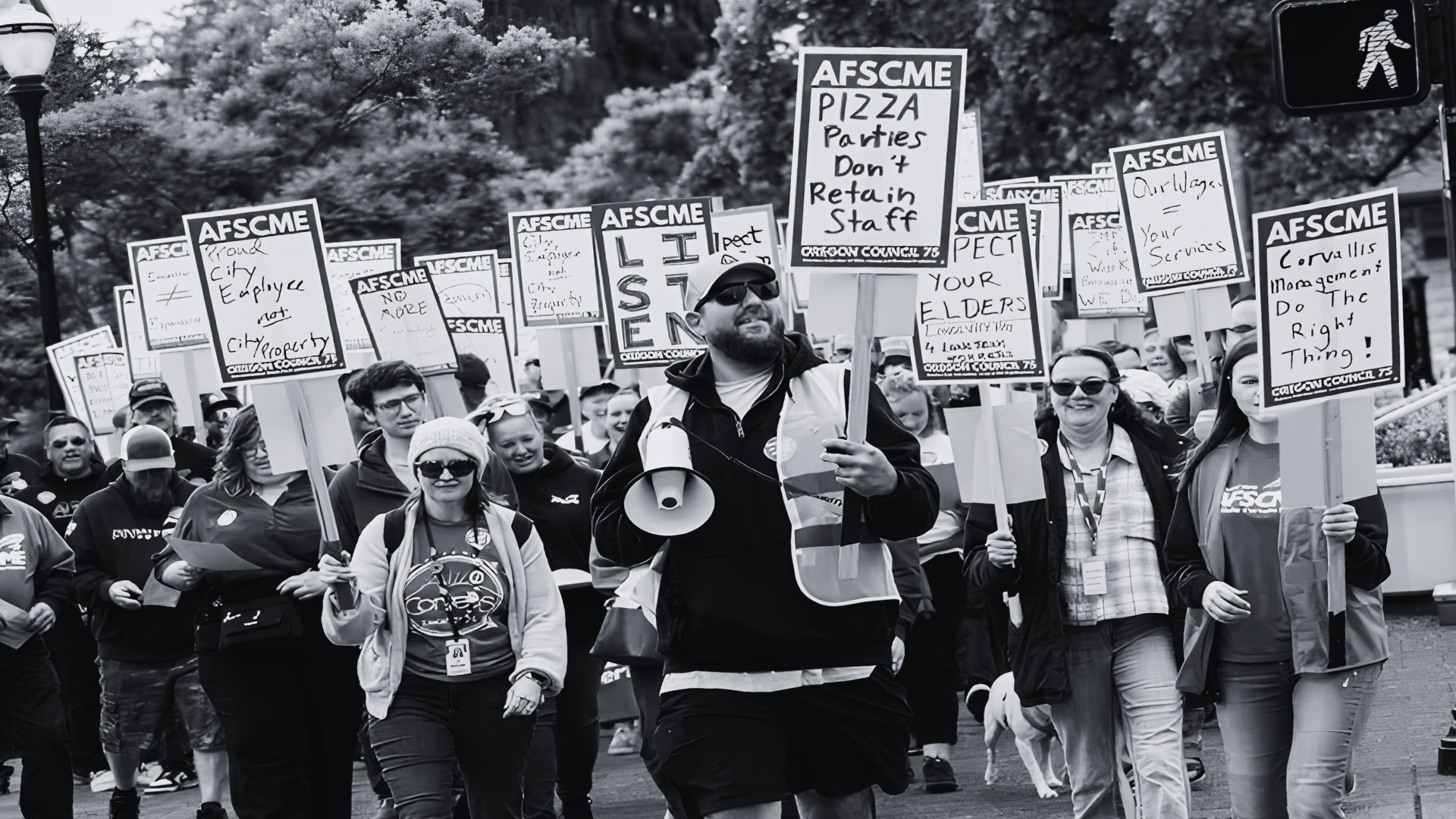
Last week, workers for the City of Corvallis approved striking. Yesterday morning, union leaders took the next step toward ultimately striking.
The American Federation of State, County and Municipal Employees, or AFSCME, Local 2975 leadership formally declared an impasse. Contract negotiations have dragged on since Jan. 15 without resolution.
After 150 days of good faith negotiations, the City of Corvallis submitted their last, best and final offer July 7, which the union did not accept, referencing multiple sticking points that did not align with the union’s values. Local 2975 has made their interests clear; cost-of-living adjustments, longevity pay, maintaining hazard pay, and health insurance premium costs.
The union’s counterproposal, sent July 20, was rejected. The City is seeking a contract which is neutral cost, one that costs no more than their last, final and best offer.
In a release, the City said, “Last month, the City presented a contract offering an increase of more than $8.4 million over three years, which represents a 12% cost of living (COLA) increase for employees. COLAs are in addition to six annual step increases of 5% for eligible employees. In the last year of the contract, the City proposed increasing the employee cost share for medical and dental insurance from 7% to 10%, an increase of approximately $26 per month for a full-time employee. This would bring AFSCME’s cost share for healthcare insurance into alignment with other employee groups. AFSCME is one of 4 different unions across the City.”
The City release also said that Corvallis is facing a $20 million budget gap “that will impact core services as early as 2027.” Back in June of this year, The Advocate reported City officials were projecting a biennial budget deficit of $8.1 million. KLCC reported in May that expenditures for Police and Civic Campus facilities would add $14.3 million to that total.
The union has been seeking a 2% general increase for all workers plus a 4% cost-of-living adjustment, a total of 6% for the first year. For 2027 they last offered a 3% increase, and for 2028 a 5% increase.
Also, they are seeking added raises for longevity. Public employees get what are called step-increases; automatic raises for specified periods of service. Meet the usual worker performance standards; you get the raise. The City offers six of these “steps” and the union is negotiating to add a seventh.
In a public statement, the union said, “Management has stated that they are ‘philosophically opposed’ to rewarding longevity and that they do not value retention of workers after the six-year mark.”
Union President Evan Newton told the Advocate, “As for the City’s press release on the union’s impasse declaration today, I am shocked and disappointed at the twisting of perspective on our labor negotiations.”
He went on to call attention to the annual step increases to union-represented employees being capped at six steps in an employee’s tenured lifetime within one position. In other words, employee wages are frozen after six increases. After that, they can only get whatever cost-of-living increases the union negotiates over time. Meanwhile, management members receive nine steps in each exempt position alongside additional benefits, according to Local 2975.
Secondly, Newton referenced the estimated $26 increase per month for health insurance coverage and claimed that it doesn’t include the additional costs of family plans, which could total up to $228.80 per month.
“Third, these negotiations are not complicated,” said Newton. “The union seeks to meet with City management on equal footing to resolve these issues at the lowest level possible. City management is the party that wishes to make this process complicated.”
According to Newton, even if the City expects the union to shoulder the budget deficit and factor it into their submissions, Local 2975 has offered non-economic proposals which are continuously rejected. “The city has made it clear that this budget deficit was totally unrelated to projected labor costs. This has been a failure of past management in addition to national interest rates and plans for new City facilities.”
When could a strike happen
The National Labor Relations Board defines an impasse as the point in negotiations when both parties are warranted in assuming that further bargaining would be futile. The stalemate in negotiations allows for a seven-day timer for both parties to send costing information, such as how much the union’s demands would require financially, to the State of Oregon’s Employee Relations Board.
Both parties are required to submit their final offers and cost summaries to the ERB, which the mediator will then publish publicly. Afterward, Local 2975 and the City of Corvallis experience a 30-day “cooling off” period, and on day 20 the union can issue a 10-day strike notice if a contract is not agreed on by then.
What the Union and City are Saying
Seventy-three percent of the union’s 248 represented employees pay dues, 90% of which voted yes on a strike authorization vote held Aug. 28.
In a letter to the City, Kim Harman, program manager, wrote, “As we have tried to explain over and over at the bargaining table over the last 6-7 months, the majority of City employees are frustrated by deteriorating morale and respect from upper management. Long-time employees have detailed how much has been lost and newer employees are often unaware of how much better working at the City used to be. We all heard Mary Beth tell us repeatedly at the table that morale is fine and she is unaware of any problems, we maintain that there is a lot at stake with this contract.”
The letter ended with the union stating they remain open to new proposals and further bargaining.
“It’s unfortunate that it’s gotten to this point,” said Newton. “It seems like management is more interested in preparing for a strike than averting one. It would be helpful if they would sit down with us.”
In the union’s statement, Newton said, “Our goal has always been to avoid a strike, because we know that it will disrupt the community services we provide, but it is unfair that most of us cannot afford to live in the community that we serve. It’s time for City leaders to invest in the people who keep Corvallis safe, healthy, and thriving.”
When asked about the negotiations and the possibility of a strike, City spokesperson Patrick Rollens said, “In a strike situation, our first priority would be to support core services, while understanding that some staff would be spread thin. We will have more information to share if the strike timeline advances.”
The next mediation session is scheduled for Sep. 10 with the state’s ERB present. The earliest date on which union-represented workers can go on strike is Oct. 9.
By Hannah Field
Do you have a story for The Advocate? Email editor@corvallisadvocate.com