

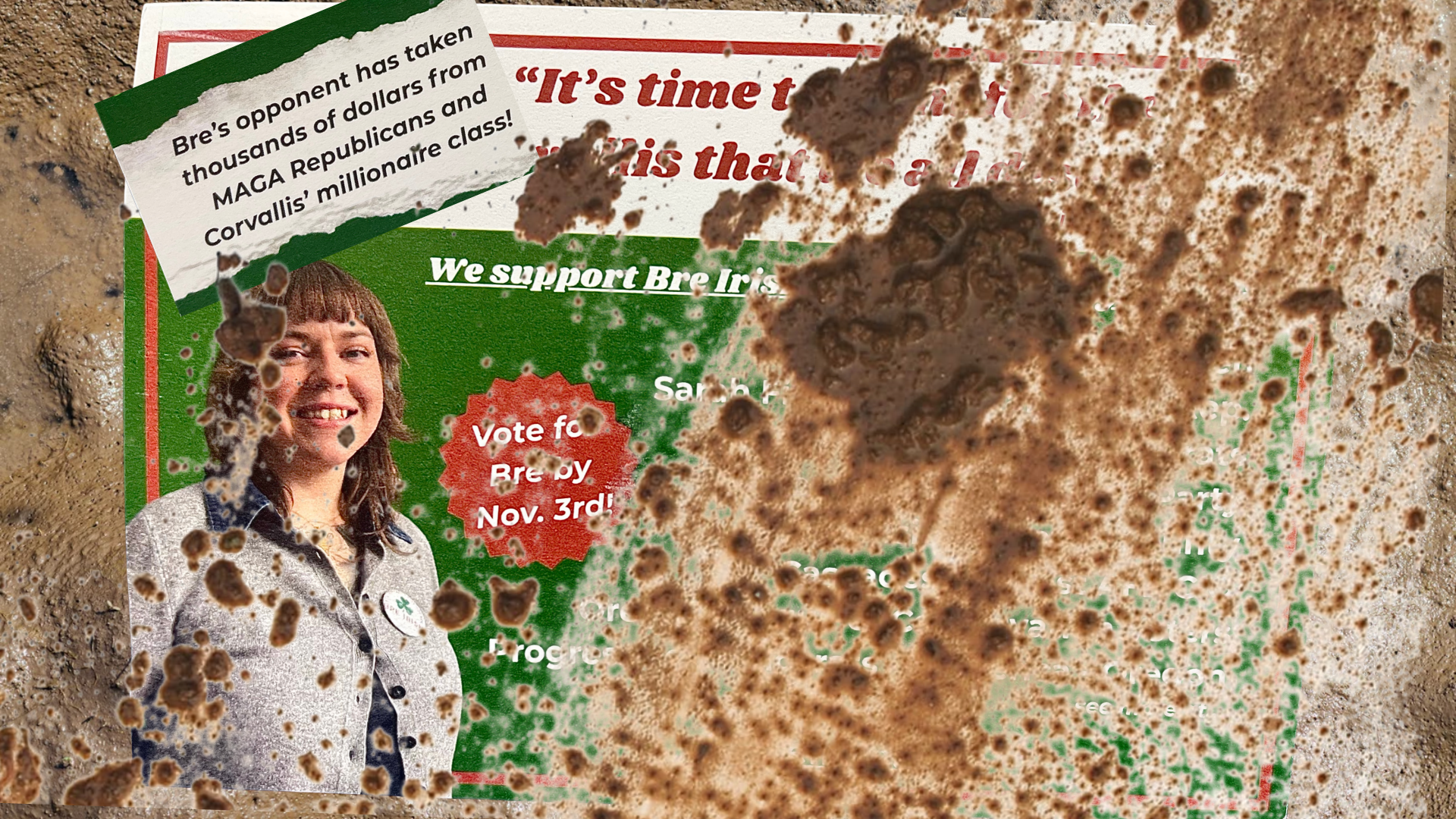
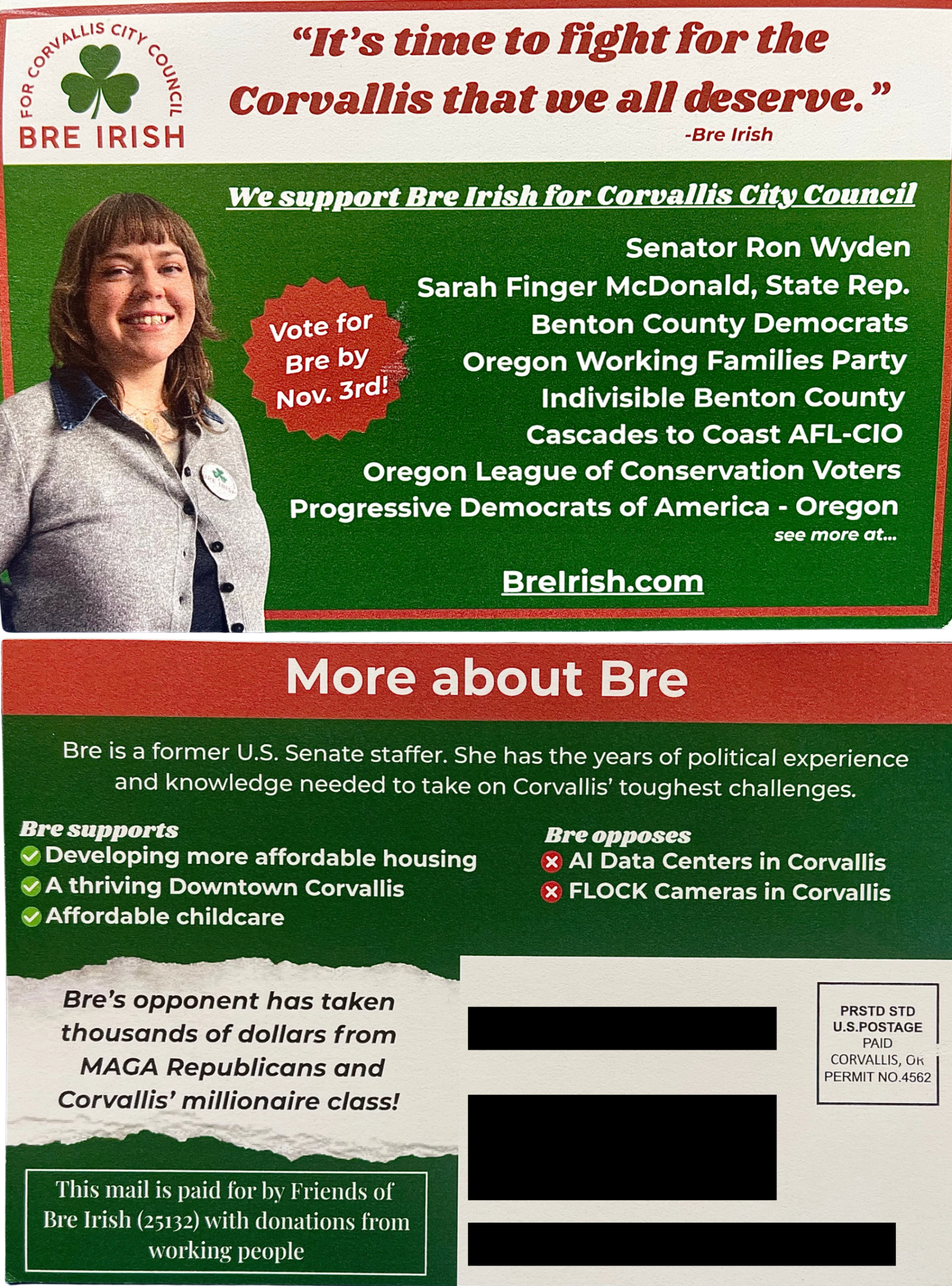
 Increasingly, Corvallis has adopted elements of national political theater. Bre Irish, a candidate for Corvallis City Council Ward 1, recently sent out a mailer reading, “Bre’s opponent has taken thousands of dollars from MAGA Republicans and Corvallis’ millionaire class.” I think it crucial to first elaborate on the context of Ms. Irish’s claim.
According to the Oregon Secretary of State campaign finance reporting webpage, Steve Clark has received $25,575.81 compared to Irish’s $6,615.00.
Clark’s largest donors are Ed Ray, former President of Oregon State University, and Pete Slayden, President of Slayden Homes. Irish’s largest donors are the AFL-CIO and the Benton County Democrats.
One of Clark’s larger donations is $1,000.00 comes from a donor who has supported Oregon Republicans like Chris Dudley and Christine Drazan. But the same donor has supported countless Democrats, including Tobias Read, Sami Al-Abdrabbuh, and Ted Wheeler.
The first claim on Irish’s mailer is that her opponent is funded by Corvallis MAGA Republicans. A donor who gives across party lines is not a MAGA donor, and one donation does not make a campaign “funded by” a movement.
The second claim is that Clark is funded by Corvallis’ millionaire class. What does that actually mean? Zillow puts Corvallis’ median home cost as just north of $550,000. Homeowners with a healthy retirement are likely millionaires by net worth. This benchmark doesn’t seem to be fair given Corvallis’ demographics.
Evident as well, is that even with Clark’s funding advantage, Irish has still raised much more than any other candidate for council, for that matter, the historical Corvallis norm..
The question should not be simplified to who has raised more money or whose
donors can be painted as more sinister. The question is what we do with those facts. Do we present them honestly, in all their complexity, and trust the people of Corvallis to
make up their own minds? Or do we flatten a complicated record into a convenient villain, attach the most inflammatory labels available, and hope that suspicion will do
the work of persuasion? I would think that Irish would be wary of doing so, given the scrutiny her mother, Liz Irish, received as a former Republican in her race for Benton County Commissioner.
In Irish’s mailer, I see a style of politics that borrows from the populist playbook of Buzz Windrip and Donald Trump; a playbook that does not belong in Corvallis. It’s politics by association: take a real name, attach it to the most politically damaging category available, and leave the voter to figure it out.
The “othering” of opponents is not new, but it is genius, if one can call it that. It allows a campaign to insinuate what it has not demonstrated and to inflame what it has not explained.
But not everyone running for office in Corvallis is reciprocating. Unlike the leftmost progressives running, the moderates have not employed this same tactic. The moderates aren’t reviving McCarthyism, though two candidates for council and mayor are self-identified as communists.
This is not how our politics are supposed to work. My first real exposure to Oregon Politics was my fellowship with the Oregon House Majority Leader. Our first session centered around The Oregon Way. As Representative Bowman read an excerpt from Fire at Eden’s Gate–a book about Tom McCall, Oregon’s former maverick liberal Republican Governor–I was instantly hooked.
The Oregon Way is mostly undefined and devoid of a checklist. Yet it flows through our state’s history like the Willamette through the valley; sometimes calm, sometimes turbulent, but always defining the region. The energy in the 50s, 60s, and 70s, was a spirit unfettered by special interests, partisan divides, or regional divisions. Vote by mail, the Bottle Bill, the Beach Bill, and countless legislation were created by visionary leaders setting aside differences to serve their state.
Unfortunately, I find this spirit hard to find in the Oregon of the 2020s. Its absence in Corvallis is particularly troubling. We are a town that does not need to borrow our political identity or strategy from Washington DC. We ought to be capable of disagreeing without turning our neighbors into enemies.
I worry about what this energy would mean if introduced to a council. The next council will have their hands full with a budget deficit, the need for a productive working space for city staff, and the broader struggle around economic development. I hope for pragmatists, inspired by The Oregon Way, who will approach every agenda item with
openness not vitriol, who will treat their ideological opposites as partners not enemies, and who will embody a vision for Corvallis not defined by the current hot topic issues, but by what is good for and by our town.
It pains me to see this type of campaigning infused in our nonpartisan races. The school board election in 2025, the judge’s race in the spring, and now City Council.
There are enough enemies of The Oregon Way that we need not manufacture more. Towns that learn to see enemies will keep finding them. A town that remembers The Oregon Way will instead find neighbors. Corvallis should find neighbors.
Alex Gough is a Corvallis native. Before graduating Crescent Valley High School, he served as the school paper’s Editor-in-Chief and worked for statewide political campaigns and interned in the state legislature, serving Democrats. Now studying Government at Georgetown, Gough works three days a week for an Oregon Congresswoman, aiding in her education, childcare, and housing priorities.
The opinions in this commentary are the author’s, they may or may not reflect the views of The Corvallis Advocate, or its management, staff, supporters and advertisers.
Do you have a story for The Advocate? Email editor@corvallisadvocate.com