

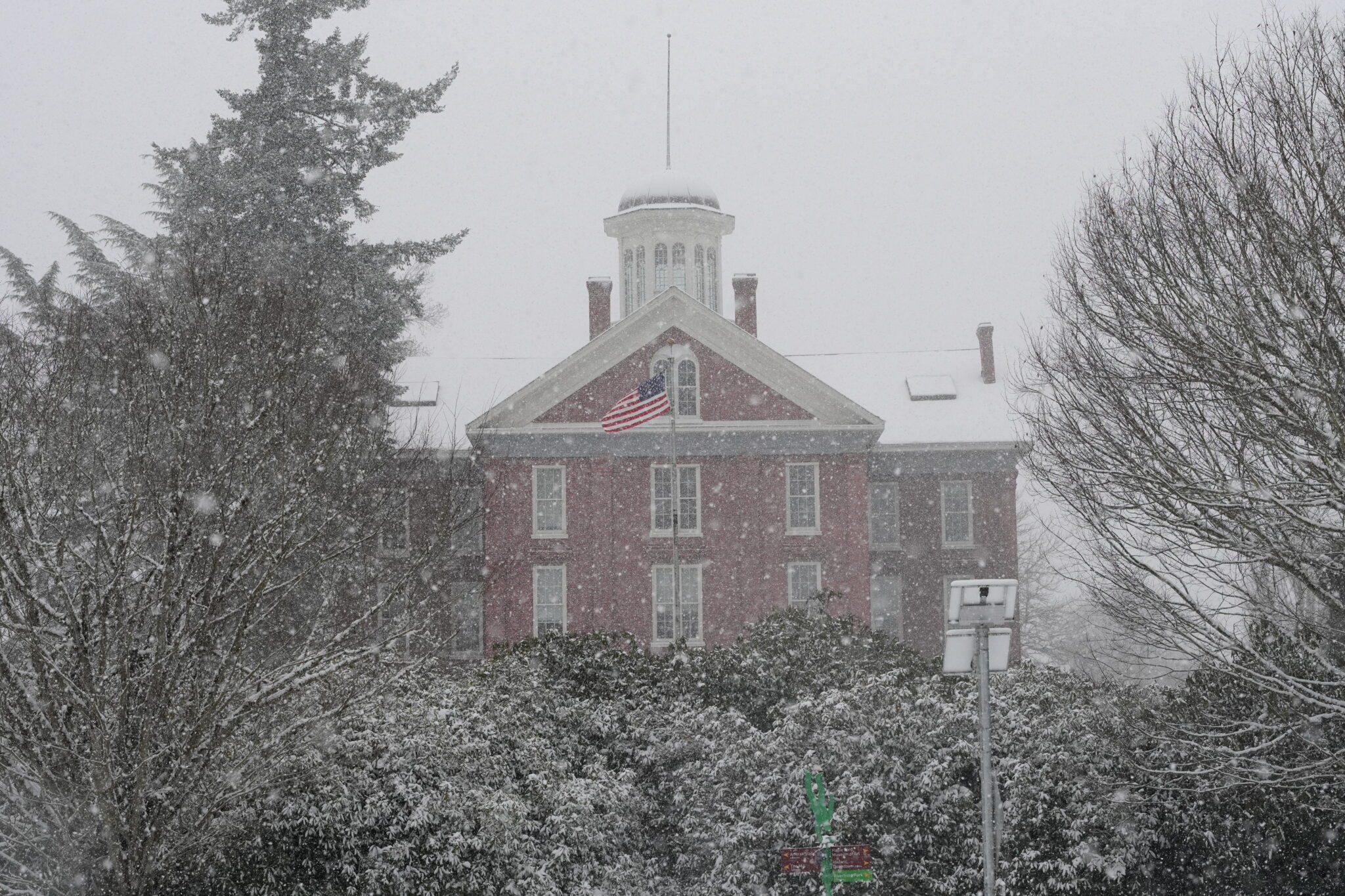
Willamette University is located across the street — State Street, in Salem — from the statehouse, and that has sometimes been a good metaphor for its status in Oregon.
Its website labels it “the Northwest’s Leading Private University” and it has had a long alliance with the state of Oregon. It was founded in 1842, the oldest university not just in Oregon but in the western United States, older than not only the state of Oregon but even the territory of Oregon.
Mark Hatfield, one of the most celebrated of Oregon’s governors and senators, attended school there while starting work next door for the Oregon secretary of state, and for decades regularly crossed the street between the university — where he also taught political science and was dean of students — and the statehouse as he moved up the political roster.
Pacific University is in the same collegiate neighborhood: U.S News & World Report named it Oregon’s top private national university, and it was highly cited a few months ago as a leading research college & university by the American Council on Education. It is nearly as old as Willamette, also older than the state since its forebear institution (Tualatin Academy) was founded in 1849.

Both are, broadly speaking, successful, productive, academically and financially healthy. So why should they consider, as they both now are, merging into something new called the University of the Northwest? What would be the point, besides turning it into Oregon’s largest private higher education institution?
These days, maybe that is the point.
The proposed merger is only in early stages and presumably the universities’ communities will be weighing in on whether they think this is a good idea. There’s plenty to think about.
A merger could yield some benefits in the grass roots, possibly allowing students to obtain access to more classes and resources. It also could result in some efficiencies of scale in administration and shared costs, and a larger support based in the institutions’ alumni and other networks.
And the plan for a merger evidently would be limited. The proposal seems to call for a “collegiate university,” in which “distinct schools and colleges maintain their character, identities, and historic campuses while unified under a shared administrative structure as a single institution. The undergraduate colleges at Pacific, Willamette, and PNCA would continue to operate with their current names … and would maintain separate admissions requirements, academic programs and athletics.”
In other words, much of the change wouldn’t even be very visible.
But there seems to be a larger picture here.
Steve Thorsett, president of Willamette University, said in the announcement that “If finalized and approved, this merger would be a defining moment for private higher education in the region.” How would it do that? He went on: “Together we seek to expand that legacy at a greater scale.”
The “greater scale,” the matter of sheer size, may be important. These two private institutions have far smaller student enrollment than the larger public universities in the state; together they would have about 6,000 students, compared to about 24,000 at the University of Oregon or about 38,000 at Oregon State University. About 200,000 students attend Oregon’s public colleges and universities (including community colleges), far ahead of the private institutions.
Universities like Pacific or Willamette do have a distinct role in the state, and their influence probably is outsized compared to their raw numbers. At the same time, their smaller size can make them easy to overlook.
Which begs the question of whether this merger, if it proceeds and seems to work, might be just the beginning. Maybe Linfield University at McMinnville, which is just a little smaller in overall size compared to the other two (but would bring some distinct specialties), is located directly between them and has had some finance issues in recent years, will want to join in.
Or maybe other private institutions around the state, such as Reed College or Lewis and Clark College, might consider similar kinds of linkups.
Something could go away in all this, too. Smaller colleges have more room for idiosyncrasy, distinct characters and different approaches to learning and research. If the smaller institutions start clumping together, would much of that be lost?
Merger into bigger seems to be the way of our society. Sometimes it can be a good idea. But nothing comes without its price.
Randy Stapilus has researched and written about Northwest politics and issues since 1976 for a long list of newspapers and other publications. This guest commentary is from news partner Oregon Capital Chronicle, and it may or may not reflect the views of The Corvallis Advocate, or its management, staff, supporters and advertisers.
Do you have a story for The Advocate? Email editor@corvallisadvocate.com