

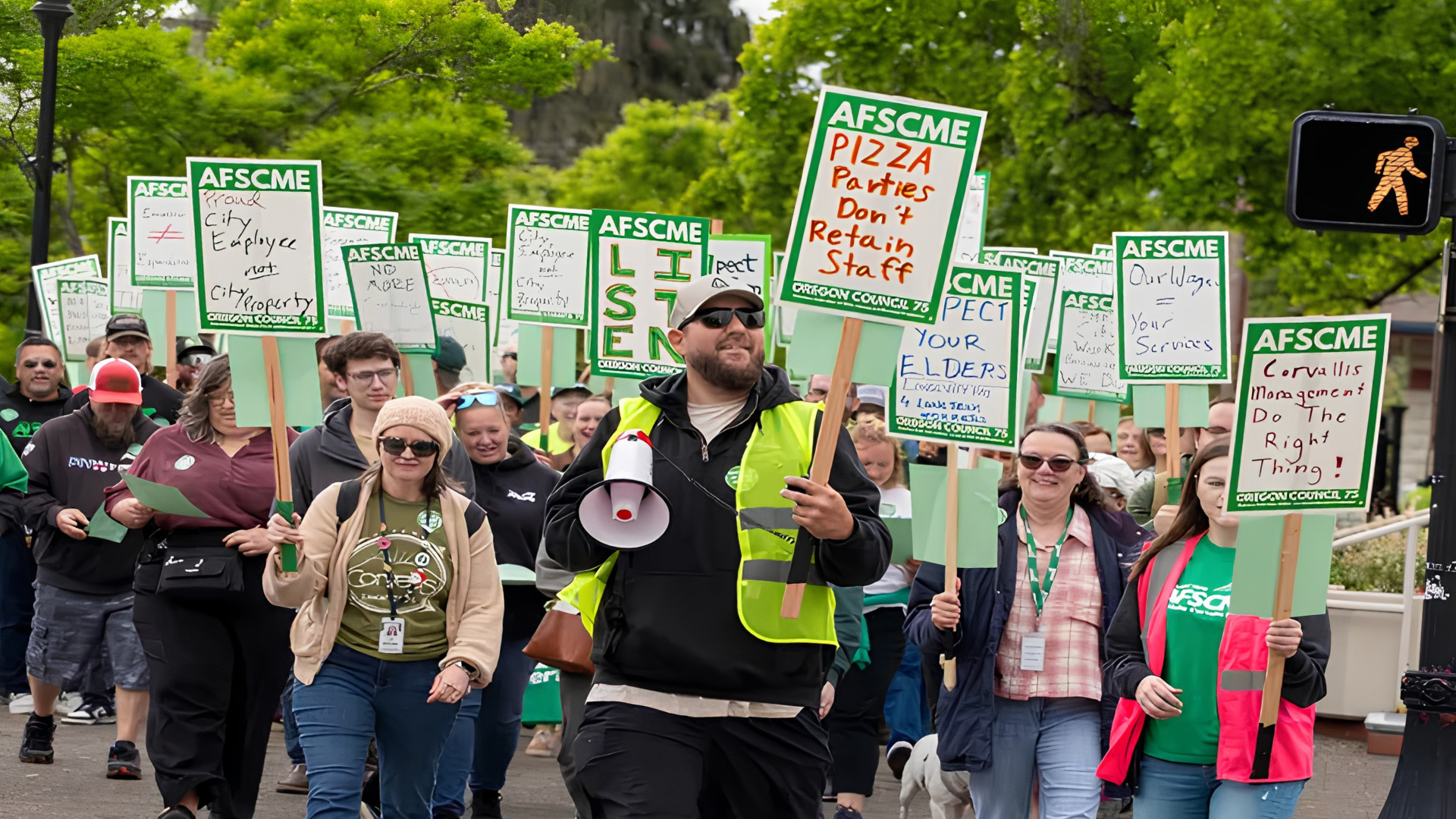
The City of Corvallis and the union representing most of its employees have submitted their final contract offers to the state’s Employee Relations Board. Required by law, the filing includes total costs for each proposal.
The City of Corvallis says their last, final and best offer would cost the City $7.8 million over the three-year period at issue. The fiscal year begins every Jul 1, the employees have been working without a contract since, so what is at issue is the contract for this year through 2028-29.
AFSCME, the American Federation of State, County and Municipal Employees is seeking terms that they’re costing out as $8.5 million for the three years. The union says it’s seeking an initial bump for all workers of 2% plus a 4% cost-of-living adjustment, a total of 6% for the first year. The raises for 2027 and 2028 would be 3% and then 5%, respectively. The cumulative bump would be 14%.

The union is also seeking an added opportunity for a longevity raise, presently there are six steps available for longevity increases, the union is seeking a seventh. At a Corvallis City Council meeting last month, union members pointed out that city management gets nine opportunities for these raises – we have not independently verified that.
The City outlines its offer in a release, writing, “The contract includes a 12% cost of living (COLA) increase for employees over three years. COLAs are in addition to six annual step increases of 5% for eligible employees. In the last year of the contract, the City proposed increasing the employee cost share for medical and dental insurance from 7% to 10%, an increase of approximately $26 per month for a full-time employee.”
Basically, the City is offering a 6% pay bump for this year and 3% a year for 2027 and 2028, but no increases in longevity pay.
AFSCME declared an impasse on September 1, which started the clock toward a potential strike. Seventy-three percent of the union’s 248 represented employees pay dues, 90% of them voted yes on a strike authorization the week before.
According to the City, both parties have now entered a 30-day cooling-off period, and after that, the union is eligible to declare a strike as early as October 9.
Union and City officials are scheduled to meet again in mediation tomorrow, September 10, with the state’s Employee Relations Board.
Budget context
Whether AFSCME and the City settle closer to $7.8 or $8.5 million for the next three years, the City had already been reporting for about a year that they’re projecting a $4 million annual budget deficit that would begin with fiscal year 2027-28.
Officials have maintained that property tax revenues have not kept pace with inflation these last few years. Oregon limits property tax increases to 3% annually. Until now, the City has largely bridged the gap by increasing service fees, which is a highly regressive form of taxation – a $20 fee impacts someone making $30,000 yearly far more than someone making $80,000. They have also persuaded voters to approve locally optional property tax levies to shore up their budgets, but these are also somewhat regressive.
Currently, the City charges no income or payroll taxes, but city councilors are reconsidering that. These kinds of taxes can be far less regressive as a floor can be set where folks aren’t taxed under a certain income – and the rates can also be graduated as incomes rise. The income taxes could loop in investment income as well, and the payroll taxes would loop in larger property tax exempt organizations, like Oregon State University.
These are taxing methods that could appeal to progressive and moderate voters.
But the conversation has taken a strange political turn as city officials have conflated addressing the deficit with wishing to fund new facilities. Public sentiment seems to view the deficit as urgent, and the facilities, not so much. As the discussion has evolved over the year, the Council that had formerly signaled strongly that it would in any case seek voter approval has started to shift – there have been more recent rumblings that they may well approve the new taxes without voter approval.
Notably, six of the nine councilors are not seeking reelection.
To view the AFSCME cost summary, click here. To view the City of Corvallis cost summary, click here.
To contact Steven J. Schultz about this story, email steve@corvallisadvocate.com
Correction: An earlier version of this story identified the contract at issue as running through 2028 rather 2028-29.
Do you have a story for The Advocate? Email editor@corvallisadvocate.com