

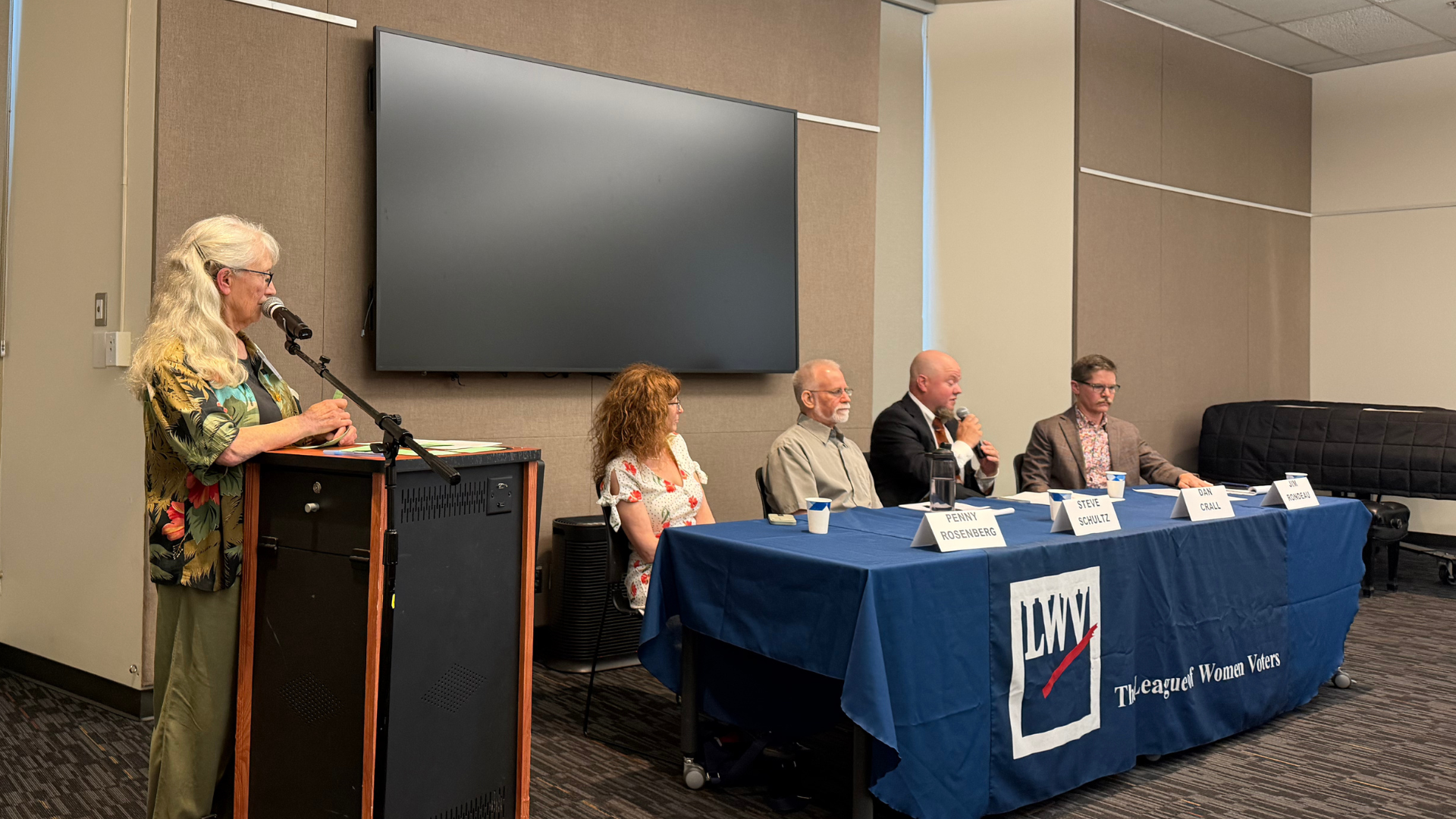
Former Corvallis Gazette-Times Editor Penny Rosenberg once presided over a staff of five reporters.
It dwindled to a staff of two. Although there were three reporters when she left the paper this summer, Rosenberg told members of Corvallis’ League of Women Voters Aug. 19 that local newspapers remain in peril.
Even the five reporters was a skeleton crew, considering the Corvallis Gazette-Times and Albany Democrat-Herald were once separate newspapers that packed their respective newsrooms with reporters, editors and photographers.
“Oregon journalism is falling apart,” Rosenberg told a packed room at the Corvallis-Benton County Public Library. “There are 26 cities and three counties that don’t even have a local paper.”
Rosenberg now works for the Oregon Journalism Project, which pools journalistic resources to provide stories to some 50 Oregon newspapers that, she said “can’t afford to have the same kind of staff that they used to have.”
League members hosted Wednesday’s forum to examine how misinformation distorts elections and the role played by local newspapers in the election process.
Rosenberg was joined by Corvallis Advocate Publisher Steve Schultz and radio station managers Dan Crall of KORC in Corvallis and Jim Rondeau of KLCC in Eugene.
“So many people in this country have been given essentially the green light to dismiss anything that is uncomfortable or doesn’t sit with their worldview very comfortably as fake,” Rondeau said.
“There are a lot of people in the news business who do lead with a lot of heart and do take what they do very seriously,” he said, adding, “The people with the most to gain by sowing distrust in the media have been very successful in doing it.”
Rosenberg agreed. “It’s a lack of resources,” she said. It is not a lack of heart. There are really great journalists out there and they want to do good jobs, but they’re not always supported.”
Schultz recognized similar roadblocks, noting the average number of reporters in the Linn-Benton area has shrunk down to a third of its previous average — leaving only one or two reporters at any given smaller publication, and the larger one’s not doing, really, any better.
A dark cloud of intimidation emanates from the national level, Crall said.
“I would say as a smaller independent radio station, we don’t have the widespread popularity of a national network, nor the level of scrutiny, which really gives us more freedom,” he said. “As a small station that relies on volunteers, our main challenge can be the lack of resources to fully report any given story.”
Rondeau noted that Google, Meta and Amazon control 50% of all advertising revenue.
“One of our biggest problems these days is not overtly political,” he said. “It’s not left and right or center or whatever frame you want to put around it. It’s that people are accepting, for example, social media as a news source, that they’re not demanding more. The funding model that used to keep local newspapers and local news organizations like us in business and thriving is no longer there.
“So if you lose subscriptions, if you lose advertising revenue and a large segment of the public isn’t demanding more news, it’s not part of their daily diet, you have a real problem,” he added. “And that’s related to digital fragmentation more so than politics.”
Panelists endorsed national news outlets like National Public Radio, ProPublica, AP News, Ground News and The New York Times as well as following individual trusted journalists. They also recommended people verify listed sources in articles and avoid 24-hour news networks, which often contribute to the muddying of the news environment.
All the panelist supported paywalls, despite the ease of accessing online news.
“The only way to get more journalists is to pay journalists,” Rosenberg said. “And I’m sorry if that sounds harsh, and Facebook is free, but I can’t pay the mortgage with free. This is a crisis. Show me your checkbook, and I’ll show you what you value. Pay a journalist somehow, somewhere. If it’s Substack, if it’s The Oregonian, OPB, NPR, somewhere, pay a journalist if you care about journalism, because that’s the only way we keep doing this.”
Rondeau said it’s a downhill spiral.
“As the local organizations produce less content, they’re less relevant to communities,” he said. “They’re less attractive sources for advertisers, local businesses, businesses spending money. As they lose subscription numbers and advertising, eventually they have to lay people off so there’s less content there, and eventually they close up.”
National news outlets rarely cover Linn and Benton counties, let alone Oregon in general, he added.
“It’s only when you’ve really lost it that you realize you’re not hearing about city council and planning meetings and city hall, and then it’s too late,” he said.
Crall and Schultz commended the difference between news outlets and other media.
“When we mess up, we fess up, and we do it in a way that doesn’t spin,” Schultz said.
“We tell you what we said, and then we tell you what the actual fact was,” he said. “It’s called a correction. And most any legit news organization does exactly that.” He noted how other industries within media don’t do that, saying, “Every time I see that our industry does that, it just makes me proud to be part of it.”
Crall said he takes the responsibility for accuracy seriously as well.
“We have to tell the truth,” he said. “What do we have to lose when the fascists come? They’re going to bully everybody. And whether or not we stand up, they would get us anyway.”
To contact Hannah Field about this story, email office@corvallisadvocate.com
Correction: An earlier version of this story misspelled KORC manager Dan Crall’s name.
Do you have a story for The Advocate? Email editor@corvallisadvocate.com