

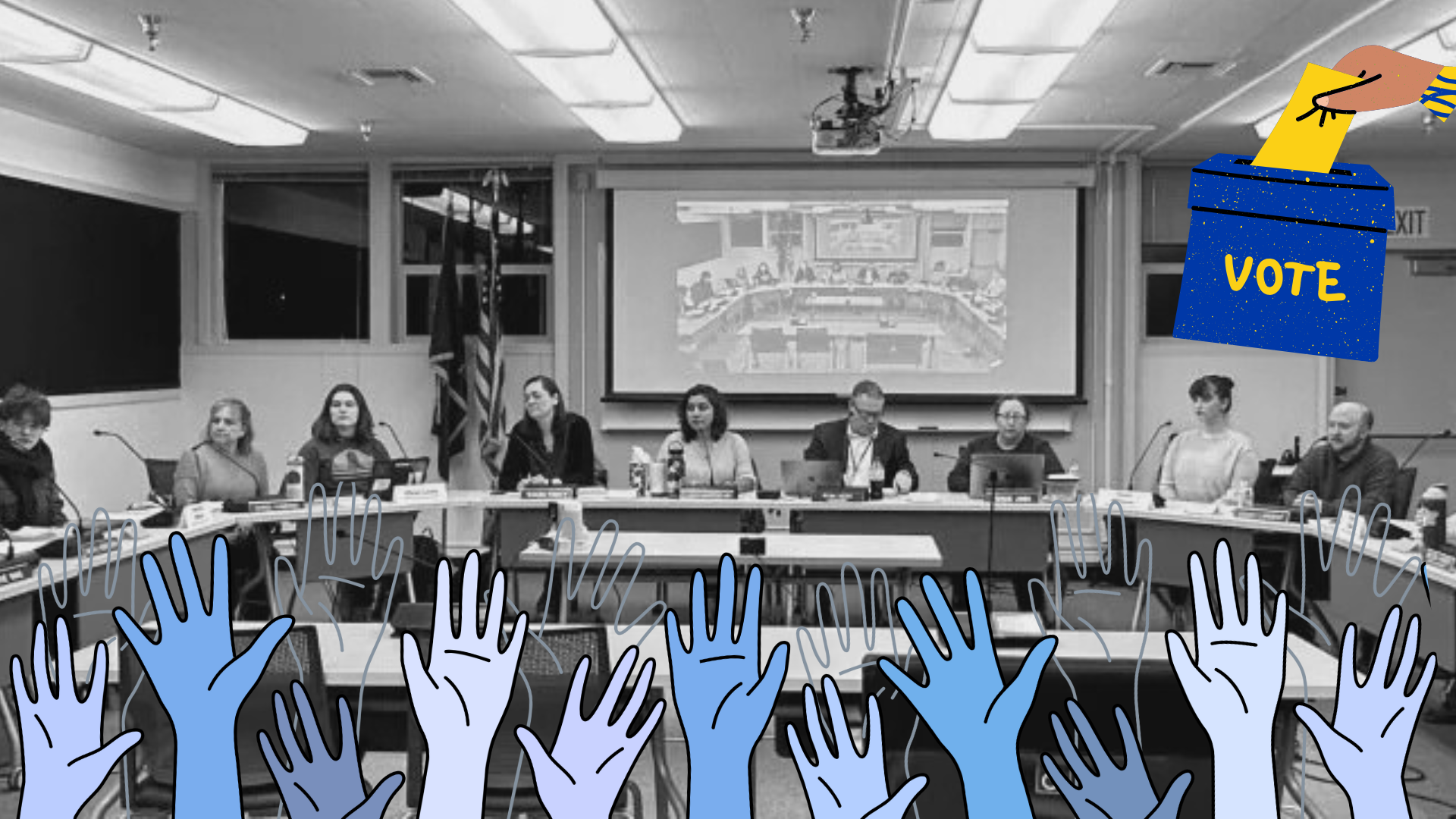
 On Friday, petitions were filed to recall the Corvallis School Board’s seven members, and if enough signatures are gathered, voters could be making a choice sometime before midyear.
Save Corvallis Schools is behind the effort; the chief petitioner is Corvallis parent Will Rottenkolber. He tells us the organization is informal, and that among the group, about two dozen have stepped forward to spearhead the recall effort.
“This recall effort isn’t about any one person on either side. It is about the decisions that this board has made over the past 15-18 months and their impacts on students, teachers and, the greater Corvallis community,” said Rottenkolber.

According to Darla Rush, the acting director of Records and Elections for Benton County, the petitioners have until April 6 to submit at least 4,577 voter signatures. That minimum is derived from a formula set by state law. If the petitioners are successful, the County would then have 10 days to validate those signatures.
If that happens, they will then notify each of the elected officials affected, who can decide within five days to resign or rebut the petition. If they do the latter, the County is obligated to conduct an election within 35 days.
Save Corvallis Schools is seeking to recall the whole Board. To do that, each Board Member must be recalled separately.
So, each of the recall petitions makes separate arguments. And, at press time, four of the School Board’s members had responded to our request for comments about the recall campaign.
What the Petitions Argue, What the Board Members are Saying
Sami Al-Abdrabbuh: The petition seeking to recall Al-Abdrabbuh says, “As a board member and then-chair, Al-Abdrabbuh supported detracking middle school math, describing the change as personal to him. The policy was implemented despite documented concerns from families about reduced academic challenge, classroom feasibility, and student confidence. The district offered no clear performance benchmarks at implementation, and years later math proficiency remains low-around 22%-raising serious questions about whether the policy has achieved its goals.”
It goes on to say, “Al-Abdrabbuh also supported the 2018 Capital Improvement Bond, a nearly $200 million package approved without sufficient consideration of declining enrollment. The district is now closing schools that were recently modernized. During board deliberations, Al-Abdrabbuh insisted on bringing the closure vote forward again after it had been initially rejected, highlighting his central role in advancing the decision. During this same period of financial strain and program cuts, he supported a substantial raise for the superintendent.”
The petition concludes, “Together, these decisions reflect ongoing governance failures that have disrupted students, families, and staff. New representation is needed to restore accountability and public trust.”
We reached out to Al-Abdrabbuh for comment, at press time, he had not responded. Later, he texted, writing, “I respect the recall process, and it is important to note Oregon’s rules require that any factual statements in recall filings be accurate. I also respect that people can disagree. But a recall will not change state funding, will not reverse enrollment realities, and will not bring closed schools back. It will add uncertainty and cost at the very moment we need stability for students, families, and staff. I’ve put more than 10,000 volunteer hours into serving our public schools over the past decade, and my focus remains steady responsible stewardship, transparent engagement, and prioritizing the needs of kids.”
Chris Hawkins: As to Hawkins, the petition says, “For decades, Hawkins worked directly with students experiencing homelessness, trauma, and instability-students who rely most on consistent routines, stable school environments, and well-resourced classrooms. Yet her recent actions on the board have not reflected those priorities.”
However, it goes on to say, “Hawkins supported a substantial raise for the superintendent during a period of financial strain, staffing shortages, and program cuts. Families expected her to advocate for directing limited resources toward classrooms and student support, not administrative compensation. Her vote contradicted the student-centered principles she once promoted,” and “She also supported the district’s school-closure process, despite widespread confusion, shifting explanations, and the clear harm closures pose to the very students she spent her career serving. Students facing instability are disproportionately affected by school transitions, yet Hawkins did not demand stronger planning, transparency, or community engagement.”
At press time, Hawkins had not responded with any comment.
Terese Jones: As to Jones the petition argues she should be recalled, “Due to a long-standing pattern of poor foresight and inadequate long-term planning. As a senior member of the board during the development and approval of the 2018 Capital Improvement Bond, Jones supported a nearly $200 million facilities package that failed to account for clear demographic trends and the district’s future capacity needs.”
“Even in 2018, enrollment projections showed flattening and eventual decline-data widely available to school districts across Oregon. Yet the bond was crafted and approved without any meaningful consideration of whether the district would be able to sustain all of its school buildings in the coming decade. Instead of aligning major capital investments with realistic enrollment forecasts, Jones supported a plan that expanded and modernized facilities only for the district to turn around a few years later and declare that multiple schools must close.”
The petition concludes, “Families now face closures, boundary upheavals, and program disruptions-direct consequences of a bond plan that lacked long-term vision. For these reasons, we believe new leadership is necessary to restore accountability land ensure future decisions reflect the district’s true needs.”
Jones had not responded with a comment by press time. However, she later responded by email, writing, “Board leadership requires a balance of serving the needs of the students in the moment without compromising the ability to maintain and grow robust opportunities for future generations. It is hard and imperfect work, carried out by dedicated people who must account for and address the known circumstances in a manner that allows the district to adapt to future changes, both expected and unexpected. We have to walk the tightrope of decision-making without the net of hindsight to catch us.”
“Corvallis voters elected me to carry out the responsibilities of School Board service. I will do that work every day until that mandate changes. At such time as my role transitions from School Board member to community member, I will be an ally and a collaborator to whoever follows in my footsteps. Though the mandate as an elected representative may change, the social mandate to support my community, and collaborate with our leaders does not.”
Luhui Whitebear: The petition says, “Luhui Whitebear [should be recalled] due to a consistent lack of tolerance for differing community viewpoints and her failure to provide open, inclusive leadership during the district’s school-closure process. At a time when families, educators, and students needed board members who would listen broadly and consider multiple perspectives, Whitebear repeatedly dismissed or minimized viewpoints that did not align with her own. This has contributed to a climate in which many residents feel unheard, excluded, or disregarded by their elected representative.”
“The school-closure process required thoughtful dialogue, transparency, and genuine engagement with the community. Instead, families encountered shifting explanations, unclear planning, and limited responsiveness to their concerns. Rather than acknowledging the validity of differing viewpoints or advocating for a more open process, Whitebear supported moving forward despite widespread confusion and frustration. Her unwillingness to consider alternative ideas deepened community division during one of the most disruptive decisions in recent district history.”
This petition concludes, ” For these reasons, we believe new leadership is necessary to restore trust, ensure respectful dialogue, and guarantee that future decisions reflect the full range of voices within the Corvallis community.”
Whitebear responding by email wrote, “I’m proud of the work I have done over the past five years and the efforts I have led to bring in multiple community perspectives to critical conversations. I understand hard decisions are made that not all agree with. As chair it has been important to ensure all voices are heard during our meetings and in community spaces that helped inform our decisions. I will be continuing to center the needs of district students, families, and staff during this critical time of transition for our community.”
Whitebear is the current Board Chair.
Shauna Tominey: In the instance of Tominey, the petition says she demonstrates a, “Pattern of indecisive leadership and a weak voice during two of the most consequential decisions facing our schools: detracking math and the school-closure process. At a time when the district needed clarity and conviction, Tominey repeatedly hesitated or shifted positions instead of advocating firmly for students and families.”
“The district’s detracking of math eliminated accelerated pathways and reshaped academic progression for thousands of students. Families and educators asked for data, transparency, and a clear plan. Instead, the process moved forward without meaningful engagement or strong board oversight. Tominey did not use her position to demand clarity, evidence, or community input, leaving students and teachers to navigate a major instructional shift without adequate support.”
“During the school-closure process, Tominey first abstained on the closure vote-avoiding a clear stance at a critical moment-then later voted in favor of closure in a second vote. This sequence reflected uncertainty rather than leadership, deepening community frustration during an already destabilizing process.”
Tominey responded by email, writing, “I am saddened to learn about the recall petition, and I recognize that this effort reflects community members who do not feel heard. I volunteer as a school board member because I believe in the value of public education and care deeply about our community and the well-being of every student, educator, and family. As a School Board member, I take seriously my responsibility to represent the community and strive to do so with care, compassion, and authenticity while continuing to listen, learn, and reflect on how to best serve the community. Although I hope to continue serving on the Corvallis School Board, I remain dedicated to serving our school district long term in ways that best support students, educators, and families.”
Judah Largent: The petition seeking Largent’s recall says, “The Osborn Aquatic Center closure moved forward without a clear plan for how the district would maintain student access to essential aquatic programs. Families, swim teams, and youth programs were left without timelines, alternatives, or a roadmap for restoring this critical community resource. Instead of demanding transparency, detailed planning, and meaningful engagement, Largent allowed the process to advance with uncertainty and inadequate communication.”
“Equally concerning was Largent’s support for a substantial raise for the superintendent during a period of financial strain, staffing shortages, and program cuts. While classrooms face resource shortages and families are asked to accept reductions, he backed a compensation increase that appeared disconnected from district needs and community expectations.”
The petition concludes, “These decisions reflect a pattern of leadership that lacks transparency, accountability, and alignment with the values of Corvallis residents. For these reasons, we believe new leadership is necessary to restore trust and ensure district decisions prioritize students and families.”
Largent responded by email, writing, “I ran for office because I love this community and I wanted to give back to it by serving. I want to continue serving this community, and I will be centering my focus on continuing to do so. If the community decides that they want to spend taxpayer dollars on a recall election, that an important cornerstone of our democratic process.”
“I am proud of the work I have done. About the decision to close Osborn, that is not a decision that was made by the school board and constituents who disagree with that decision should be raising those concerns with the City of Corvallis.”
Largent concluded, “Regardless of whether the recall moves forward, I will be focusing on what I was elected to do and working with everyone in the community willing to work with me.”
Bernie Wang: The petition against Wang cites, “Decisions that have eroded public trust and failed to reflect the needs of our community. The handling of the Osborn Aquatic Center closure is a central concern. Osborn is a critical resource for students, families, and local programs, yet the board moved ahead without presenting a clear path forward. There was no transparent plan for timelines, alternatives, or long-term solutions. Instead, the community was left with uncertainty, unanswered questions, and no roadmap for restoring access. Wang didn’t push for the clarity, planning, or engagement this decision required.”
“Equally troubling was his support for a substantial raise for the superintendent during a period of financial strain and program cuts. Rather than prioritizing classrooms and student needs, he backed a decision that appeared disconnected from district realities.”
The petition concludes, “These actions stand in stark contrast to the leadership qualities Wang was known for in his previous career, where communication and strategic planning were central. His performance on the board has not reflected those strengths.”
Wang responded by email, writing, “For clarity on an item in the petition regarding Osborn Aquatic Center: the City of Corvallis has operated the Aquatic Center, and the school district owns the facility. The City closed Osborn on October 2, 2024 after routine maintenance found rust and corrosion in roof-support steel, pending further technical evaluation. I was appointed to the School Board in November 2024, after that operational closure decision had already been made. Since then, I’ve participated in public updates and supported the superintendent’s work with local leaders and legislators to pursue emergency funding and longer-term solutions.
I joined the board a little over a year ago as a community member who wanted to contribute and help work through tough problems. Public service has always been a privilege to me as a first-generation American and I have been a public servant the majority of my adult life, and I honor that privilege. Out of respect for the process, I’ll keep my public comments limited and stay focused on the work in front of the district—student outcomes, fiscal responsibility, and transparent public oversight.”
School Superintendent Ryan Noss Responds
We asked School Superintendent Ryan Noss for comment. He responded by email, writing, “I think it is important to recognize that the costs associated with a recall election would be the responsibility of the school district. The district typically budgets $30,000 for a shared ballot, which includes other jurisdictions. In this instance, the costs would be higher because other jurisdictions would not have an election on the ballot.”
He then also said the County’s election office would need to provide a specific cost figure for this particular election, should the petitions be successful.
He also wrote, “An additional concern is that the recall process does not distract from our core mission of providing daily education to our students.”
Update: This story has been updated to include the statement of a School Board Member that responded after press time.
By Steven J. Schultz and Hallie Greenberg
Do you have a story for The Advocate? Email editor@corvallisadvocate.com