

Brooke Davis loves sharing her seven-acre hobby farm with animals. Horses, chickens, ducks, goats, pigeons, dogs and cats all call the property home.
Wildlife is also part of daily life.
Located across the road from the Dunn Research Forest, Davis regularly sees native wildlife near her property. After losing one of her geese to a bobcat last fall, she knew she needed a better way to protect her animals without harming the wildlife she values.

“I studied biology, so I know how important predators are,” Davis said. “We love the wildlife here, but I needed to figure out how to keep it away from my animals.”
She found a solution through Benton County’s Agricultural and Wildlife Protection Program (AWPP).
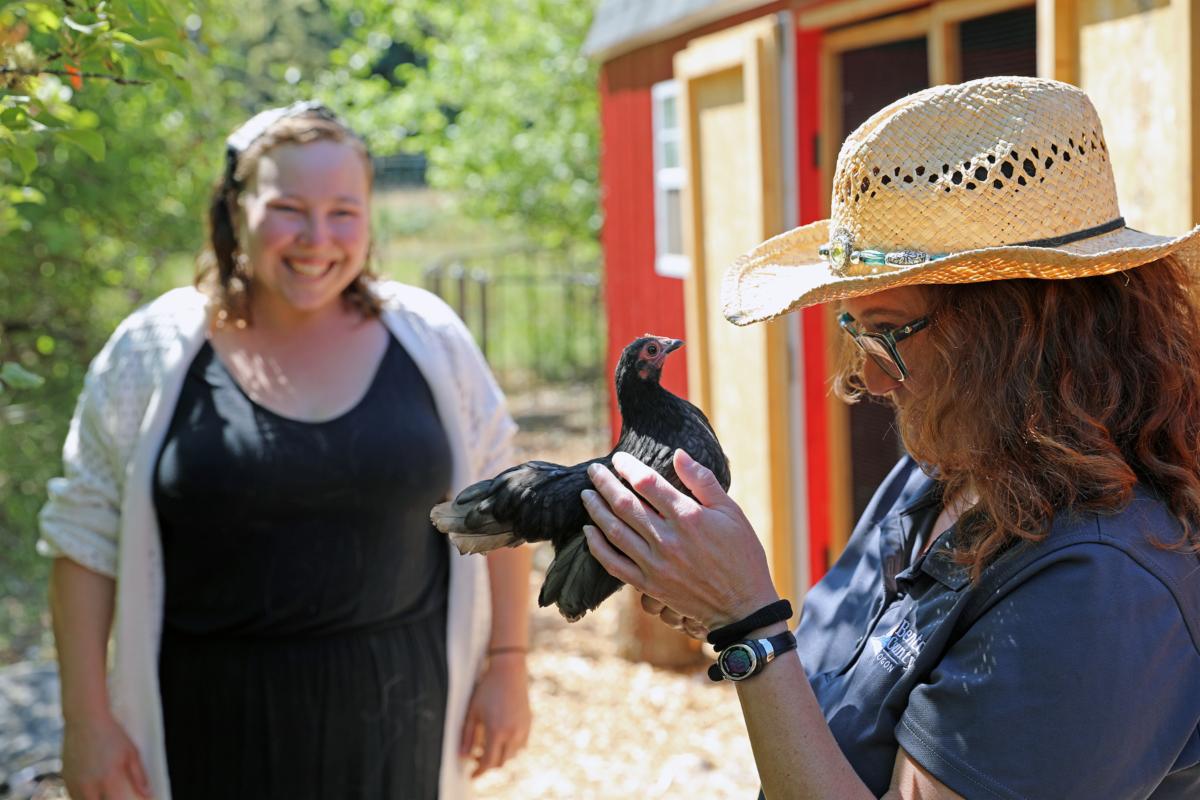 The program, coordinated by Sheanna Steingass, PhD Environmental Project Coordinator for Benton County Public Works, provides reimbursable grants that help farms use nonlethal methods to protect livestock, crops and property while allowing wildlife to remain part of the landscape. Farms of any size can qualify for up to $5,000 in grant funding for eligible projects.
For Davis, the grant helped fund a secure 200-square-foot poultry coop and enclosed run that protects her chickens and ducks during periods of high predator activity.
“I was planning to add more chickens, so I knew I needed something more secure,” Davis said. “Now, I have a place where they can safely stay during the winter or when predators are more active.”
Davis first learned about the program through a local horse group on social media.
“I saw people talking about it and thought it sounded like a great opportunity,” she said. “I reached out, and the process was really straightforward.”
Steingass said the program is designed to support farms of every size.
“Our main goal is to help maintain local wildlife while finding ways for local residents to keep their farms and livestock safe,” Steingass said. “We’ve worked with everything from large sheep operations to small hobby farms.”
Beyond grant funding, the program also provides free site visits and technical assistance to help property owners identify practical, cost-effective ways to reduce conflicts with wildlife. Equipment lending and educational resources are also available.
“We can visit farms, talk through challenges and recommend cost-effective ways to protect animals,” Steingass said. “It’s a great opportunity for people who want to coexist with wildlife while protecting their livestock.”
Steingass said one of the most rewarding parts of coordinating the program is seeing how it benefits both people and wildlife.
“It’s not often that you get to work on a program that benefits everyone,” she said. “It supports wildlife, farmers and the community. It’s an honor to be part of it.”
And on the Davis farm, the project also became an opportunity to teach the next generation. Brooke invited three young family members, a 10-year-old and two 12-year-olds, to help build the coop.
“They love horses and chickens,” Davis said. “They helped build this coop, learned how to safely use power tools and learned about caring for animals. They were involved from beginning to end.”
She said the grant made that experience possible. “It gave them a chance to learn real skills while helping create something that protects our animals.”
For Davis, who moved to Benton County two years ago, the experience has also strengthened her connection to the community.
“It’s been amazing,” she said. “Working with the county has made me feel welcomed here.”
How to apply
Benton County accepts Agricultural and Wildlife Protection Program grant applications each year from Oct. 1 through Nov. 30. Farms and agricultural operations of any size in Benton County are encouraged to apply.
Residents experiencing active livestock losses due to wildlife do not have to wait for the annual application period. They can contact the Agricultural and Wildlife Protection Program coordinator at awpp@bentoncountyor.gov to inquire about an emergency grant application.
Do you have a story for The Advocate? Email editor@corvallisadvocate.com