

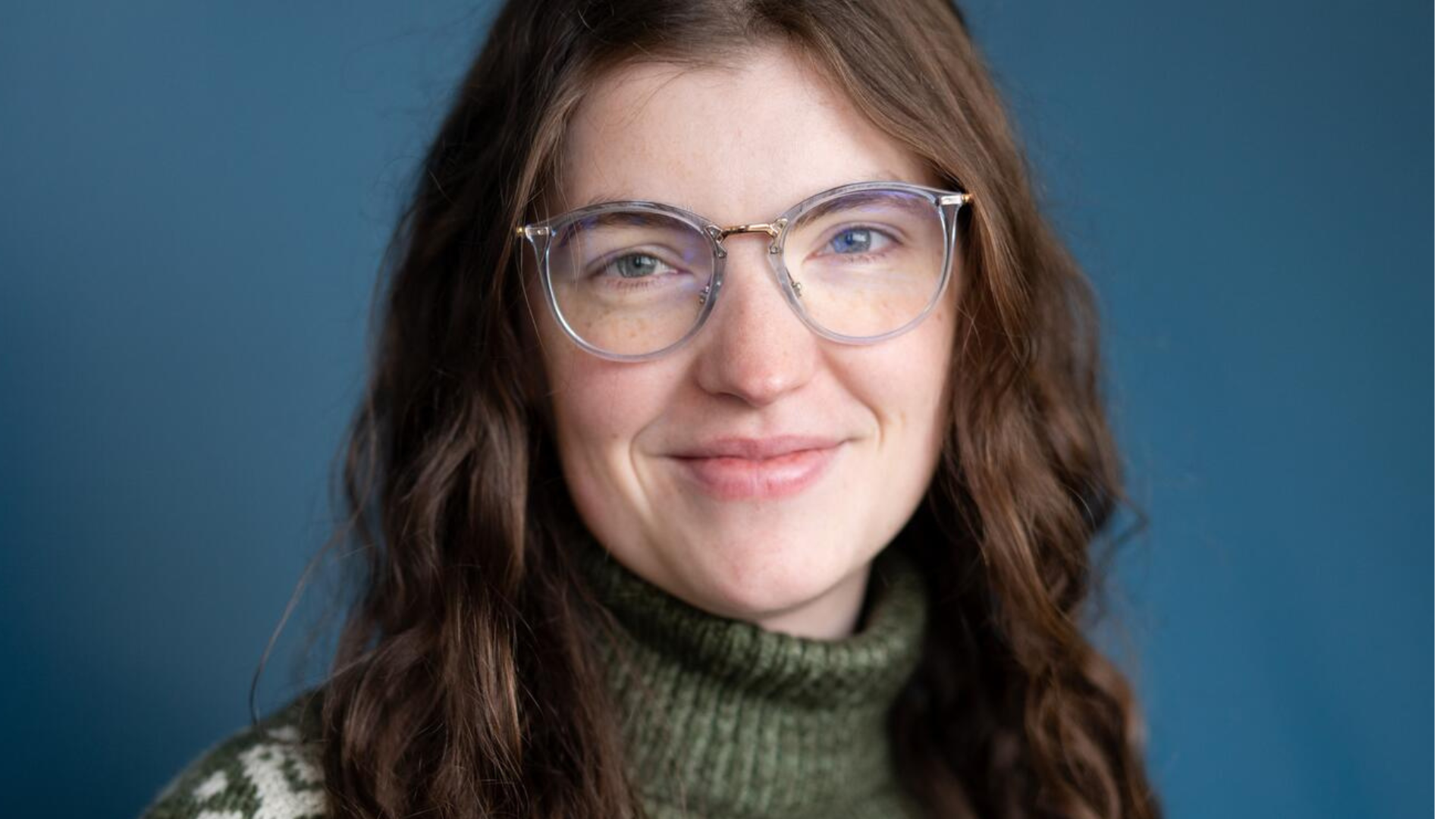
 When Giulia Wood was 22, she did something few other undergraduate students have done. She spent five months in Antarctica studying juvenile krill with Oregon State University Professor Kim Bernard’s all-women research team. For Wood, it was one of many extraordinary opportunities during her academic journey, and in December, she learned she’d be taking yet another huge leap, this time to Liverpool, England.
Wood has been named one of 43 Marshall Scholars in 2026, a prestigious scholarship offered by the United Kingdom to a select group of Americans to study at graduate level in a UK institution of their choice for up to three years. This is the first time an OSU student has received the award. The Marshall Scholarship Program started in 1953 as a gesture of gratitude for the assistance the UK received from the United States after World War II under the Marshall Plan.
Wood, who is now a graduate student in CEAOS at OSU, will pursue a Ph.D. in the department of earth, ocean and ecological sciences at the University of Liverpool, where she will investigate Antarctic krill physiology and their role in biogeochemical cycling in the Southern Ocean.
For Wood, her passion for science ignited early in life. One moment that stood out was during elementary school, when a lesson about how the epiglottis functions that suddenly opened her eyes to a world she’d never considered before, how life actually works.
“The epiglottis was an answer to a question that I had never thought to ask before – why air goes to your lungs and food to your stomach – and I was thrilled by the idea that there was so much more that I could learn about how life works,” Wood said. Growing up on an island north of Seattle, Wood was exposed to the beauty of nature, and she found herself wanting to pursue the big questions behind the world around her.
Wood picked OSU to pursue a biochemistry degree after being inspired by meeting Senior Instructor Kari van Zee during a campus tour, and exploring the university’s lab spaces.
“I remember very clearly walking away from that college tour feeling like with faculty like Kari, the biochemistry program at OSU was the right fit for me, and it was a place I would really be able to grow as a student and scientist,” Wood said.
She pursued two Honors Bachelor of Science degrees in biochemistry and molecular biology and environmental science, with a minor in studio art. She joined the Forest Animal Ecology Lab her freshman year as part of the URSA Engage program. Then, after spending her sophomore year working in a lab in the UK, she returned to OSU with a definite taste for research. That’s when she discovered Bernard’s KrillSeeker Lab and the world of krill suddenly became her enthusiastic focus.
“I think one of the wonderful things about krill is that they are so cosmopolitan. You can find krill everywhere in the ocean, from the tropics to the poles and from the surface to the deep ocean,” Wood said.
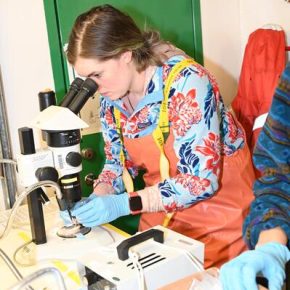 Krill play an important role in marine ecosystems across the world’s oceans, she explained, serving as a link between the bottom of marine food webs and marine predators like fish, whales, seals, seabirds, jellyfish, manta rays and penguins. The Southern Ocean food web is an example of how crucial krill can be, as many species there either eat krill directly or eat species that eat krill.
“Because of their central position in the Antarctic food web, a loss of krill could have substantial negative impacts on the Antarctic ecosystem,” she said.
Wood completed her undergraduate work in 2023 and is now pursuing a master of science with Bernard’s KrillSeeker lab. She said being surrounded by female mentors in science has been a big part of her inspiration.
“I feel very lucky that I have gotten to ‘grow up’ as an oceanographer surrounded by extraordinary women who offered mentorship and support in the lab, in the field, and in all the other aspects that make up being a scientist,” Wood said. “As I progress in my career, I want to carry on the message that women and girls belong in marine science, and the field is better for their contributions to it.”
Bernard is proud to have been part of Wood’s journey.
“Giulia Wood is one of the most brilliant and talented students I’ve had the pleasure of working with in my career,” Bernard said. “Over the past four or so years, I have seen her grow from a promising undergraduate into a confident, capable early-career scientist whom I have the utmost confidence will make important contributions to the field of marine science.”
Wood pursued the Marshall Scholarship at the suggestion of LeAnn Adam in National and Global Scholarships Advising at OSU. Wood was looking for a Ph.D project, and the scholarship seemed like the perfect fit. She was excited and in disbelief when she was accepted.
“I am excited to be advised by exceptional female scientists in the UK for my Ph.D. and feel very lucky that this work will provide me with the opportunity to dive into trace-metal research, which is relatively new to me,” she said. “I am looking forward to getting to work in conjunction with the British Antarctic Survey and to see all of the wildlife the sub-Antarctic hosts during the austral summer.”
Wood hopes to one day lead her own zooplankton ecology lab to explore how global climate change is impacting zooplankton, and to impact the development of evidence-based management policies in the Antarctic. She also wants to give back to the scientific community.
“I hope to create opportunities for young women to get involved in marine science,” she said, “and to get out into the field to get valuable hands-on fieldwork experience.”
By Theresa Hogue
Do you have a story for The Advocate? Email editor@corvallisadvocate.com