

Recently, Corvallis residents, and Reddit users specifically, have expressed outrage at the City of Corvallis for their potential use of Flock Cameras — an AI powered license plate reader used by police, businesses, and according to the ACLU, also Immigration and Customs enforcement. But City of Corvallis officials say they are NOT using them.
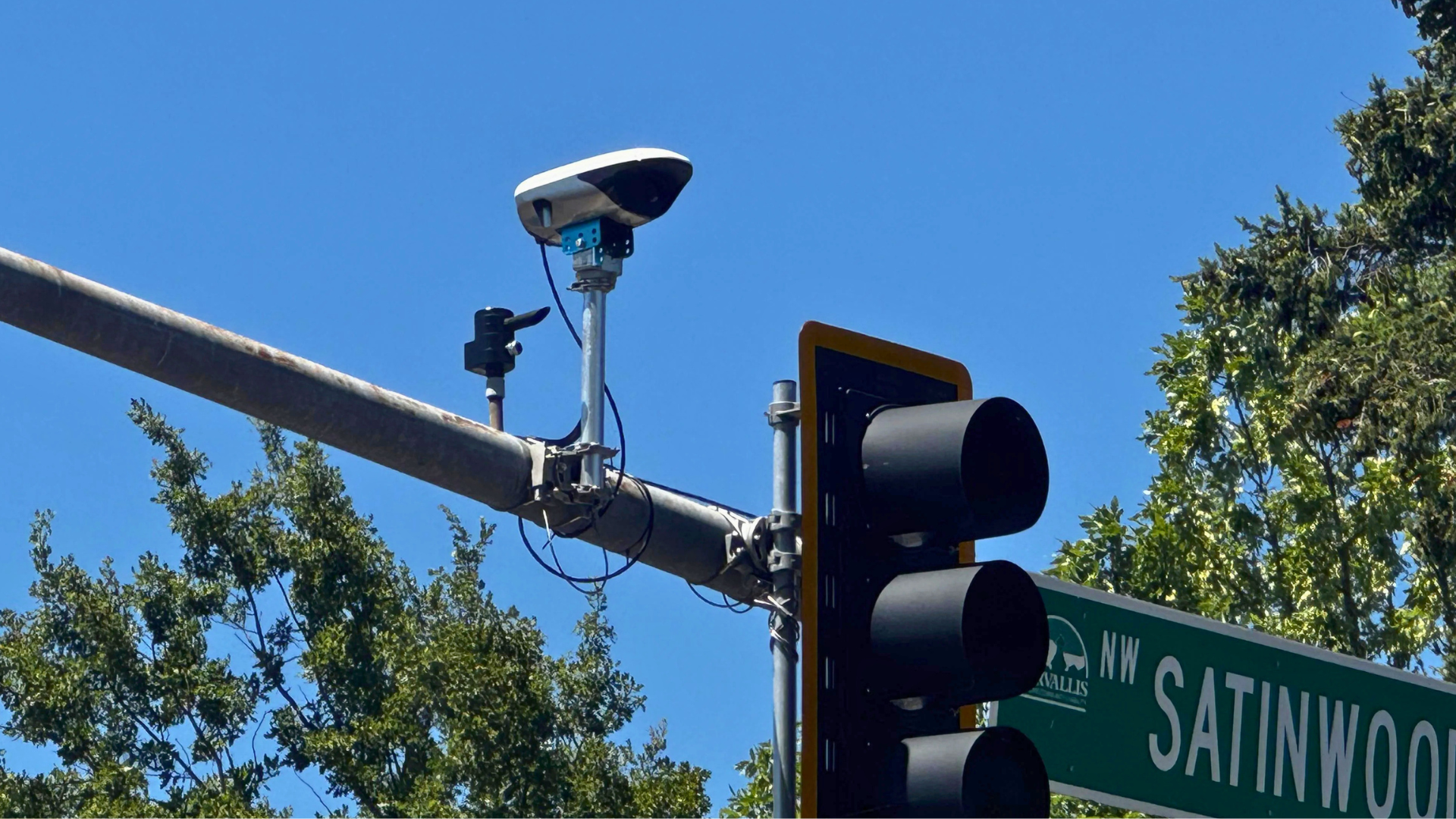
The fear they are in use around town is being fueled, in part, by devices on Walnut Boulevard that look like Flock cameras but aren’t. Adding to the speculation, they are also being labeled publicly as Flock devices on crowdsourced platforms like maps.deflock.org, an open-source project which maps license plate readers.
However, the devices seen on Walnut Boulevard are in fact not Flock Cameras, but overhead traffic detectors manufactured by NoTraffic. Much has been said on local social media about the company’s country of origin, they were founded in Tel Aviv, they also have a U.S. presence, headquartered in Overland, Kansas. The cameras they supply to Corvallis do not read license plates or recognize faces, and law enforcement has no access to the devices or the data they accrue.

They do, however, function similarly to common traffic readers previously installed beneath ground to help control traffic signals at intersections around town, says Patrick Rollens, Public Information officer for the City of Corvallis.
These overhead traffic monitoring devices are a better option according to Rollens because they are easier and cheaper to install and repair, and unlike their below-ground counterpart, they do not get damaged by construction, which is apparently common.
These devices do store video and images for 30 days. But it’s only City Public Works staff that work on traffic signals that can view those video feeds for diagnostic purposes. Other than that, none of the video or images are retained or downloaded unless the City requests it, and only for diagnostic purposes at that.
For now, the NoTraffic devices are deployed at Kings Boulevard and Satinwood along Walnut Boulevard. Rollens says they cost $25,000 to $30,000 for each intersection, less than their inground alternatives.
Readers are Used for Police Stops, Parking Enforcement
Other than NoTraffic cameras, the city deploys the use of license plate recognition for parking enforcement throughout its multiple parking districts, according to Rollens. The data collected by parking officers with this technology is not connected to outside databases, beyond what is retained for citations, and that data is automatically deleted after 30 days.
Plus, Corvallis Police Department patrol cars do include cameras mounted within the vehicle, equipped with automated license plate readers. These cameras record traffic stops, DUII investigations and other emergency responses These systems, as well as the department’s body cameras, are supplied by Axon, a public safety technology developer based in Arizona, not Flock. The data collected by these cameras is “maintained in accordance with Oregon state laws”, says Rollens.
Finally, there are Flock device supporters, they believe these cameras may help solve difficult crimes. However, the ACLU says devices like these, “build a nationwide mass surveillance system,” and for many, this is a prevailing concern.
In Oregon, some cities are incentivized to use Flock cameras, such as Junction City which is awaiting a vote on a 90-day trial agreement with Flock that would install eight plate readers within city limits, says KEZI ABC, as well as Eugene and Springfield, both of which recently discontinued their use of the technology over “‘identified vulnerabilities and limitations.’”
However, Rollens says that Corvallis is not, and has not considered using Flock technology locally.
By Campbell Grove
Do you have a story for The Advocate? Email editor@corvallisadvocate.com