

 To improve school attendance in a state with one of the nation’s highest absenteeism rates, Oregon education officials on Tuesday presented lawmakers with a plan to repeal existing attendance laws.
The high-level presentation and 20-page report presented to the Senate Interim Education Committee described a strategy to replace existing attendance laws “rooted in compliance” with new rules that measure “attendance as a performance growth indicator.” It left lawmakers with many more questions than answers: State Sen. Courtney Neron Misslin, D-Wilsonville, almost immediately requested a follow-up meeting to get more clarity.
Senate Bill 315 passed during the 2025 legislative session required the Oregon Department of Education to produce by May 31 a report that outlined how districts are handling attendance policies, best practices for recording and improving student attendance and statutory recommendations that could apply in Oregon. Lawmakers will take up any recommendations during the next legislative session in 2027.
Oregon schools have among the highest absenteeism rates in the country, state data shows, and it’s a problem that has persisted since students returned to school following the COVID pandemic nearly five years ago.
Roughly one-third of Oregon students in 2024 were considered chronically absent, meaning they missed 17 or more school days during the school year in a state with one of the shortest school years in the country. About one-fifth of students nationwide were chronically absent in 2024, according to the U.S. Department of Education.
Repeal and replace
Among the recommendations state education officials offered are to repeal 11 state statutes relating to compulsory school attendance and to replace them with statutes that “would include compulsory attendance requirements and exemptions,” and also outline the responsibilities of guardians and school districts when it comes to student attendance. The report described some state attendance laws as “outdated” and “duplicitive,” and said some homeschooling regulations are wrapped into attendance laws.
The State Board of Education would be tasked with coming up with the new statutes, and attendance would be wrapped into new legislatively mandated accountability measures.
“Oregon’s current compulsory attendance statutes and rules are grounded in compliance-oriented definitions of attendance, static thresholds, and enforcement mechanisms. Maintaining compulsory attendance statutes rooted in compliance creates tension with this model, as they rely on fixed definitions of absence and enforcement responses that create conflict with attendance as a growth-based measurement,” the report reads.
Notably absent is any recommendation for punitive action or a framework for accountability from students or their families when a student continues to miss school. Lawmakers in 2021 repealed an Oregon law that allowed schools to issue truancy fines to parents or guardians for a child’s ongoing and unexcused absences from school.
“This represents a shift from enforcing attendance through prescribed sanctions to using attendance data as a continuous signal for improvement, support, and system effectiveness,” the education department recommendations read.
Candice Castillo, deputy director of academics at the state education department, told lawmakers that some students who continually violate district attendance policies will unenroll from school or just stop showing up, disappearing altogether.
“There’s all these barriers and these challenges that our students and communities are facing, and compulsory policies can be helpful to some extent, but there is a broader system that needs to be in place in order to really support students,” she said. “What we aim to do with this recommendation beyond that compulsory requirement is really to help the district build a system and build an approach that allows us to support the student needs, so that our students would want to be in the classroom consistently.”
State Sen. Janeen Sollman, D-Hillsboro, asked Castillo “what the teeth” of the proposal would be.
“I think you can have that level of the ‘wrap around supports’ — What supports does this student need? What supports does this family need? — but we also can hold students accountable,” she said. “I sometimes worry Oregon gets in its own way when we remove the accountability.”
Other attendance policy recommendations
Education officials told lawmakers that there are major inconsistencies in how districts record student attendance, as well as how they record the reasons why a student is absent, making it difficult to collect accurate data on why so many students in Oregon are not going to school regularly.
The education department would create 17 possible codes districts could use to record students not as merely “excused” or “unexcused” but as “present” or “absent.”
Under the new codes, a student could be marked “present” even if they are out of school for a debate tournament or sport, are temporarily getting remote instruction or are attending a tribal education program or event. A student would be marked “absent” if they are ill, working, can’t find transportation to school or if their situation is unknown.
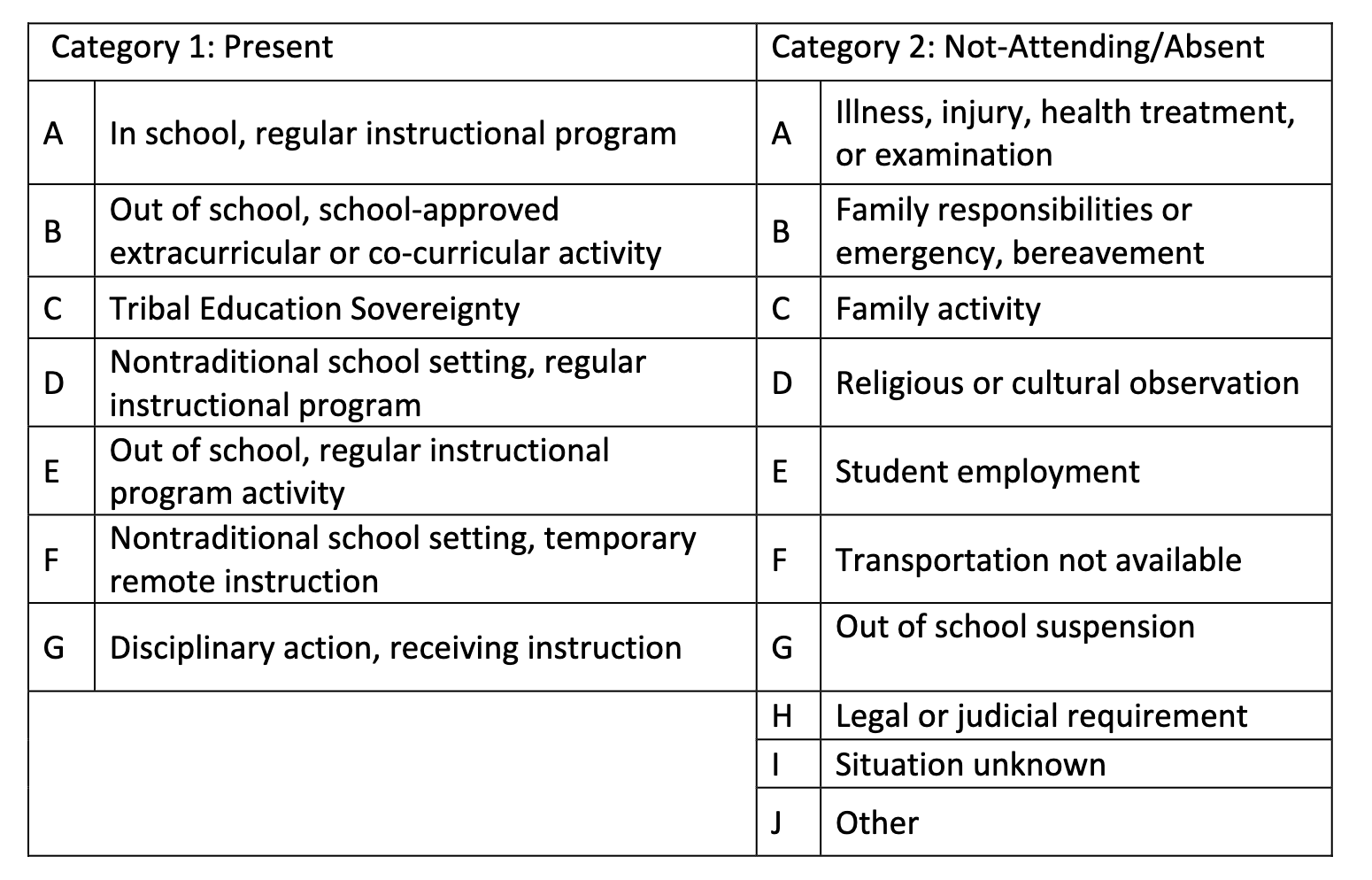
In their presentation, state education officials noted that merely recording a student as “excused” or “unexcused” lacks clarifying information and “places a value statement on absences and contributes to a misconception about absences,” while recording students as “present” or “absent” provides more context and “centers the loss of instruction for any reason and elevates root causes for appropriate interventions.”
Education officials also recommended studying and revisiting Oregon’s 10-day rule, under which students are automatically unenrolled if they miss 10 consecutive days without an excuse. The rule’s intended to ensure districts are not double-counting students who may have moved between districts, but it can create barriers for students who eventually return to a school after a prolonged absence and require a school to resubmit enrollment information to get the student’s per-pupil funding restored.
They also recommended the state provide more money for the agency’s Every Day Matters program, which currently has just two full time employees, and to fund a statewide information and data collection system so the education department can more easily collect attendance information from schools and provide technical help.
The agenda for the three-hour meeting included more updates from education officials on the legislatively mandated accountability metrics and the rollout of Gov. Tina Kotek’s recent executive order stopping school districts from cutting instructional time to save money.
“How does low instructional time and days contribute to a culture of non-attendance?” Sollman asked Castillo.
Castillo acknowledged Oregon’s short school year, and research showing school attendance is one of the single most important indicators of student success.
“While there’s always benefits for our students to have longer instructional time, we also know that, as we referenced earlier, it has to be a cohesive and holistic approach and system,” she said. “Having additional instructional time will be important, but we’re also creating the right conditions for our students.”
By Alex Baumhardt of news partner Oregon Capital Chronicle
Do you have a story for The Advocate? Email editor@corvallisadvocate.com