

Democratic leaders in the Oregon Legislature want to move a statewide vote on transportation taxes from November to May.
After submitting enough signatures to the Oregon Secretary of State’s Office, petitioners with the Republican-led No Tax Oregon campaign blocked hikes to the gas tax, vehicle registration and title fees and payroll tax included in a 2025 transportation law from taking effect pending a statewide vote in the November general election — thus delaying $791.2 million in revenue for the Oregon Department of Transportation in the 2025-27 budget cycle.
However, House Speaker Julie Fahey, D-Eugene and Senate President Rob Wagner, D-Lake Oswego announced late Wednesday that they will introduce legislation to set the date of the referendum for the statewide primary election on May 19.
“Voters were clear that they want to have a say on this bill, and legislators and our local partners need to know the transportation funding landscape so meaningful conversations can continue,” Wagner said in a statement. “Setting the election date for May achieves both these goals.”
But Republicans vowed to fight the effort to reschedule a vote. Rep. Ed Diehl, a Scio Republican and one of the leaders behind the referendum campaign called Democrats’ efforts to move it to May “callous.”
“(Gov. Tina Kotek) doesn’t want to be on the same ballot as this referendum,” Diehl told the Capital Chronicle. “I’m going to fight it tooth and nail. They’re not going to get away with this.”
Kotek and legislators will be on primary ballots in May, but only Democratic ballots. Oregon’s closed primary system means only registered Democrats receive Democratic ballots and registered Republicans get Republican ballots, while the more than one-third of voters who aren’t affiliated with either major party receive shorter primary ballots with only ballot measures and nonpartisan races.
Fahey said setting the referendum date for the May primary gives lawmakers and Oregonians the needed clarity on the next steps for Oregon’s transportation future.
“In this time of uncertainty, we’re focused on governing, not politics,” Fahey said. “That means acting as quickly as possible to prevent disruption in our transportation system and to protect the roads and bridges that connect Oregonians to work, school and emergency services.”
Transportation department short on funding
The transportation department is behind $242 million for the current two-year budget cycle. Starting next year, it will only be able to afford paving its interstates, meaning Oregon drivers can expect more potholes, rutted roads, faded pavement markings and higher vehicle repair costs, department chief engineer Tova Peltz previously told lawmakers.
The efforts to move the referendum come weeks after Gov. Tina Kotek called on lawmakers to repeal the transportation law she championed and Democratic lawmakers passed in a September special session to raise $4.3 billion in transportation maintenance funding over the next 10 years. However, a 1935 Oregon Attorney General opinion states the Oregon Legislature can’t repeal a law once it has been referred to the ballot.
Chief Legislative Counsel Dexter Johnson wrote a legal opinion to Diehl on Jan. 9 that if the legislature repeals the transportation law, then it ceases to be an act which means there is no longer a basis for a referendum.
But Johnson since reversed his opinion, Diehl said, concluding that Oregonians have a right to the referendum process and the Legislature cannot repeal a measure that has been referred, though it can set a date for the election.
Lawmakers have done this before. Transportation legislation passed in the 1999 session was referred by voters and went to the ballot in May 2000.
Kotek told the Capital Chronicle that she’s focused on providing stability to the transportation department so it can provide essential services.
“I’m focused on solving the problem, and that’s, to me, the easiest thing to do,” Kotek said. “The most direct approach is to start over, then solve the problem, and then get back to the table on what we need to do for transportation long term as we go into the next session in 2027.”
Republicans criticize attempts to move referendum to May
Diehl was a lead petitioner for the campaign alongside Senate Minority Leader Bruce Starr, R-Dundee, and Jason Williams, director of the Taxpayer Association of Oregon. On Nov. 12, they received approval from the Oregon Secretary of State to begin collecting signatures to refer the law to the ballot, and within a month the group submitted nearly 200,000 signatures.
“When we did the referendum, we marked that box that says we want it on the November 2026 ballot,” he said. “We got all the signatures, all verified for November 2026. This ship has sailed. I know they have the legal right to move it, but November is the people’s day to vote. That’s when the people show up to vote in the general election.”
Starr echoed Diehl’s concerns, noting that primaries usually have less voter turnout than general elections. In the state’s last gubernatorial election year in 2022, voter turnout reached 37% in the primary, compared to 67% in the general election.
“Republicans have been clear from the beginning that we can balance ODOT’s budget without raising taxes, and that is exactly what we are working to do,” Starr said. “We are having real conversations about priorities and accountability, and that is how governing is supposed to work. Manipulating the election calendar to avoid political consequences is not how Oregonians expect their government to operate.”
Gubernatorial candidate Sen. Christine Drazan, R-Canby, also criticized the attempts to move the referendum.
“This is what desperation looks like,” Drazan said in a statement. “Tina Kotek is afraid of being on the same ballot as her gas tax. At the end of the day she can’t avoid Oregonians; they will hold her accountable.”
Oregonians rallied together in record time to advance the referendum, and for the first time Democrats are realizing the power of the political minority, House Republican Leader Lucetta Elmer, R-McMinnville, said in a statement.
“If this policy is so good, it should stand on its own — on a full, general election ballot,” Elmer said. “Trying to tuck it away in an off-cycle election only confirms what the people already know: this gas tax is unpopular, and the public deserves a real say.”
Diehl is Running for Governor, Seeks Republican Nomination
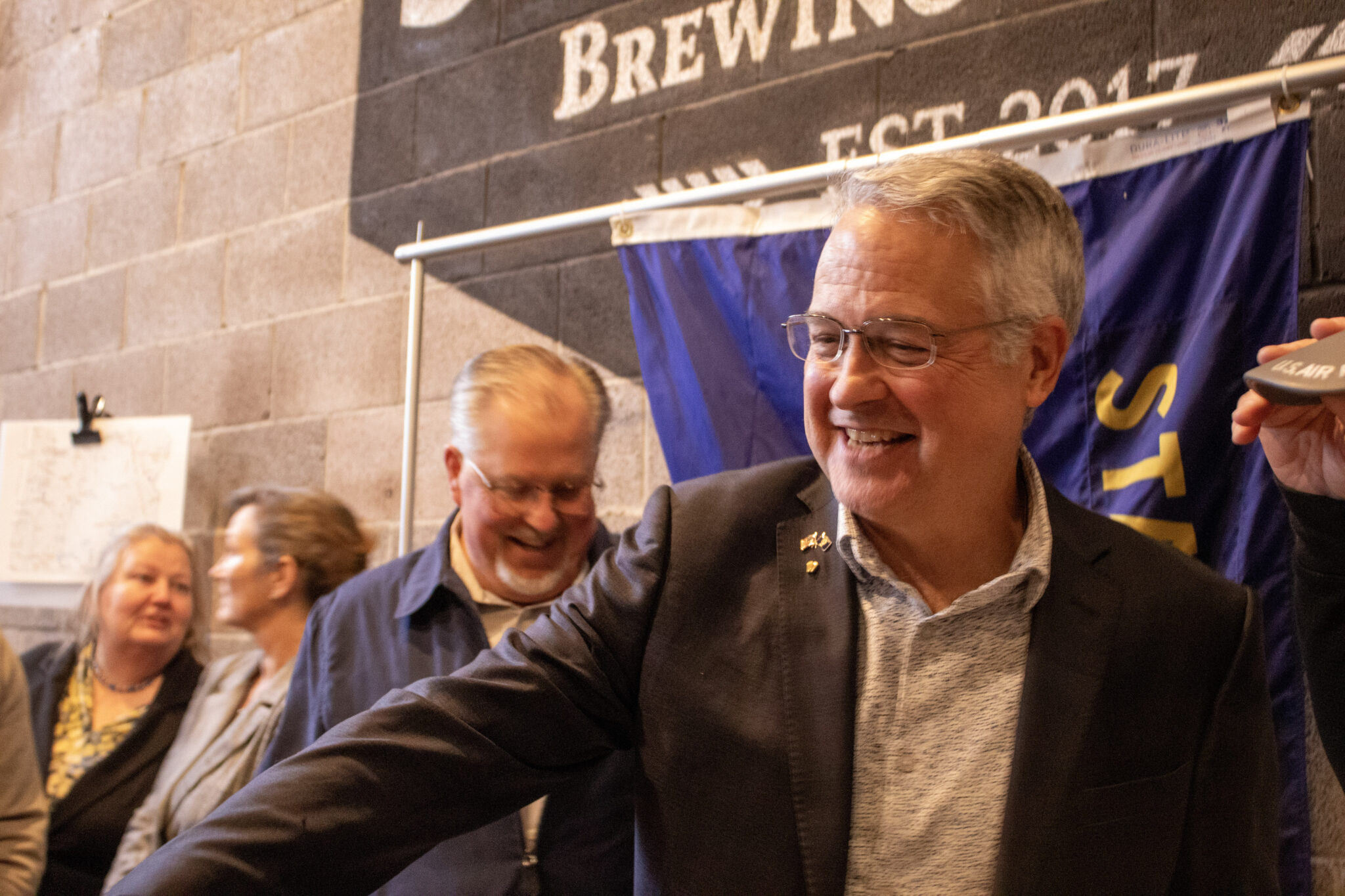 One of the leaders behind the effort to block increases to Oregon’s gas tax has entered the race for governor.
Rep. Ed Diehl, R-Scio, shared the announcement with his supporters Wednesday evening at Stayton’s Snow Peak Brewing. The crowd of people, some of whom drove from Washington, Yamhill and Multnomah counties, overflowed the brewery where the lawmaker regularly hosts town halls.
“I’m running for governor to restore accountability, affordability and competence to state government,” Diehl said in a statement. “Oregon should be a place where working families can get ahead, where budgets are disciplined and where results matter.”
Diehl said the decision came after spending a long weekend with his wife along the Oregon Coast and reflecting on what his heart was telling him to do.
“I’m doing this for the forgotten Oregonians, the ones who work hard and take care of their families, play by the rules, pay their bills, sometimes praying, but they’re always paying the government tab,” he said. “You deserve better.”
Diehl is in his second term representing Oregon’s 17th House District, which stretches from East Salem to Detroit.
He made headlines this year for helping lead the No Tax Oregon campaign, which blocked hikes to the gas tax, vehicle registration and title fees and payroll tax included in a 2025 transportation law until a referendum vote in November 2026. Diehl led the campaign alongside Senate Minority Leader Bruce Starr, R-Dundee and Jason Williams, director of the Taxpayer Association of Oregon.
Because Gov. Tina Kotek delayed signing the transportation bill into law, petitioners had roughly two-thirds of the usual time to gather signatures. Still, the petition organizers submitted more than 200,000 signatures from Oregonians — more than the 78,000 required to send the tax and fee hikes to voters for approval.
Anna Munson, a volunteer for the No Tax Oregon campaign and Republican candidate for the Salem-based 19th House District, drove from Salem to support Diehl.
“He’s willing to do the work, and he’s willing to make the hard decisions and say ‘This is really what we have to do,’” she told the Capital Chronicle.
Jack Tibbetts, who is running for the 6th Senate district in rural Lane County said he met Diehl through his campaign and considers him down to earth.
“Honestly, I’m a Republican and when you’re in a super minority, there’s not a lot we can do,” he told the Capital Chronicle. “I was really inspired by the fact that he didn’t stop working inside the building. He said ‘I’m going to go outside the building and actually bring some of these questions to the voters.’”
Diehl was born in Plains, Montana, to a family of sawmillers and loggers, according to his campaign website. He received his bachelor’s and master’s degrees in mechanical engineering at Stanford University before moving to Oregon in 1989, eventually settling in Scio and co-founding Albany-based automation consultant firm Concept Systems Inc. Outside of state politics, he’s involved in the Catholic Church and sits on the board of directors for Santiam Hospital, according to his biography on the Oregon Legislature’s website.
Some of his campaign priorities include education, street homelessness, gun rights, limiting abortions and supporting small businesses, according to his campaign website.
The Republican competition ahead
Oregon hasn’t elected a Republican as governor since the 1980s, and only two Republicans have won a statewide election since 2000.
As of Wednesday, 12 people have filed to run as a Republican candidate for governor, according to the Secretary of State’s website. That includes frontrunner Christine Drazan, a state senator from Canby who ran against Gov. Tina Kotek in the 2022 general election and lost by more than 66,000 votes.
Drazan’s campaign did not respond for comment, and Diehl said he hadn’t spoken to Drazan yet about his announcement. “There are no secrets in this business,” he told the Capital Chronicle. “I still owe her a call, I want to talk to her about it. I have a lot of respect for her. I just think I see a path to victory for me, and I don’t see one for her.”
Diehl will also be running against Marion County Commissioner Danielle Bethell.
“Oregon voters deserve a choice — the Republican Party doesn’t do coronations,” Bethell told the Capital Chronicle. “My reason for running hasn’t changed: Oregon needs an experienced executive as its next governor, not a policy maker. Whether that policy maker just got here or has spent a career in the legislature, they haven’t managed departments or delivered results.”
Bethell is currently under investigation from the Oregon Government Ethics Commission over allegations she used her position as a county commissioner to benefit her children.
“Oregon needs a governor who understands how systems work, how to manage budgets, how to build effective teams and how to deliver results,” Diehl said in a statement. “We need a governor who will improve affordability, reduce cost of living, and increase opportunity for all Oregonians. I know how to do that — and I know Oregon can do better.”
By Mia Maldonado of news partner Oregon Capital Chronicle
Do you have a story for The Advocate? Email editor@corvallisadvocate.com