

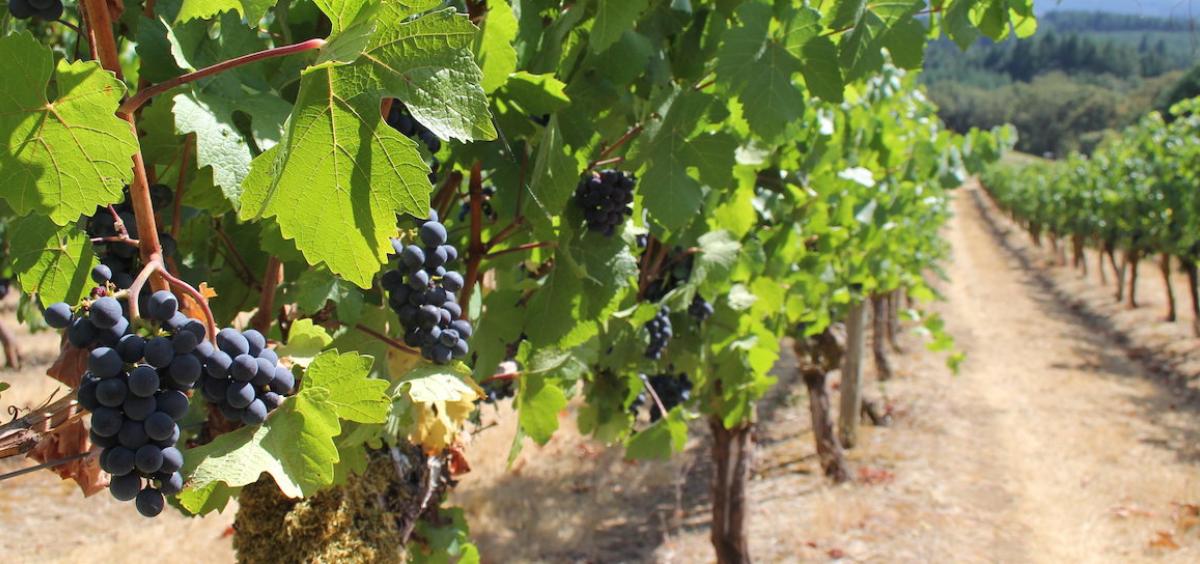
 Bordeaux, Burgundy, Bologna, Sonoma, and now the Willamette Valley. These are regions where temperature, light, water and fine earth on sloped hillsides balance in perfection, for wine, and an education about the business of wine.
Now, Oregon State University’s College of Business has joined the other aforementioned globally leading winemaking regions — with the launch of the Oregon State MBA in wine business management, ready with its own significant “business terroir” to contribute to the wine industry.
Here’s what’s happening. In partnership with the OSU College of Agricultural Sciences, the new MBA brings the advanced business management principles the program is known for — markets, costs and valuations, sales and legal environments, operations, decision-making, supply chain, and analytics and information systems.
With the strength and reputation of the College of Agricultural Sciences, ranked no. 12 globally and top-ten nationally, adding vineyard operations and principles of wine production, the MBA offers executive-level knowledge and leadership skills to professionals, both inside and outside the industry.

“The wine industry and Oregon State University make a fantastic pairing,” said Jayathi Murthy, president of OSU. “OSU has long supported the state’s world-wide reputation for excellence by advancing the science of winemaking. Now, we will bolster the state’s impressive global standing by delivering knowledge and leadership skills to the next generation of the food and beverage industry.”
The MBA in wine business management is built on the strengths of the Oregon State MBA. John Becker-Blease, Ph.D., associate dean of undergraduate and graduate programs and services, emphasizes that the program brings the usual rigor of the graduate degree.
“This is what we do: Deliver the essential skills of team management and leadership,” he said. “We bring those skills to the current workforce and also create a workforce that is highly astute to the business elements of winemaking, wine distribution and the wine industry. We’re preparing tomorrow’s industry leaders.”
The business is serious: Within the massive U.S. food and beverage industry, exceeding $2.6 trillion in consumer spending, wine contributes a generous splash. Forbes says that U.S. wine sales in 2023 reached $107.4 billion, up from $73.4 billion in 2018. In Oregon, grapes are the state’s most valuable fruit, and Oregon cellars have increased in number from about 200 to 1,200 over 15 years and focus on higher quality and price point.
Wine industry overview
With both growth and industry-specific challenges, finding business advantage becomes more nuanced. The 2024 BMO Wine Market Report, a comprehensive publication from the leading business-to-business media company on the North American wine industry, WineBusiness, says that the market “offers opportunities for proactive companies leveraging data to retain or increase their share of the market.”
Andrew Adams, report lead author, editor and writer for WineBusiness, discusses business challenges for the industry and Oregon.
“The wine industry goes through many different sectors from agriculture to production to distribution, that particularly here in the United States, are very fragmented,” Adams said.
“This unique route to market and knowing how all these somewhat disparate pieces enter in and affect each other and how to navigate all the intricacies require people who are very experienced and skilled. Oregon is not that much different in terms of the wider industry and its challenges at the moment. The post-pandemic trends and tourism have been perhaps a bit harder for Oregon. And while pinot noir is without doubt — and should be — the signature grape of the state, being so closely linked to one varietal is a challenge.”
He cites the diversity of Sonoma County as an example of a region that can handle shifts in preference and popularity. “I think chardonnay and sparkling wine continue to offer a lot of potential,” Adams said. “The quality has increased tremendously over the last few years, and I think consumers are gaining an appreciation of those wines from Oregon.”
New energy of Oregon vintners
Stepping up are David and Lois Cho, husband and wife, winemaker and wine business manager of the award-winning Cho Wines, which includes of course classic pinot noir, but also white, rosé and sparkling wines. They met playing music on the streets of Santa Monica, got a gig at a winery, and the vision and the dream built up from there. “We really had zero experience in wine,” Lois Cho said. David Cho ’18, earned his bachelor’s in viticulture and enology, gaining experience at Stoller and Argyle cellars. Lois, a nurse practitioner, took to researching compliance and business. They dreamed of and planned for their winery after putting their young children to bed, launching in 2020. While the pandemic impacted revenue streams in tasting rooms across the country and the world, Lois marketed online.
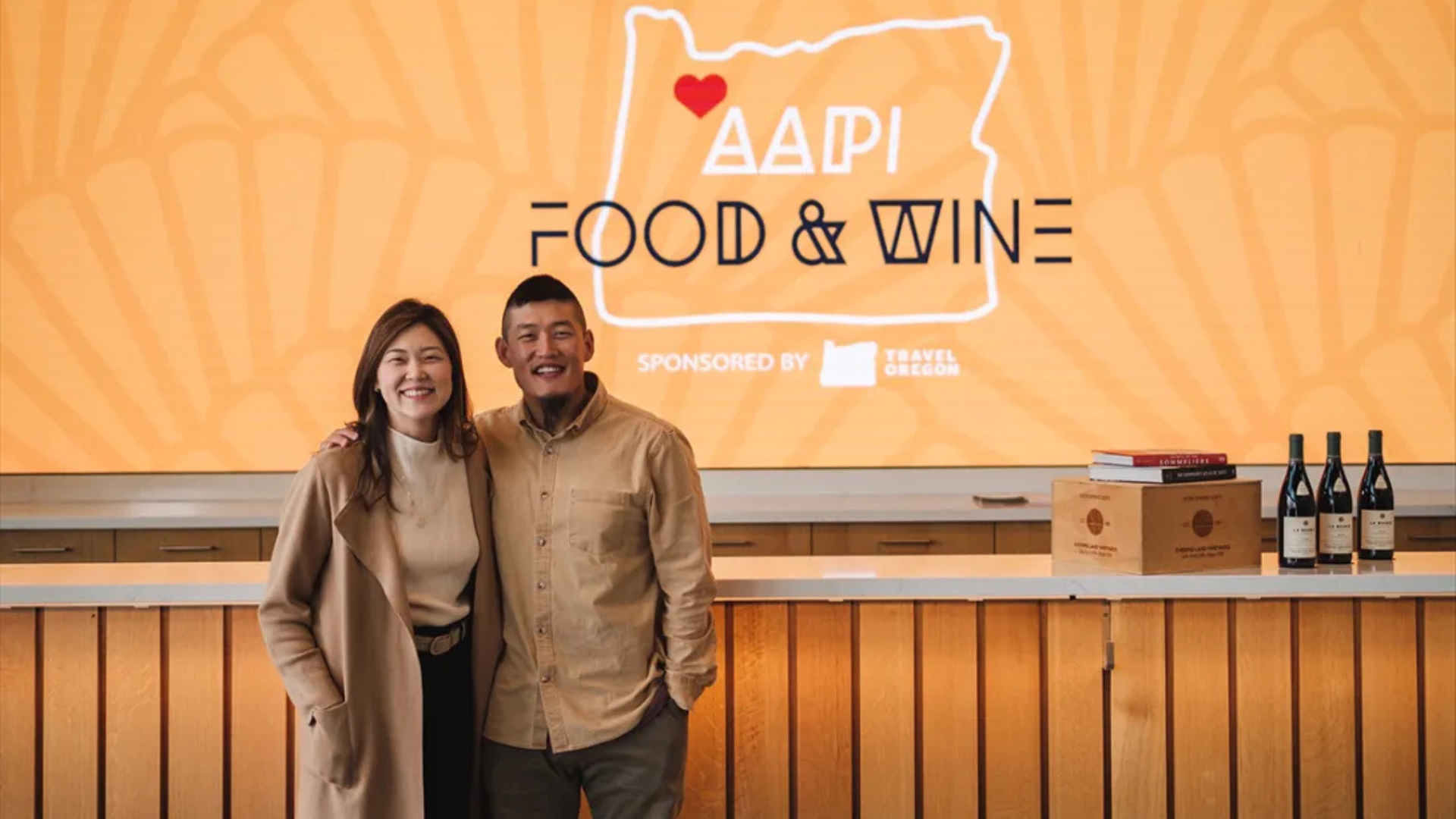
“It just started taking off online,” she said. “People are very engaged on social media. We had not foreseen to sell half of our production, before it was even bottled. It was a really exciting time for us, and we saw a future in it.”
David’s wines, the first release, scored above 90 points; they were named “rising star vintners” and recognized as the first Korean-American winemakers in Oregon. A community and a brand began forming around them. Lois founded AAPI Food and Wine, a national nonprofit platform celebrating Asian American voices in food, wine and hospitality.
Five years later, the startup is a nationally recognized brand, and Lois Cho has a moment to reflect on the challenges:
“I wish that there was a huge resource like this for us, when we were pursuing this,” Lois said. “I love studying; I could be a student my whole life. But we are scrappy. Even now, there’s still learning how to manage a business and manage employees and train leadership and all these things we’re learning as we go.”
Global leaders put training at the forefront
And yet, small Oregon wineries with incredible origin stories must also compete with global leaders.
Gallo, today the world’s largest wine producer by volume, also started with a winemaker and business partnership (of brothers), and it remains a family business that values training and education. Jim Coleman, Gallo’s co-chairman of the board, served in an advisory role to the College of Business during the development of the college’s specialized master’s degrees, championing the case that businesses across all industries needed people with analytics, supply chain analytics and marketing analytics skills.
OSU College of Agricultural Sciences alumnus Chad Clausen, senior value stream manager in operation strategy at Gallo, has been upgrading these skills since joining the wine and spirits company as a research winemaker in 2010. With his degree in food science and technology, Clausen worked to evaluate how viticultural and winemaking tools could enhance wine quality. As his career at Gallo transitioned into production winemaking, Clausen became involved in the complete process of bringing grapes from the vineyard, partnering with operations, supply chain, warehouse, logistics, sales and marketing along the way.
He trained Lean Six Sigma in-house with Gallo and then completed a graduate certificate in supply chain and logistics management with the College of Business in June.
“This is a very complex business that is capitally intense and doesn’t allow much margin for error,” Clausen said. “When we compound that with the different curve balls being thrown its way — be it climate, water availability, shifting consumer preferences, wildfires, labor, etcetera, each winemaker and winery has their choice of the proverbial litter. There is no shortage of challenges or opportunities for Oregon winemakers and the wine industry in general.”
Clausen points to a lot of hard — and not so glamorous work — that’s needed to transform grapes into elegant wine. And similarly, he says, while the public may celebrate — with wine — without knowledge or exposure to the difficulties and strenuousness of working a harvest, winemakers via their undergraduate education are typically not exposed to the sales, marketing or supply chain needs of the wine business.
“A key part of the graduate program that has been beneficial has been the diversity of industries represented by my graduate student peers and faculty,” Clausen said. “Collaborating with supply chain professionals from Nike, Intel, Amazon, LAM Research, government, academia and various companies globally provided valuable real-world examples of best practices beyond the wine and spirits sector, enabling me to apply new scenarios effectively in my job.”
Leveraging OSU collaborative strength
Lisbeth Goddik, professor in food science and technology at the College of Agriculture Sciences, points out the overlap while describing the college’s strong research that investigates quality and innovation in winemaking, informed by an impactful industry advisory board compromised of food and beverage industry leaders. The Oregon Wine Research Institute has a long history of supporting Oregon’s wine industry with collaborative research, partnerships and knowledge-sharing.
She describes the need to break down the silos: “This is food science. This is business. This is engineering. And there’s overlap.”
“We seem to be really equipped to leverage a lot of our strengths and talents at OSU in order to pursue innovation,” Goddik said, “This is not just for wine. This is for every single aspect of the food beverage sector in Oregon. We have to compete on quality and innovation. Those are two aspects where OSU is uniquely qualified to step in and to help industry.”
Do you have a story for The Advocate? Email editor@corvallisadvocate.com