

 Anyone shopping for a new TV is likely to notice the term OLED, short for organic light-emitting diode. Unlike traditional inorganic semiconductors, OLED displays use thin, carbon-based organic semiconductor layers to emit light, delivering better picture quality, faster response times and thinner displays. That flexibility opens the door to new kinds of devices.
The materials that make that flexibility possible are chemically different from silicon and other high-performance inorganic semiconductors, which allows the materials to be printed on a variety of surfaces, bent or stretched, and manufactured at lower temperatures – capabilities impossible with inorganic alternatives.
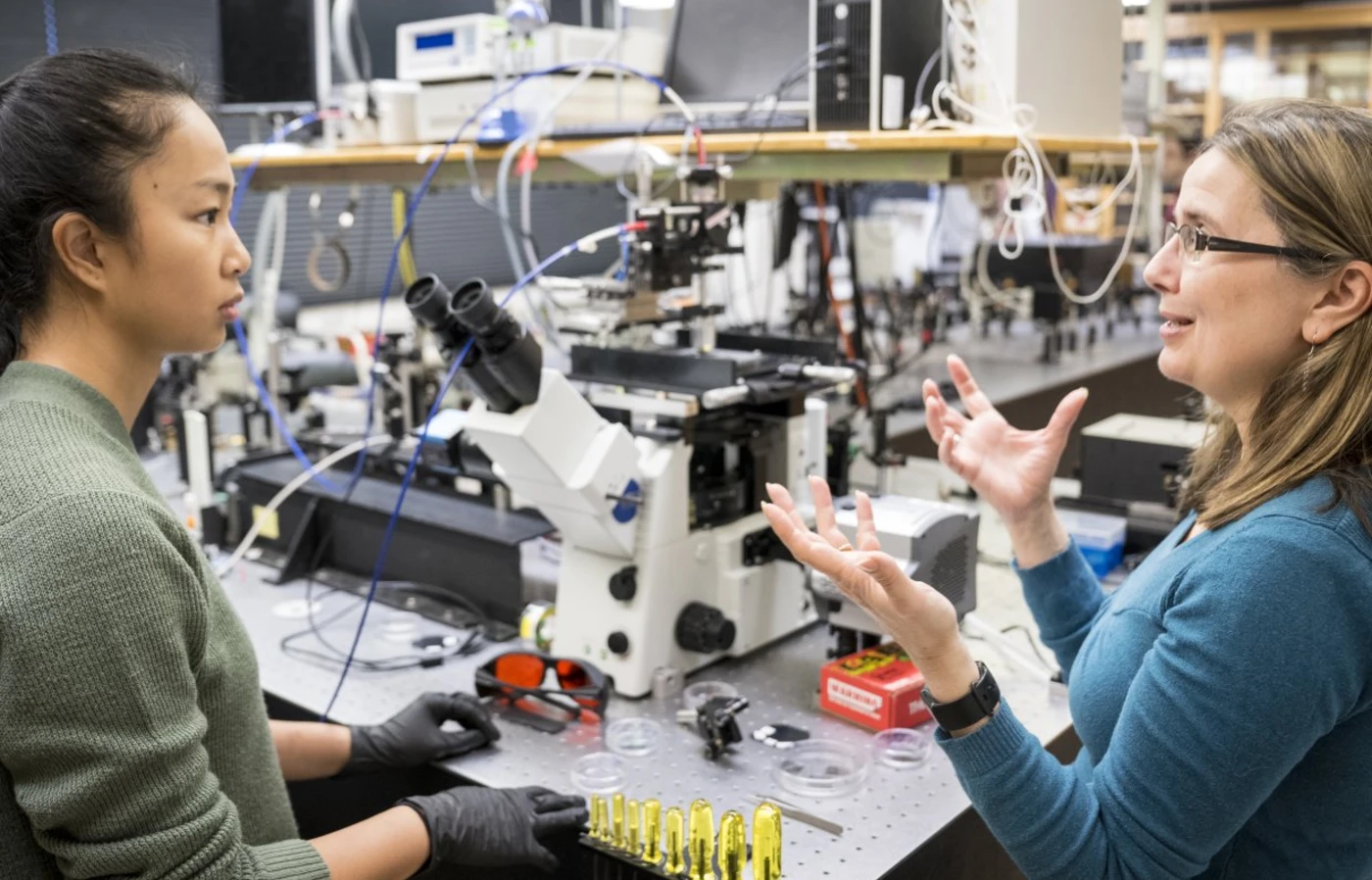
Physicist Oksana Ostroverkhova studies similar organic semiconductors in her laboratory at Oregon State, exploring how light interacts with these materials and how those interactions can be harnessed to create new optoelectronic and photonic devices.
Her work extends beyond semiconductors to organic, carbon-based compounds — including pigments from fungi that can bend, guide light or change color in response to electricity. She is also advancing spintronics, an emerging approach that transmits information via spin waves rather than electric current.

From televisions to solar cells, the technologies she studies are already part of everyday life, even if most people don’t realize it.
“If we can make them sustainable, low-cost and wearable, that’s an added bonus,” Ostroverkhova said. “Right now, the performance of organic molecules isn’t as good as silicon, and the stability isn’t as high. We want to understand how we can make them perform better and what kinds of tricks we can use to improve them. They’re not going to replace silicon everywhere, but we want to find their niche.”
Focusing on the unique needs of specific products helps narrow down where organic versions can shine.
“For example, disposable sensors. You don’t want to have an expensive silicon sensor telling you whether your milk is still OK to use,” she said. “We are also thinking about toys and games and other products which shouldn’t need the high performance of silicon.”
Her team is also exploring how organic materials can complement, rather than compete with, traditional versions. “Can we use a carbon-based layer on a silicon solar cell and boost its performance?” she wonders.
The advantages of organic materials could be especially meaningful when it comes to sustainability. Although organic semiconductors don’t produce as many toxic substances during processing, they are still synthesized in laboratories. Ostroverkhova is working with collaborators to explore a natural alternative.
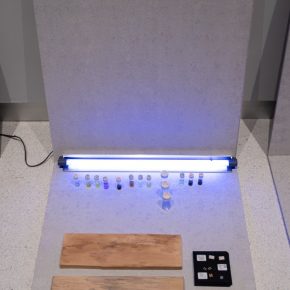
In collaboration with researchers in the colleges of forestry and engineering, her team is investigating pigments like xylindein, a blue-green compound produced by wood-eating fungi. Its durability makes it especially compelling, as artists have used it for hundreds of years.
“If something lasts on a church ceiling for more than 500 years and hasn’t degraded from light or heat, I want to know why,” Ostroverkhova said.
Through their research, the team has discovered that the fungus grows fibrous and highly flexible crystals. Because you can bend them, these crystals can act as waveguides, structures that direct the flow of light.
The pigments can also respond dynamically to electrical signals. “You can apply voltage to some of these pigments and they change color. So we are thinking of applications where this might be useful,” she said.
In addition to researching what high-performance semiconductors should be made of, Ostroverkhova is also rethinking how they function.
Boosted by a College of Science Research and Innovation Seed grant, she is part of a collaborative research group of physicists, chemists, mathematicians, and engineers collaborating on spintronics, an emerging approach to computing that uses magnons, or tiny packets of spin waves, rather than electrical charge to carry information. In conventional semiconductors, information is processed by moving electrons through a material, generating heat as electrical resistance builds. Spintronics takes a fundamentally different approach: instead of moving charge, it transmits information through waves of electronic spin.
To do that, researchers are relying on a new class of materials known as two-dimensional (2D) magnetic semiconductors, ultrathin materials that can support both electronic behavior and maintain magnetic order.
Because magnons do not produce resistive heating, they offer a path to faster, more energy-efficient technologies. But to make that possible, scientists first need to understand how these waves move through a material and how to control them. Integration of these 2D magnets with organic molecules could be one of the knobs to tune spin wave propagation.
The group will use the new supercomputer in the Huang Collaborative Innovation Center to model spin waves with greater accuracy than previously possible.
Lighting the path to the future

Looking ahead, Ostroverkhova envisions a world where light-based technologies are integrated into everyday environments in ways that are difficult to imagine today.
“We’re going to have entire walls that function as a display and use touch screens,” she said. “Possibly 3D holographic displays, where you can create a rewritable 3D image.”
While this almost sounds like magic, she emphasizes that these advances are rooted in fundamental research, the kind that often goes unnoticed. “People are so used to technology that they don’t think about where all of this is coming from,” she said. “And it is coming from research labs, doing research in this field.”
That research environment plays a critical role in preparing students for careers in a rapidly evolving field. Ostroverkhova’s lab includes both undergraduate and graduate researchers, many of whom go on to work in the semiconductor industry or pursue advanced degrees.
“We need to train students not for the current technology, but for the future technology,” she said.
Hands-on experience is key to that preparation. Countless undergraduate students have told her they landed a career because of undergraduate research opportunities in the College of Science.
As students and researchers explore how molecules absorb, emit and transform light, they’re laying the groundwork for devices and applications that don’t exist yet. Those tiny reactions are the foundation for future displays, sensors, information processing, and energy devices, built with the unique advantages of organic materials. What starts as an interaction of light at the molecular level may soon take form in the world around us.
By Hannah Ashton
Do you have a story for The Advocate? Email editor@corvallisadvocate.com