


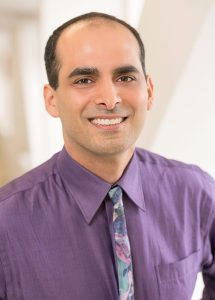
 Pooya Tadayon, Ph.D. physical chemistry ’98, will return in September to his roots at Oregon State University to advance semiconductor research and education. He brings practical experience from nearly three decades of working in industry to a dual role as executive director of semiconductor research programs for the College of Engineering and professor in the School of Electrical Engineering and Computer Science.
“I’m interested in solving problems that bring value to the semiconductor industry with real-world solutions, doing our part to close the workforce gap by training the next generation of engineers and technicians, and helping maintain the cycle of innovation in the industry,” Tadayon said.
Tadayon started his career as a test engineer at Intel. Over the next 27 years, he held various leadership roles, culminating in his position as an Intel Fellow and director of assembly and test pathfinding. He retired from Intel in 2024 and is currently vice president of packaging, test, and platform engineering at Ayar Labs, a startup at the forefront of co-packaged optics.
Tadayon is widely recognized for his breakthrough work in semiconductor test and advanced packaging technologies, including numerous inventions in test interconnect and thermal technologies, 2.5D/3D packaging, and co-packaged photonics solutions. His contributions have significantly shaped the semiconductor industry’s roadmap for high-performance, cost-effective manufacturing.
“Pooya brings years of experience developing leading-edge semiconductor technology. This will provide an advantage for our students and current researchers as we expand our use-inspired research collaborations with industry and the federal government,” said Tom Weller, the Michael and Judith Gaulke Chair in Electrical Engineering and Computer Science.
Collaborative solutions for semiconductor issues
Identifying the grand challenges for the semiconductor industry is Tadayon’s priority. He will start by leveraging industry contacts to identify the key technical barriers that researchers can help industry surmount. His next step will be finding the right experts in the academic community to address those challenges.
“Many people don’t realize that problems in the semiconductor industry require an interdisciplinary approach,” Tadayon said. “I’ll be looking to pull in folks from many departments to solve some of these problems, including chemistry, physics, and the biological sciences.”
Tadayon also plans to look for collaborators beyond Oregon State. His vision is to create a West Coast hub of researchers and industry partners, working together to secure funding for projects that can advance technology for applied solutions.
With so few universities focused on packaging and test, Tadayon sees huge potential for Oregon State to take the lead.
“Packaging and test are becoming more and more important because of the way semiconductors are being manufactured,” he said. “This is a great opportunity for Oregon State to build the infrastructure, build the expertise, build the ecosystem, and build the partnerships to drive a semiconductor agenda and advance the industry.”
Comprehensive team drives semiconductor innovation
Oregon State is leading two large consortiums that aim to stimulate economic development by boosting innovation and commercialization of advanced technologies: the FAST Regional Innovation Engine and Corvallis Microfluidics Tech Hub.
Earlier this year, the university announced its hire of Christie Dudenhoefer, formerly at HP, as executive director of semiconductor economic development and the Corvallis Microfluidics Tech Hub’s regional innovation officer.
“I’m looking forward to working alongside Pooya, combining his research perspective with my economic development perspective, to collectively move the ball forward for Oregon and the semiconductor industry,” Dudenhoefer said.
Rebecca Robinson, associate vice president for economic development and industry relations is heading efforts to develop collaborations across campus and with regional partners to build strategies and capacity at Oregon State to support innovation, talent development, and economic growth across priority sectors, including semiconductors.
Tadayon’s insight into how industry works will help Oregon State’s broad effort to strengthen partnerships with regional semiconductor companies.
“I have an understanding of how companies adopt new technology and go from lab to fab, where their pain points are, and who they want to hire,” Tadayon said.
Do you have a story for The Advocate? Email editor@corvallisadvocate.com