

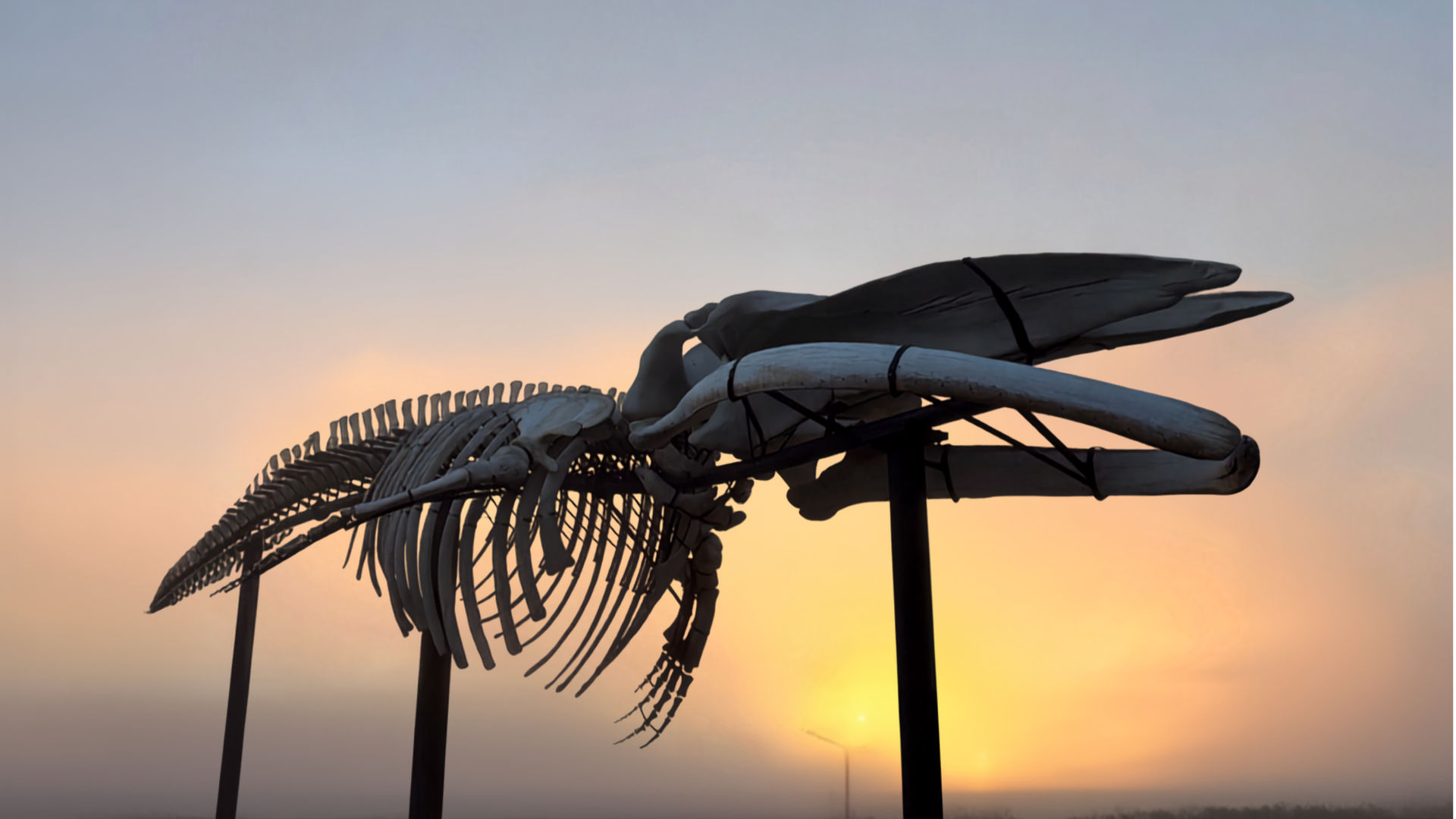
There’s something about the possibility of walking under such a great beast’s bones that gives me the willies in a good way.
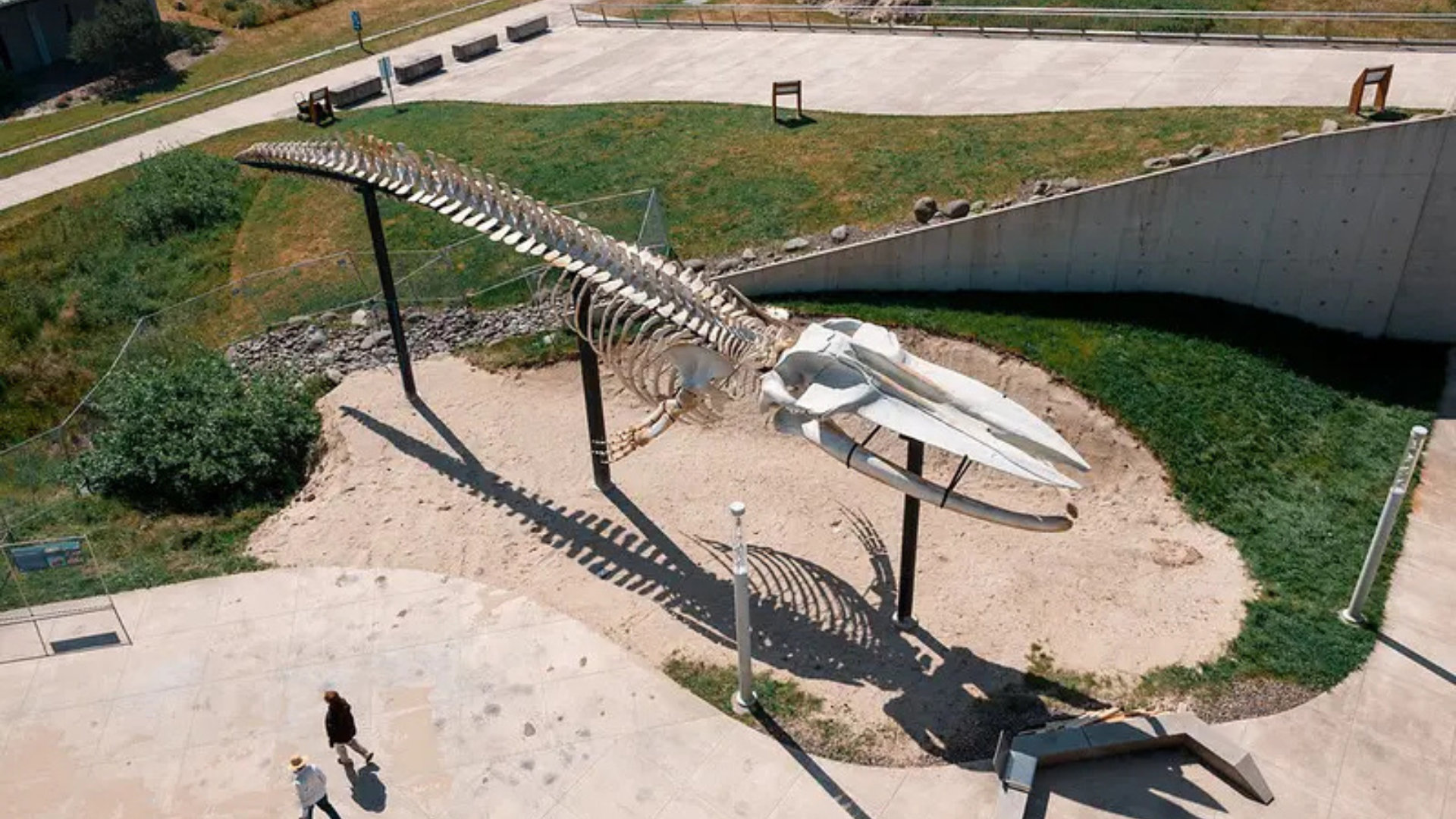
Nearly eight years after writing these words for a short Corvallis Advocate article, I find myself reading them again, flushing at the face and chuckling under my breath at my younger self’s gall. I am sitting on a cement bench near the entrance of the Gladys Valley Marine Studies Building on Oregon State University’s Hatfield Marine Science Center campus, and before me are the bones of a 70 ft long blue whale, held 15 ft above the ground by a metal frame and pillars. Those willies I had predicted? While I might not use exactly the same word today, I know I’ve just had them, trying to comprehend the scale of this life form in front of me. In my estimation, it would take three of me laying side by side just to cover the length of the curved lower jawbone. The major rib bones are also longer than I am tall, as are the length of the bones that come together to form the pectoral fins. For a half hour or so, I witness other onlookers come and go, similarly sizing up the thing. They are white-haired and they are knee-high; they are chatty and they are quiet; they are taking pictures and they are soaking it in—present in this shared but independent experience. Somehow during this viewing, I get this déjà vu feeling: I think I’ve written about this before. I look it up, and there, still stored on the internet, those silly willy words.
Blue whales— Balaenoptera musculus— are the largest species on Earth, growing up to 80 feet long in the flesh. In their bodies, they hold hearts the size of a piano, I will read in later days after my first visit to the skeleton. The heart of a blue whale can crush a car. This particular factoid grips me. I can relate. There are moments when I can erupt in anguish at this or that unfairness in the world, times when I might misdirect words towards those close to me, who don’t realize the depth of my feeling until it appears on the surface. I read soon after: the tongue of a blue whale alone weighs as much as an elephant.
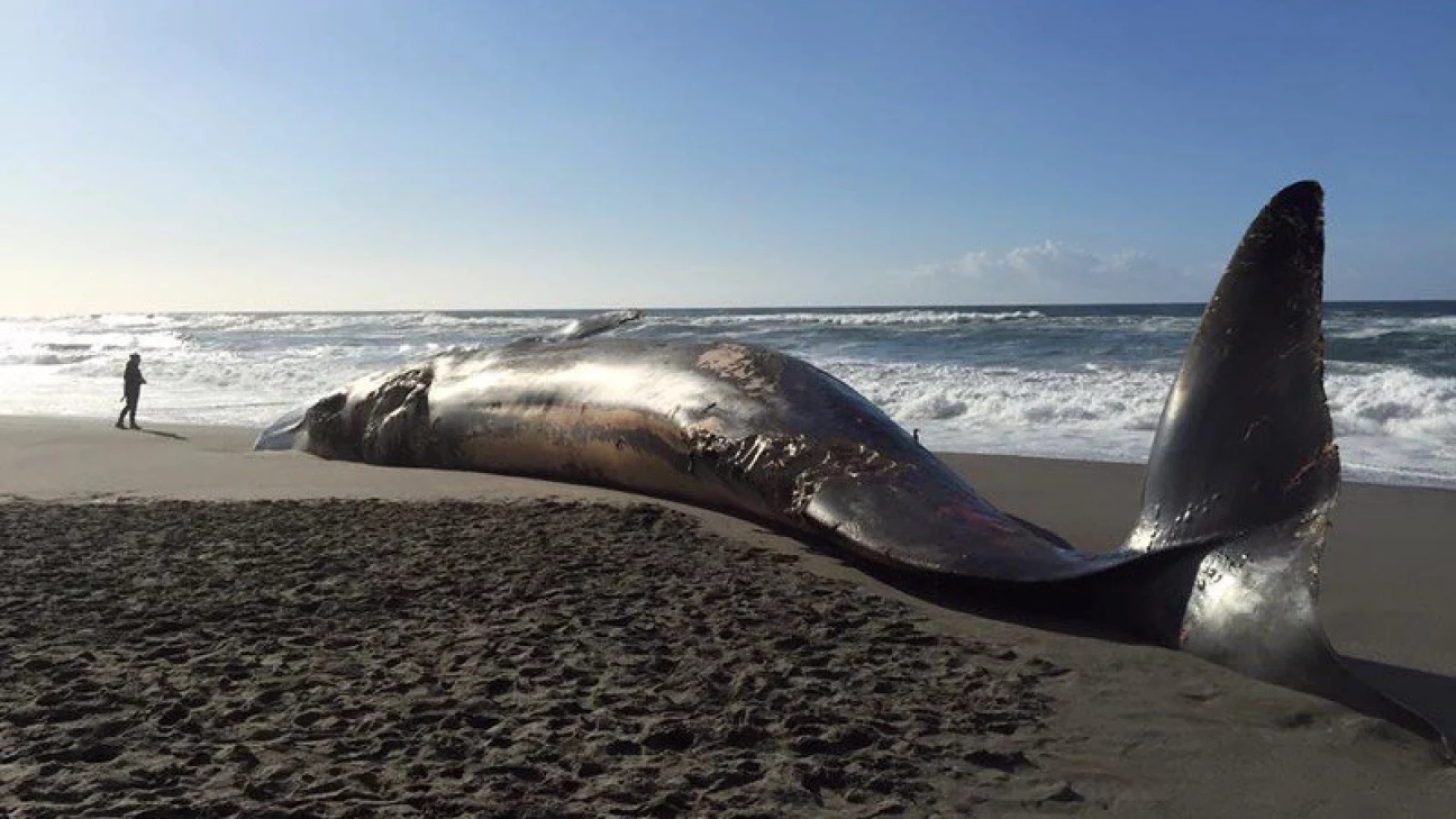
Odd, perhaps, this new relation to blue whales, when besides these bones, I have never seen nor expect to see the living breathing thing. Blue whales live primarily in deep waters, and tend to sink to even further depths when they die. On the Oregon Coast, it is most common to see gray whales from shore, the mist from their spouts catching the light just right, maybe some length of their back showing as they coil up to dive—if you’re lucky—their tail appearing just before a deeper descent. Gray whales seen in Oregon may be migrating on their way to and from their feeding grounds in subarctic and arctic Alaska and their calving lagoons in Baja California. Or they may be full-time residents of the Pacific Northwest, part of a group of more than 200 whales with different feeding behaviors than their tens of thousands of traveling relatives. Gray whales are also increasingly commonly seen visiting our shores in death. Since 2019, more than 900 eastern North Pacific gray whales have stranded in Mexico, the United States, and Canada. Within this year, the US West Coast has had 47 strandings, and in just Lincoln and Lane counties of Oregon, there have been 3, all occurring within spring’s northward migration time. As planktonic food webs in the Arctic alter with earlier melting and overall diminishing sea ice, migrating gray whales have appeared emaciated, with less calves in tow, and are traveling closer to shore to access alternative food sources on their journeys, putting them in harm’s way of ship strikes, entanglements in crab pots, and natural predators alike.
The blue whale whose bones are now displayed at HMSC first arrived on Oregon’s shores by stranding too. Near Gold Beach in 2015, this was the first stranding of a blue whale since the days of Lewis and Clark. The necropsy results pointed to malnourishment, a likely ship strike, and exposure to domoic acid (the neurotoxin produced by algae that causes shellfish poisoning) as causes. That, amidst all these challenges, a creature so ginormous still makes its home among us is awe inducing and place-putting to say the least. In front of this skeleton, we humans are so small it boggles the mind. How, in our puniness, did we become the creatures to have such an overproportioned impact on this planet?
Eight years ago, I had already experienced my fair share of climate anxiety, and the “unusual mortality event” of gray whales had just begun. Lately, I worry even more about how some advancing technologies are furthering our unhealthy relationships with nature. Those close to me know I am quick to cite the following numbers: while a standard search on Google uses 0.3 watt-hours (Wh), one using ChatGPT uses 2.9 Wh, and an AI-powered Google search uses 10 times more energy than a standard Google search. Individuals making these searches don’t see this increased energy usage in their monthly bills, because that extra energy is spent not at home, but at the data centers housing the computer servers and processors behind AI. We are distanced from the fact that the energy source powering data centers is often carbon burning fossil fuels, as most data centers are at least partially powered off grids which countrywide still rely predominantly on petroleum and natural gas, these land-based sources of fuel that historically replaced the use of whale oil. In addition to their energy use, data centers rely on water to cool their computers, using as much potable water in a year as hundreds of houses would.
When faced with the numbers above, most individuals I know recommit themselves to lessening their personal impact (I often recommend the use of alternative search engines and web browsers, such as DuckDuckGo and Firefox, that allow the ability to change settings if the user does not want AI-powered features. Or, to get in the habit of typing “-ai” at the end of each search). Yet, at larger scales, states and municipalities vary in their approaches to new builds of data centers, some even using taxpayer dollars to court tech giants for the largely impermanent economic gains to communities during center construction. I can’t understand this strain of thinking, inconsiderate of those without the means to insulate themselves from the impacts, and so wanting of convenience as to sidestep much contemplation. Is it possible, in this world, to relate more to another species than to the techno- and autocrats in power?
At the time I first visited the blue whale skeleton in early June, I also feared the impacts to communities locally and globally from the then-ensuing dismantling of an ocean observing network funded by the National Science Foundation, the Ocean Observatories Initiative, due to a process of “descoping” influenced by our current presidential administration. Off the coasts of Oregon and Washington, this meant losing the Coastal Endurance Array, which collects data to monitor ocean health in a region that takes up less than 5 percent of the ocean’s surface area yet contributes a quarter of the global fish catch. With issues such as hypoxia and ocean acidification happening in real time, this array provides important information to those engaged in keeping commercial fishing a sustainable industry. Fortunately, a bipartisan effort in the US Senate was enough to reverse this dismantling. I read about the reversal in relief a week later.
I think about the time after the beached blue whale was necropsied, when scientists turned into salvagers. They cut away flesh and connective tissue from the bones, which in turn were driven north and—in bags made from old fishing nets—lowered into Yaquina Bay by crane and weighted to the bottom. For three years, crabs and other critters ate away the remaining tissue from the bones. Then, the bones were retrieved again to remove 150-200 pounds of whale oil so that the bones could be more easily articulated in its natural shape, a process that took another three years, after a pause in the whole operation in the early years of the coronavirus pandemic. All these years of work and planning, and the skeleton got put up in just six days.
While we don’t know much about the life of the blue whale that now graces Newport, we do know of the value it is providing in its’ death. Although I imagine in the future I may become desensitized, to some extent, from the awe these bones inspire, a month after my first visit, I am told by my partner and his colleague, who both work in a nearby building, that the number of visitors to the skeleton each day hasn’t let up. People want to see this giant, and I think, to feel seen in this tangible scale of difference.
On a walk on the 5th of July, I find myself at Newport’s Don Davis Park, in a gazebo overlooking the Pacific Ocean. From the posts that support the roof are more than dozens of length of twine strung across, with clips attaching postcards to them. These postcards have been made into works of memory, contemplation and inquiry by local artists who answered a call out form the organization Postcards to the Future and the Coastal Art Guild on what America 250 means to them. It is affirming to see the minds of others more prone to grappling with than celebrating our nation’s history and current trajectory. One posits that in the aftermath of Anthropocene, tardigrades— the eight legged, microscopic “water bear” capable of surviving extreme conditions including a trip to space— will be the first to crawl out of the resulting nuclear muck. In the center of the postcard is a cut out of a tardigrade, with a speech bubble asking, anybody got a flash drive?. Another postcard depicts whale bones of a different species than have been occupying my mind. In a triptych, a pair of orcas are shown first as thriving living beings swimming, then as suffering while contending with pollution from smokestacks and plastic, and lastly as bones heaped up on a yellow sand beach. Amongst the anticipated wreckage, it is restorative to see that included in the display are also watercolors of the official bird species of each state, postcards that pair visual art with haiku, and other natural landscapes that remind one that even with all the losses of the last 250 years, there is still so much alive and worth trying to save.
On the windowed wall of the gazebo is the invitation to make your own postcard with provided art supplies. I take a seat in front of the horizon and pull out my phone for the picture of the blue whale skeleton I’d taken a month ago. In pencil and pastels, I try to do justice to its form and scale, then color the background in marine tones streaked with purples, golds and fuchsia. I want to live in a world of possibilities. Sitting here in front of the ocean, with warm strangers beside me making art, and the other visitors to the blue whale skeleton still in my mind’s eye, I think maybe I do. I look up the lifespan of a blue whale, and learn they live about as long as humans do, at 80-90 years. I do some rough math, and find in 250 years, about 13 generations of the largest animal on earth might have lived. I write this on the back of my postcard and bring it to the event organizers, who help me find one of few remaining empty clips on the string to join the others.
On that first visit to the blue whale skeleton, I remember how it was a squeal from a child still in the throes of their delight that brought me out of my existential spiraling and back to the hulking rib cage in front me—us. The size of the heart that thing must have carried. In the distance that day I could hear the metronomic blaring of the Yaquina bay jetty fog horn, and the memory of that rhythm is enough for me to imagine how that blue whale’s heart once beat. How those that see its remains might leave and go on with our days.
Ari Blatt regularly contributed to The Corvallis Advocate from 2018-2022. Her short stories and poetry can be found in Cirque, SHARK REEF, Thimble, and Eleventh Hour literary journals. She is a co-founder and editor for Tethered Literary. 
Do you have a story for The Advocate? Email editor@corvallisadvocate.com