

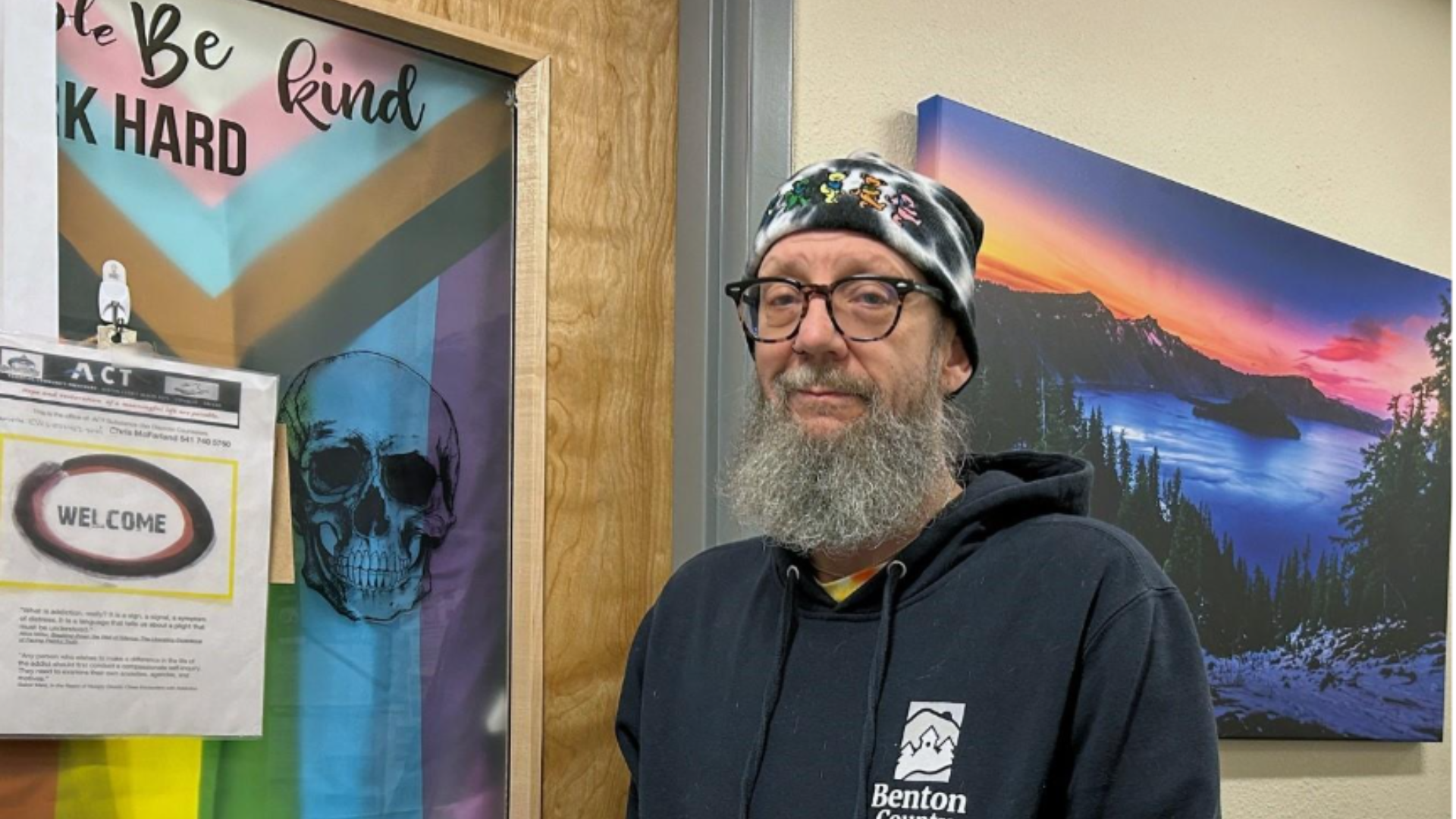
 Today, Chris McFarland is a certified alcohol and drug counselor, a mental health professional that is working for the Benton County Health Department, Behavioral Health Division. But the path that led him there was not easy. It was shaped by hardship, resilience and a deep understanding of what it means to live on the margins.
McFarland now serves on the County’s Assertive Community Treatment team, or ACT, providing intensive, community-based behavioral health and substance use disorder services to individuals with serious mental illness—many of whom are experiencing homelessness and repeated contact with crisis and emergency systems.
The work is demanding and deeply personal. For McFarland, it hits close to home.

Clients allow ACT team members into the most vulnerable parts of their lives, McFarland said, sharing fears, losses and hopes that are often hidden from the rest of the world. He said one of the things he is most proud of is when clients tell him they finally feel heard, respected and treated like a person, not a diagnosis or a case file. Hearing that, he said, is a reminder that showing up consistently and leading with empathy are what truly matters.
McFarland joined the U.S. Army in 1986 as a “homeless 17-year-old high school dropout”, hoping to find direction and stability. With limited options, he served as a light infantry soldier with the 1st Battalion, 87th Infantry Regiment, 10th Mountain Division. He completed basic and advanced infantry training at Fort Benning, Georgia, and was stationed at Fort Drum, New York which is known for some of the Army’s toughest training conditions.
McFarland said it left a lasting impact.
“The military taught me how far I can push myself, physically and mentally,” he said. “It taught me discipline, how to focus, how to take care of the person next to you, and that ‘no’ or ‘I can’t’ isn’t an option when something needs to get done.”
After leaving the Army, McFarland’s life took a difficult turn. He spent more than a decade cycling through homelessness, substance use, incarceration and violence, ultimately serving time in prison from 1997 to 2000. Those experiences, he said, now inform how he approaches his work on the ACT team.
“I’ve lived the chaos that many of our clients are living,” he said. “I know what it’s like to be stigmatized, discarded and forgotten. Those experiences didn’t break me—they shaped me.”
McFarland initially pursued a degree in psychology, later shifting to public health, believing he did not want to work as a counselor. That changed during an internship at a residential drug and alcohol treatment facility for adolescents.
“That experience changed everything,” he said. “I realized I didn’t just enjoy counseling. I was good at it. More importantly, I realized I could use my lived experience to support people who felt invisible.”
On the ACT team, McFarland works where clients are, be that in shelters, on the street, in hospitals or navigating court and crisis systems. The model emphasizes relationship-based care, harm reduction and long-term engagement.
Meghan Carlson, a mental health professional with the ACT team, said McFarland’s lived experience and openness about his journey have had a lasting impact not only on clients, but on the team itself.
“Chris’s willingness to share his lived experience with us as clinicians has really changed how many of us approach client care,” Carlson said. “He has helped reshape how our ACT team functions, and in my 12 years working with this team, I can honestly say it’s been for the better.”
That impact is reflected in how he works with clients day to day.
“Chris meets people exactly where they are,” said Carlson. “He listens without judgment, shows up consistently and never loses sight of the person behind the diagnosis.”
County Administrator Rachel McEneny, who has spent time in the field observing McFarland as he worked directly with clients, said his approach reflects the values Benton County strives to uphold.
“Spending the day riding along with Chris and his colleagues in the field was a powerful and important experience for me as county administrator,” said McEneny. “Their work takes them everywhere from the correctional facility to city parks, the hospital and the Corvallis Daytime Drop-In Center. The experience underscored the difficulty and complexity of the roles Chris has to juggle. It requires unique skills, compassion and understanding.”
McFarland said working for Benton County feels like a culmination of everything his life has taught him.
“After living so many years in survival mode, being able to serve my community and help people find stability and dignity is incredibly meaningful,” he said. “This work feeds my soul. I honestly believe this is exactly where I’m supposed to be.”
Do you have a story for The Advocate? Email editor@corvallisadvocate.com