

Wildfire smoke is a growing risk for wine grapes in Oregon and across the West. When smoke reaches vineyards near harvest, grapes can take in smoke compounds that later affect wine flavor and aroma. In bad years, growers and wineries may not know whether a crop is worth picking. That uncertainty can lead to major losses and ripple effects for rural communities.
In response, researchers in Oregon State University’s College of Agricultural Sciences and Oregon Agricultural Experiment Station are testing a spray-on coating that could be applied to grapes before smoke arrives. The goal is simple: Create a thin layer on the grape skin that helps keep smoke compounds out.
In a 2023 study, published in the Journal of Agricultural and Food Chemistry, the research team tested several coating recipes made from plant-based fibers and a natural compound called chitosan. The researchers also used a custom device to see whether smoke compounds could pass through the coating.
They focused on three smoke-related compounds that are commonly used as markers in grapes and wine. Some coatings did a better job than others. Coatings that included chitosan were better at keeping two of the compounds from passing through. All the coatings tended to trap a third compound. In a vineyard test on Pinot noir, the coatings did not change berry size or weight.
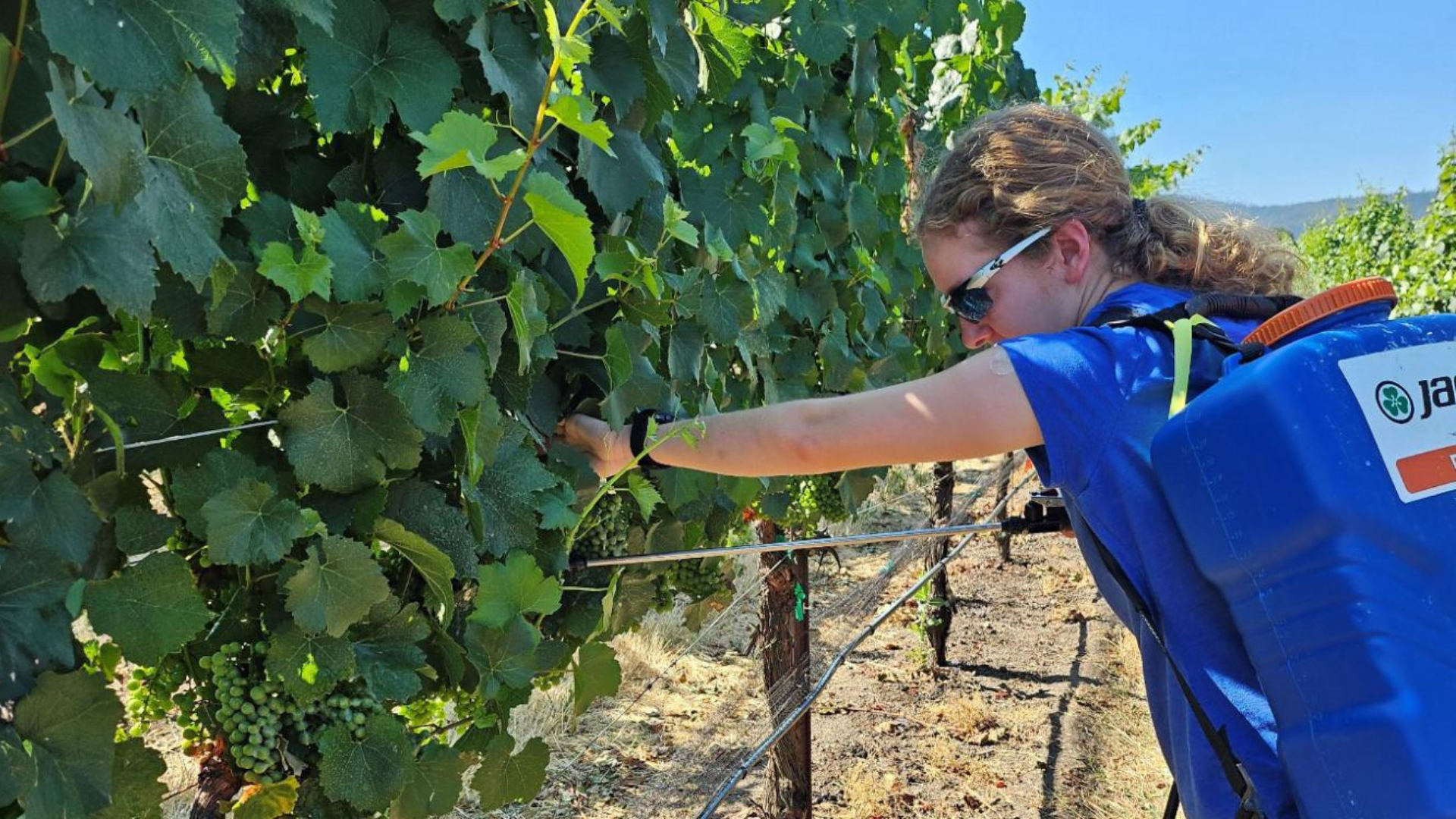
One chitosan-based coating was linked to higher levels of natural color compounds in the grapes. The smoke during that season was too light to confirm how well the coatings work under heavy smoke. The researchers determined more testing was needed.
A 2025 follow-up study, published in the Journal of Food Science, tested updated coatings and looked more closely at timing. The researchers compared different mixes of the same two main ingredients. They also ran a controlled test on table grapes and found a caution sign. In that test, some coatings were linked to higher levels of smoke compounds inside the grapes. That suggests some coatings may soak up smoke compounds and allow some to move into the fruit. That is not the result growers want.
The 2025 study also included field trials with Pinot noir under different smoke conditions. In grapes exposed earlier in the season, the coatings lowered two smoke markers by a few parts per billion. In grapes exposed closer to harvest, the coatings lowered another smoke marker by about 1 to 2 parts per billion. They also lowered one “bound” smoke marker by up to about 8 parts per billion.
Across these trials, the coatings did not change grape size or basic fruit measures such as sugar and acidity. Results were mixed, though. The researchers said natural variation in smoke exposure and grape response made it hard to draw firm conclusions. They recommended more work to improve coverage and test the coatings under more consistent smoke conditions.
For the wine industry, the research offers progress and clearer guardrails. It shows the approach may help in some situations, but it is not yet a dependable tool. It also highlights why “blocking” smoke is the best-case outcome. If a coating soaks up smoke compounds, those compounds might still end up in the grape.
For the public, better options for managing smoke risk could help stabilize a high-value sector that supports jobs, tourism and rural economies, while reducing uncertainty for growers and wineries during severe wildfire seasons.
Funding for this work was provided by the Oregon Department of Agriculture Specialty Crop Block Grant (ODA-21013-GR) and by the Specialty Crop Research Initiative grant (2021-51181-35862; project accession 1027470) from the U.S. Department of Agriculture National Institute of Food and Agriculture.
By Jooyeoun Jung and Yanyun Zhao
Do you have a story for The Advocate? Email editor@corvallisadvocate.com