

 Oregon State University researchers will officially be part of American history for their innovative and collaborative approach to COVID-19 testing and wastewater monitoring in the early days of the pandemic, thanks to recent StoryCorps interviews that are now included in the Library of Congress.
The interviews provided an opportunity for the interdisciplinary team of researchers to revisit and marvel at the ways OSU’s strengths aligned to build the TRACE-COVID-19 project and successfully measure community prevalence of coronavirus strains, especially amid the uncertainty of early 2020.
“We’ve all sort of moved on, and you often think that what you know now is what you knew then, but that is absolutely not the case,” said Jane Lubchenco, OSU Distinguished Professor in the College of Science and one of TRACE’s principal investigators. “We stood up very, very rapidly a complex system to deal with a very specific problem, and we were able to mobilize the people, the finances, the equipment, and the public understanding and willingness to participate, that drew on all of OSU’s assets.”
Today, TRACE has evolved into a sustainable forecasting system for infectious diseases in Oregon, tracking and predicting seasonal epidemics of influenza, COVID and RSV. Leaders hope to expand it into a national coordinating network for city-level monitoring of respiratory epidemics.

“Our vision is to do for infectious disease forecasting what NOAA does for weather: continually integrating local measurements into forecasts that are actionable and scientifically informative,” said Ben Dalziel, associate professor in OSU’s College of Science and one of the TRACE founders alongside Lubchenco and now-Provost Roy Haggerty.
TRACE — “Team-based Rapid Assessment of Community-level Coronavirus Epidemics” — was conceived at OSU in early 2020 as “a public health surveillance project that will gather timely and lifesaving information that is essential to slow the spread of the disease.”
The nonprofit StoryCorps invited Lubchenco and Dalziel to record a segment in February 2026, and were so impressed by the example of a non-medical university activating its resources in a public health crisis that they wanted to hear more, Lubchenco said.
StoryCorps has now interviewed six OSU faculty who served as TRACE project leads or principal investigators: Lubchenco, Dalziel, College of Health Associate Professor Jeff Bethel, College of Science/College of Agricultural Sciences Associate Professor Katie McLaughlin, and College of Engineering professors Tyler Radniecki and Christine Kelly. The interviews join an archive of more than 700,000 recorded audio conversations housed in the American Folklife Center at the Library of Congress in Washington, D.C.
TRACE had two main branches: door-to-door individual nasal-swab testing on OSU’s Corvallis and Bend campuses and in the communities of Bend, Newport, Eugene and Hermiston, and analysis of wastewater samples in the same communities.
When COVID cases started popping up in the U.S. in early 2020, public health infrastructure was not equipped to process the volume of testing needed to understand the virus’s spread and potency. When Dalziel first approached Lubchenco and then-College of Science Dean Haggerty about an OSU-led project, the state of Oregon was struggling to deliver just 10 to 20 test results a day, and Dalziel knew OSU had untapped potential to assist.
So the team invited Section Head and Assistant Professor Justin Sanders in the Oregon Veterinary Diagnostic Laboratory, housed in OSU’s Gary R. Carlson, MD, College of Veterinary Medicine, to join the effort. The OVDL’s role in monitoring animal-based epidemics meant it was already prepared for the scale and speed required, and after a few months the lab secured the accreditation to run human samples on its own. Sanders oversaw the massive lab testing operation, which ultimately tested more than 300,000 samples.
As an epidemiologist, Dalziel knew that understanding the virus’s community prevalence was key to an effective public health response, but no one was doing that testing. That’s where Bethel’s expertise was critical: He designed a robust sampling design of neighborhoods and OSU campuses to give public health officials the information they needed to determine how widespread the virus was.
Huge numbers of students from all over OSU volunteered to go door-to-door, even traveling across the state to Newport, Bend, Eugene and Hermiston, teaching people to perform nasal swab tests and collecting samples to bring back to the lab.
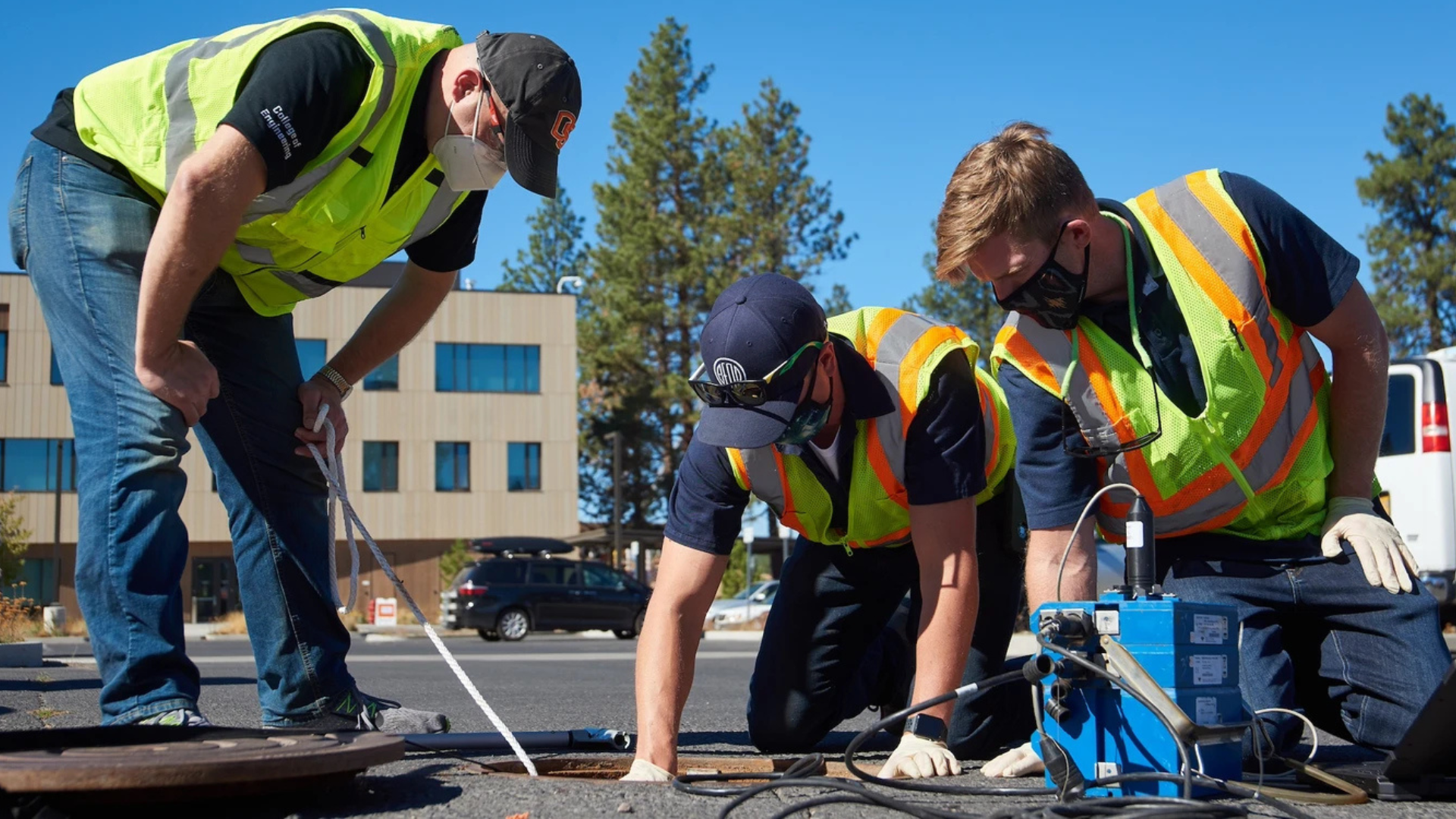
Meanwhile, Radniecki and Kelly were developing protocols and taking wastewater samples to spot trends in viral spread, sometimes before illnesses were widely reported in a given area. It was among the earliest major efforts to use wastewater testing to monitor a respiratory virus.
Not only did TRACE provide crucial real-time data to help public health officials identify hotspots in different communities, but by comparing the results of individual testing and wastewater sampling, researchers also validated wastewater testing as an accurate measure of disease prevalence. So in places where individual testing data was not yet widely available, researchers could still sample the wastewater to determine if specific COVID strains were present in a given community. In 2020, the CDC established the National Wastewater Surveillance System to focus on wastewater testing, Radniecki said.
The full TRACE team from 2020 is still listed online, spanning five colleges. Each leader brought a different area of expertise and professional relationships, and OSU’s status as an R1 research institution was crucial, Radniecki said.
“We need a statistician? We’ve got Katie. We need sampling design? We’ve got Jeff. Ben was doing infectious disease modeling. Jane knew how to rapidly stand up and manage complex teams and obtain funding. Roy brought credibility with OSU leadership. Really whenever we needed X expertise, we were able to find it on this campus,” he said.
Bethel is still in awe that they pulled it off, especially with balancing family and teaching needs on top of TRACE. But it was a university-wide effort, he said.
“We had a receptive audience, a willingness to pitch in from the entire campus,” Bethel said. “The land grant mission has a belief in service, in serving the community, and I think that permeates throughout the entire university.”
To listen to the four StoryCorps TRACE interviews, check out the following links:
- Jane Lubchenco and Ben Dalziel on the origin of TRACE, why it was needed and its overall goals and challenges, recorded Feb. 20.
- Lubchenco and Dalziel part two, recorded June 3.
- Katie McLaughlin and Jeff Bethel on the sampling design and statistical analysis, recorded May 15.
- Tyler Radniecki and Christine Kelly on their work with wastewater surveillance, recorded May 15.
Do you have a story for The Advocate? Email editor@corvallisadvocate.com