

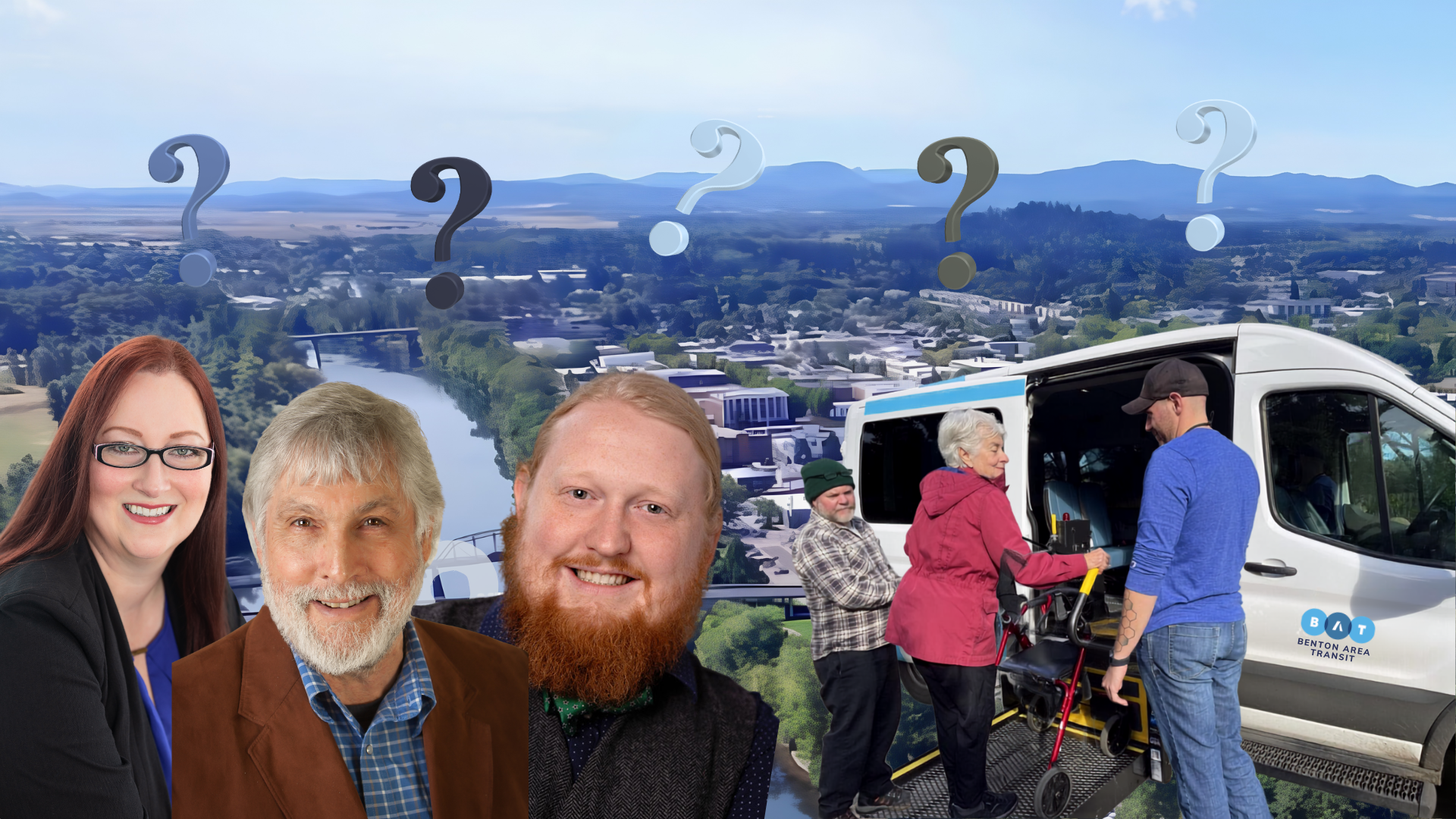
Diana Del Rio’s voice cracked as she tried not to cry when she spoke to Benton County commissioners March 17 about Dial-A-Bus services for people with disabilities.
“Dial-A-Bus is my freedom,” she said.
Del Rio told commissioners she fears county officials are going to tinker with Dial-A-Bus to where it will no longer provide the level of service she’s relied on for seven years. “They don’t need to be fixed,” she said. “They’ve been doing this very well for a long time.”
There are many vulnerable people in Benton County scared by what’s happening with their bus service. Like Del Rio, they come to commission meetings to express their fears.
“SOME PEOPLE DON’T KNOW WHAT DIAL-A-BUS DOES”
Anne Thwaits, a Benton County public information officer, said their fears are often exaggerated – possibly stoked by employees at Dial-A-Bus itself.
Dial-A-Bus is a private nonprofit organization that contracts with the county government to schedule rides and provide drivers for people with disabilities. The buses are owned and maintained by the county through federal funding.
That funding comes with strings. Data needs to be reported. County officials are required to reboot the contract for driving and scheduling services every five years through a competitive bidding process. To her recollection, Thwaits said, Dial-A-Bus has been the only organization who has responded to the request for bids since the service started in 1975.
While she couldn’t confirm that recollection, she added that Dial-A-Bus has definitely been the only applicant since Gary Stockhoff became the county’s public works director in 2019.
The flow chart can be confusing.
Dial-A-Bus is not a county agency. Its employees lease offices from the county, but they are not government employees.
“We run the Benton Area Transit service with our equipment,” Thwaits said. “We own all the buses. Our fleet staff over at public works does all the maintenance on the buses. We do all of that. Dial-A-Bus just provides scheduling and drivers to run our program, using our equipment.”
County officials are considering taking over the driving and scheduling operations as well. If that happens, Thwaits said riders will still receive the same level of service. She added that nothing has been decided yet.
Commissioners hired Kittelson & Associates Inc. of Portland for $150,000 early last year to look at the program, identify weak spots and provide options. Kittelson staffers spent most of the year looking at back-end operations. Their assessment didn’t include Dial-A-Bus staff or riders.
That upsets many of the riders.
“Sounds like some people don’t know what Dial-A-Bus does,” Del Rio told commissioners March 17. “Maybe before changing something, that kind of information is important.”
Thwaits said there was no need to talk to drivers and riders.
“DIAL-A-BUS CAN ABSOLUTELY KEEP APPLYING”
“We weren’t looking at services provided to the public,” Thwaits said. “We were looking at back-end operations — data and budgets and grant applications and those sorts of things. The riders don’t know anything about that.”
Public input is still important, she said. “That’s later in the process.”
Kittelson’s team came up with three different alternatives. One was staying the course with Dial-A-Bus. Another was the county taking over the service. The third option was a mixture of the two. Kittelson’s team recommended the second option — literally putting the county in the driver’s seat.
The county running the service would ensure the service is more efficient and effective, and county officials could monitor compliance issues more directly, Kittelson officials said in their report.
Commissioners approved sketching out a plan Dec. 2 for taking over Dial-A-Bus services. A draft of the plan is expected by the end of the year with commissioners possibly making a decision on it early next year. Nothing would change until at least July 1, 2028 when the existing Dial-A-Bus contract expires.
Kittelson’s report concluded a county-run program would cost $2.3 million per year while taking in $2.48 million in revenue for a net balance of $178,700.
“Self-performing best aligns with Benton County goals and can be provided without a reduction in service,” the report concluded.
The county pays Dial-A-Bus $90,116 per month at present. The contract “represents a fraction of the operational costs associated with delivery of county transportation services,” Thwaits said. She added Dial-A-Bus generates almost no revenue itself.
Members of the Benton County Statewide Transportation Improvement Fund Advisory Committee voted unanimously March 2 against the county spending money to investigate taking over services from Dial-A-Bus.
The vote was symbolic. County officials already paid for the analysis and didn’t need to spend more money to continue their evaluation.
Commissioners directed County Administrator Rick Crager April 14 to draft a more specific proposed contract when the bidding process opens in 2028. Requests for proposals for the next contract will be issued next year.
“What the county is doing right now is we’re developing a draft implementation plan for what it would take to deliver the service ourselves without a contracted vendor and what would we need to change to improve our contract and improve our service delivery if we continue to use a contracted vendor,” Thwaits said.
No decision will made until the end of this year.
Dial-A-Bus is not automatically out, said Thwaits. “Dial-A-Bus can absolutely keep applying and submitting proposals, but we have to review all proposals objectively,” she said.
“SERVICE IS NOT GOING AWAY”
Many people don’t seem to understand the objective part of the process, she added.
“We’ve had a lot of people show up unsolicited at board of commissioners’ meetings to give public testimony,” Thwaits said. “They’re all Dial-A-Bus customers, family members or riders who are saying, ‘Don’t get rid of Dial-A-Bus.’ Unfortunately, we can never guarantee to them that we’ll keep Dial-A-Bus because we’re required by law to do a competitive bidding process starting next year.”
She stressed that people with disabilities will still have access to transportation.
“Benton Area Transit service is not going away,” Thwaits said. “It’s going to be exactly the same service, but the drivers might be different. There will be very little observable difference. We’re going to have the same routes and same hours of operation.”
Kristen Jocums questions the county’s own objectivity.
Jocums is a mediator and lawyer who serves on the board of Dial-A-Bus and uses the service herself because she is blind. County officials may say nothing has been decided, said Jocums, but they give every indication they are determined to take over Dial-A-Bus services.
Such a takeover would be a mistake, she said.
“BEST PARA-TRANSIT SERVICE I’VE SEEN”
“Counties across the country that do this self-perform style pay close attention to rules and regulations, but they’re not very client-centered,” Jocums said.
Dial-A-Bus always puts its riders first, she added. “It’s an incredibly client-centered service,” she said. “It’s probably the best para-transit service I’ve seen in the country, and I’ve lived in several different states.”
Thwaits said county officials have to take any problems they identify with Dial-A-Bus extremely seriously.
“If our program is found out of compliance with federal requirements, we could lose our funding completely,” she said. “Then the service just goes away. Dial-A-Bus doesn’t go away because it’s an independent nonprofit, but we would no longer have the funding to provide transportation for people who are elderly or disabled.”
Jocums said county officials should avoid pointing fingers at Dial-A-Bus when some of those fingers are pointing back at them.
“Some of these vehicles that have been purchased are huge buses that take a lot of strength to get up the stairs to get in the buses,” she said. “The folks who are ambulatory who don’t need the wheelchair lifts have a difficult time.”
This is not just a problem with brand-new buses, she said.
“Most of the vehicles the county has been buying in the past five years have made it more difficult for riders to get on and off the bus and have a safe and comfortable ride,” Jocums said. “This is yet another example of why riders of special transportation are literally scared for how the county’s ill-advised self-perform model is likely to proceed if it is actually implemented.”
Jocums added the county’s statements all boil down to the government wanting to take over Dial-A-Bus services – ignoring that it could cost at least $800,000 more for staffing and other factors. If county officials truly looked at the service from the perspective of the riders, she said, they would find Dial-A-Bus provides Cadillac service at Nissan prices.
“THE COUNTY ISN’T AWARE OF CLIENT NEEDS”
“The concern that our local folks have is they’re trying to drastically change the model of delivery that has been the gold standard here,” Jocums said. “The county is making these changes without talking to the riders at all. The county isn’t aware of client needs. They aren’t aware of what the clients like, or maybe dislike, about Dial-A-Bus.”
Jocums likes Dial-A-Bus a lot.
“You can schedule with them on the half hour,” she said. “I know that sounds like a big window to people who drive their own cars and can just jump in and go, but other systems have very difficult scheduling systems. You can ask for a particular time, but they have like an hour window to get to you.”
She’s particularly concerned about losing Dial-A-Bus drivers.
“I love the drivers at Dial-A-Bus,” she said. “They’re super-kind folks, and they will assist you in any way you need. In other systems, the drivers are there to operate the vehicles, and they don’t take into consideration the human side.”
“LITTLE DID I KNOW I’D END UP WITH A BAD BACK”
Lindy Burgess, a retired teacher, also worries about the fate of Dial-A-Bus.
Her late husband was a Dial-A-Bus driver. “Little did I know that I would end up with a bad back and have a 10-hour surgery,” she told commissioners April 7. “I needed transportation, and I found out how wonderful Dial-A-Bus was in taking me to my doctor appointments, taking me to my physical therapy, just taking me wherever my needs were in Benton County.”
She still knows several of the drivers personally. “Many of them are teachers that I taught with in Philomath and around Benton County,” she said.
Thwaits said many people are responding to misinformation. “There’s been a lot of confusion in the county,” she said. “We’ve had people saying that Benton County is trying to take over Dial-A-Bus, which is not true.”
Nonetheless, she added, some facts are unavoidable.
“The contract says that we’re supposed to get annual reports,” she said. “We’re supposed to get some very specific data from our contracted vendor that we can use to report to the federal government as well as plan for the future. We’re not getting the amount or the consistency of data reported to us that we need.”
Thwaits declined to elaborate on the specific data Dial-A-Bus is failing to provide and what reports the organization is not filing.
“IT’S BEEN A NECESSITY, NOT A LUXURY”
Taking over Dial-A-Bus services is not the remedy, Jocums said.
“We’re trying to help the county see that doing that self-perform model is not going to be the best way to go,” she said. “It’s going to create a less client-centered system, and it’s going to cost the county more to run through a self-perform model. Dial-A-Bus has been able to keep costs very low. We’re hoping the county will realize that Dial-A-Bus is providing a great service.”
Thwaits said people will have more opportunities to share their thoughts, public engagement sessions are upcoming.
One of the speakers will likely be Christina Steiger, an ardent Dial-A-Bus supporter. She’s taken Dial-A-Bus three to five times a week since 2021 after two neurosurgeries.
“I am ambulatory today largely because Dial-A-Bus services gave me consistent access to infusions and physical therapy,” she told commissioners March 17.
Her mother also depends on the service to receive treatment for advanced cancer. “It supports the stability and the treatment of our entire household,” she said.
Arona Rosegold has been using Dial-A-Bus for 37 years since she had a baby.
“It’s been a necessity, not a luxury, in my life and many other people’s lives,” she told commissioners at the same meeting. “The people I’ve worked with have always been compassionate and helpful with Dial-A-Bus, and it’s made a great deal of improvement in my life — kept me independent.”
PUBLIC ENGAGEMENT DATES
A public engagement session is set for 4 pm, Tuesday, July 23, at the Kalapuya Building, 4500 SW Research Way. Another meeting Tuesday, Sept 15, at the Kalapuya Building will also take public comments. A time for the meeting has not yet been set.
By Tom Henderson
Do you have a story for The Advocate? Email editor@corvallisadvocate.com