

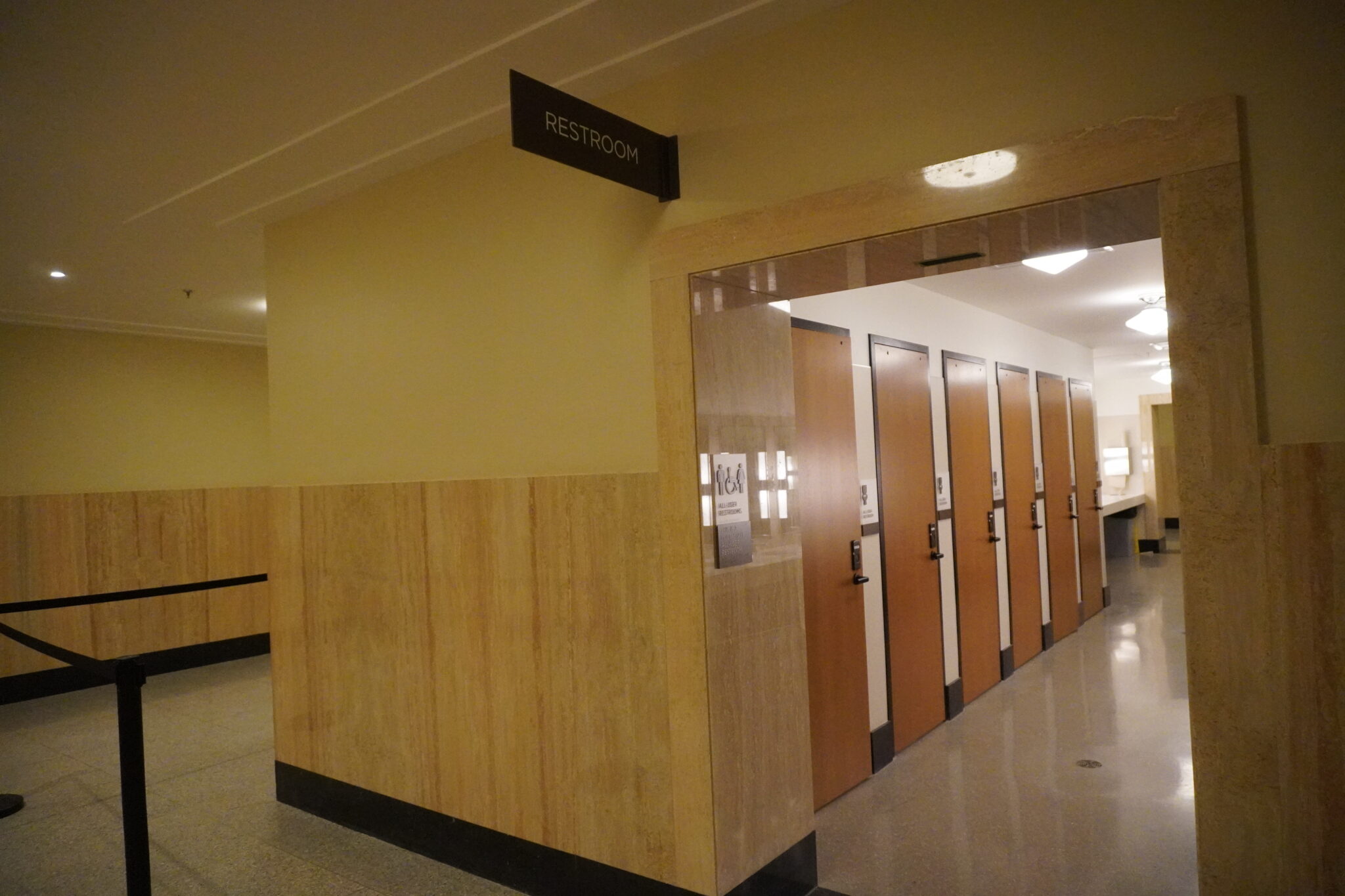
In two newly-opened halls hugging the rotunda of Oregon’s Capitol, a set of wooden doors stand side by side, wall to floor. Mirrors with sinks and bright lights radiate in the background, with a sign on the front entrance reading: “This is a multi-stall, all-user restroom.”
The first-floor bathrooms are a new addition brought forth by a decade-long, $598 million construction project aimed at improving accessibility and safety. The overall project, which included redoing the building’s foundation to better withstand earthquakes, continues to inch toward its goal of completion for next year after the Capitol opened its doors to the public in late September.
The additional 16 gender-neutral stalls aren’t replacing other options for lawmakers and capitol attendees who prefer to use sex-segregated stalls or individual bathrooms. Single-stall units to accommodate disabilities or families with small children also remain. But when it came to maximizing the amount of bathroom space for all potential Capitol attendees, adding “all-user” restrooms appeared to be the most efficient, according to project director Jodie Jones.
“If you have to start splitting things up by male and female, and then accessibility and changing stations and family units and all of that, we just didn’t have enough room,” Jones said. “We kind of went to the drawing board and thought, ‘Well, what if we made several of them gender-neutral?’”
Oregon has historically positioned itself as a safe haven for LGBTQ+ rights, home to the nation’s first openly bisexual governor, one of its first lesbian governors and many political leaders who identify as members of the LGBTQ+ community.
Over the past few years, leaders in Salem have pushed to safeguard access to gender-affirming health care, prevent book bans and strengthen anti-discrimination protections. Those moves have galvanized polarizing walkouts and protests from lawmakers on the right.
The new bathrooms, however, have so far served as a rare area of common ground across political aisles at the center of the halls of power. The new capitol expansion was first open to the public in late September, yet to date, no Republicans or Democrats have issued press releases or statements in support or opposition to the new restrooms.
Restroom access experts told the Capital Chronicle the new addition would likely help in combatting the historical problem of unequal access to bathrooms that women, who on average need to use the restroom for longer, face compared to men.
They were unaware of any similar projects in any other state legislature across the nation, some of which have individual gender-neutral units alongside single-sex stalls or restrooms. A 2017 study from researchers at the Belgium-based Ghent University, however, found that a gender-neutral setup could reduce women’s bathroom wait times from over 6 minutes to less than a minute and a half.
“I would likely give it an A grade, because it solves a lot of problems that plague the gender-specific restrooms,” said Kathryn Anthony, a professor emerita at the University of Illinois at Urbana-Champaign’s School of Architecture. “Despite the fact that it was not intentional, the Oregon State Capital may now become a shining star among state capitols in the U.S., in part for this reason.”
The expansion project
Oregon already has laws ensuring that students and workers can use the bathroom aligning with their gender identity, including a rule that ensures an employer cannot ask a transgender person to use a gender-neutral restroom. In 2019, then-Gov. Kate Brown issued a sweeping pro-LGBTQ+ executive order asking stage agencies to establish at least one gender-neutral stall if possible while requiring the designation of single-stall bathrooms in state buildings as “all user” restrooms.
But the move to add the state legislature’s bathrooms did not result from a request from an official or lawmakers, Jones said.
“Because we were doing such a massive renovation to the building, when you start touching things, you need to start bringing other things up to code,” she said. “Other state capitals…if they haven’t actually touched and started renovating their buildings, they wouldn’t have to address adding more bathrooms.”
John Banzhaf III, a law professor at the George Washington University Law School and a national expert on bathroom access disparities, said he expects “to hear from people on both sides of the issue once the thing gets going.” But overall, he said many younger Americans appear to have less of an issue with sharing restrooms across gender identities.
“All of it, I think, is a matter of attitude and possible prejudices,” he said. “We’ve had tremendous changes over even the last 10 years in terms of traditional roles and expectations of males and females. We’ve had dramatic changes in terms of how we look at transgender issues. And I think probably, almost certainly, there is an age differential.”
The installation also comes after pushback to gender-affirming bathroom accommodations nationwide. In Congress last year, House Speaker Mike Johnson, a Republican from Louisiana, announced that he would bar transgender women from using women’s bathrooms in the U.S. Capitol, following the election of the nation’s first openly trans member of Congress, U.S. Rep. Sarah McBride, a Democrat from Delaware.
At least 15 Republican-led states across the country have enacted laws seeking to prevent trans people’s access to bathrooms in alignment with their gender identity in government-owned buildings.
In the meantime, support for some policies restricting transgender Americans’ rights has increased. A February 2025 poll released by Pew Research Center found that 49% of Americans favor or strongly favor requiring trans people to use public bathrooms that match their sex at birth, rather than the gender they identify with, while 26% oppose or strongly oppose. LGBTQ+ advocates often point to UCLA studies from 2025 and 2018 showing no link in policies allowing the use of trans people’s preferred bathroom to spikes in crime related to safety and privacy violations.
Mikki Gillette, a major gifts officer with Basic Rights Oregon, the state’s largest LGBTQ+ advocacy group, said efforts to restrict bathroom access do not just harm trans and nonbinary people.
In Florida, for instance, a Walmart worker said in March that she was fired from her job after reporting threats from a man who followed her into the women’s restroom and mistook her for a transgender woman. Parents with kids who are a different gender than them as well as other caregivers can also take advantage of the common area offered by the capitol’s new bathroom, Gillette said.
“This kind of policing just makes everyone less safe,” she said. “I think trans people go to the bathroom for the same reason that everybody goes to the bathroom, which is just to take care of their needs.”
When it comes to the capitol building’s model, there are still tweaks that could be made. The expansion project is now mulling adding doors to the bathroom’s main entrances with a glass panel. The goal, Jones said, is to ensure transparency for anyone who may be uncomfortable using a mixed-sex space, while also preventing noise from leaking into the rest of the building.
But the new bathrooms already have even some prominent conservatives offering praise.
Rep. Ed Diehl, R-Stayton, was among the Oregon House Republicans in June who unsuccessfully sought to force a vote on legislation that would have required Oregon schools to ensure school bathrooms and locker rooms are divided by students’ sex assigned at birth. He told the Capital Chronicle that he had consulted with other women about their comfortability with the new capitol bathrooms and that it “caught me off guard at first, but I think I’m fine with them.”
“It’s not like they put up (the) signs ‘all gender bathrooms for a gender-diverse society.’ They said ‘all user restroom,’ I’m fine with that,” Diehl said, chuckling. “All-user restroom — I like that.”
By Shaanth Kodialam Nanguneri of news partner Oregon Capital Chronicle
Do you have a story for The Advocate? Email editor@corvallisadvocate.com