

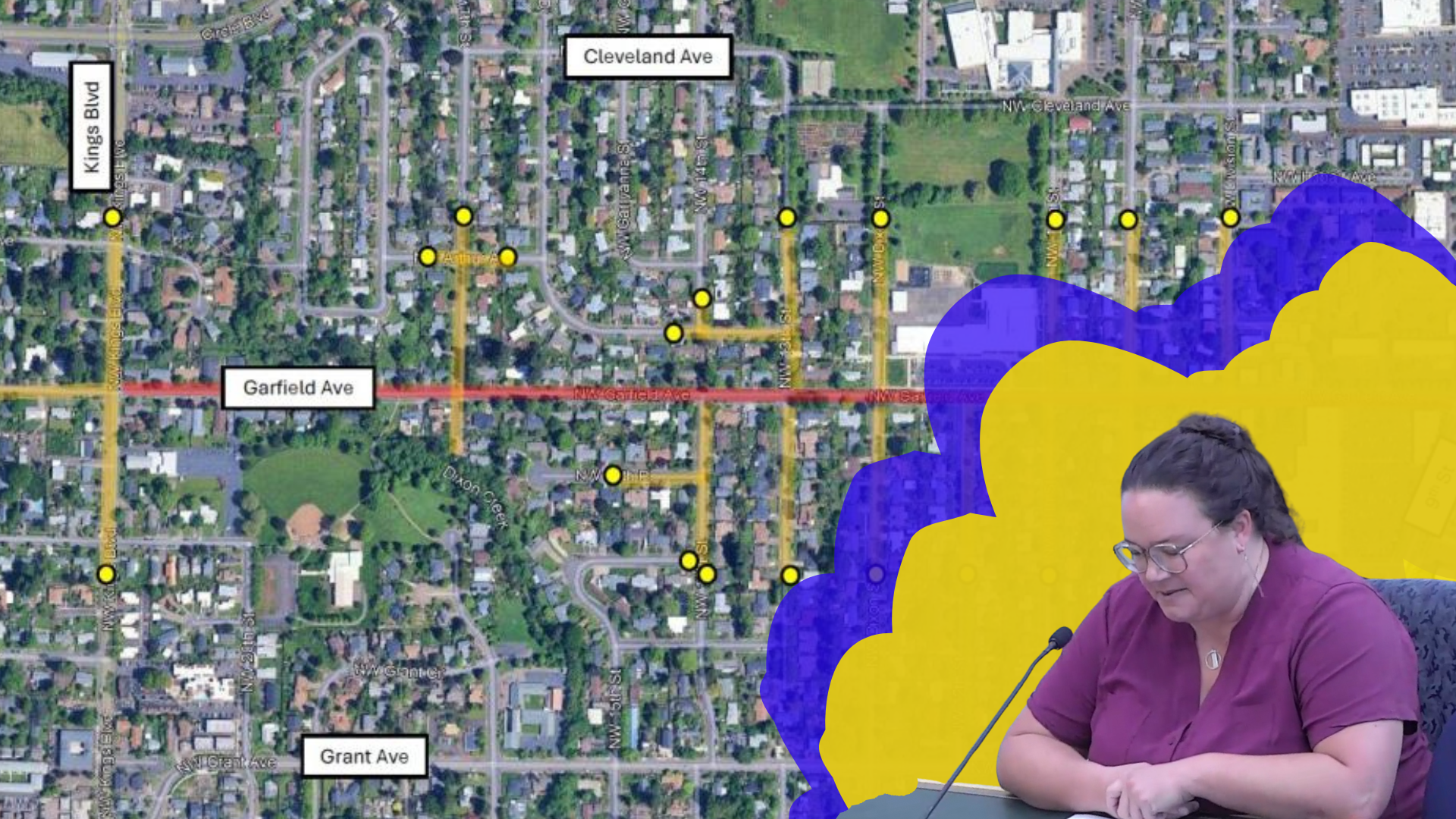
“We should never do this again, it was unintentionally, I think, difficult for the neighborhood, put some unnecessary stress on folks, and it was extremely time-demanding and consuming for staff,” said Jeff Blaine, Corvallis’ public works director.
Blaine’s candid summation, made at a City Council work session on July 23, came after months of work weighing possible changes along Garfield Avenue. More deeply it was about competing public goods, and what many Corvallis neighborhoods sometimes go through nowadays as the city grows and societal norms evolve in ways that can change how people live even if they’re not seeking that change.
In the instance of Garfield Avenue, the City staff had been weighing enhanced support for alternative transportation; space for new dedicated bike lanes that would have come at the cost of removing public parking in front of homes along on the street.
Ultimately, City staff recommended against the idea.
The goal, however, was laudable. Wendy Byrne, cyclist activist, advocates for a changing society. From an overreliance on cars, which could be a person’s largest expense only second to rent or mortgage payments, to the cheaper, more environmentally sustainable option of biking, while sill acknowledging the need for a “better transportation network that serves more people.”
Steve Starcevich, a friend of Byrne and fellow cyclist activist agrees and believes that the city deserves “praise for evaluating the ways we use the public commons.”
The environmentalist’s goals to reduce greenhouse gas emission and car dependency raise the importance of expanding bike lanes, which for him, could be a solution towards reducing climate pollution, “giving people more opportunities to have a healthy, active, lifestyle.”
But not everyone can take advantage of that. Garfield Avenue is lined by single-family homes and a few apartment buildings. Residents range from newly arrived immigrants to those that have aged in place. There are young children to be hustled from car to front door. There are folks that have aged in place. There are people with limited mobility that rely on services coming to them. They also rely on friends coming to see them – friends that may have mobility limitations of their own.
Donald Forbes is a Garfield resident and navy veteran; he lost his ability to walk after an intense car crash and is now wheelchair bound. He receives care multiple times a week. His caretakers are required to bring a lifesaving defibrillator with them to each appointment, rain or shine.
“This person has to be able to carry 50 pounds,” he says. And with the possibility of an added 600 feet, which is equal to two football fields, it may be an “unreasonable” request. He worried that if his nurses were put under these new conditions, they may only allow him to receive services at their facilities, a feat closer to climbing a mountain than going to the doctors for someone who isn’t disabled in the ways that he is.
Likewise, there are elderly people in the neighborhood that are no longer driving. Nena Bement hosts get-togethers in her home with longtime friends as a way of staying connected. But those friends, being also elderly, sometimes have their own mobility challenges, even if they can still drive. In those instances, losing parking in front of one’s house could have meant a friends that couldn’t visit, it’s a loss that could have been isolating.
Tori Geter, a Garfield neighbor, and Mental health professional, would agree with advocates for improvements to our transportation infrastructure. “We need public transportation,” she says.
Her envisioned future includes more jobs in Corvallis, less commuters, and more who can divorce their cars, allowing them to use the infrastructure we already have implemented. “If you want to get rid of cars, we need to first have the infrastructure that allows for that. We need to think about what all the people need, and all the diverse types of people and types of experiences,” said Geter.
The Time Tax
Dawn Warneking, neighborhood activist and a leader of the neighborhood’s petition efforts, reflects back to a May 5thth open house about the City’s plans, where she remembers feeling as though a “deeper discussion about what the real safety concerns is on the street, how can we make it better for all of us?”
For this community, ‘all of us’ looks like neighbors who are disabled, minorities being targeted currently by our federal government, apartment renters without dedicated parking, and neighbors like Nena Bement and Donald Forbes, Garfield residents who might have lost the invaluable experience of being enmeshed in a community.
Warneking submitted the neighborhood’s 250-signature petition to the City Council – it landed in the Council’s July 20 meeting packet. It was a community effort.
People living along Garfield worked and worried for months. They attended meetings, formed groups, and were present at City Council sessions. They committed time and energy that could have been otherwise spent, maybe on just living life.
That effort had an impact. The pubic works director was moved to publicly say things most public works directors wouldn’t usually say. There was an honorableness in that. But could this process have been cut short to save folks along Garfield some time and worry – maybe next time for the next neighborhood.
For Garfield Avenue
City staff met with the City Councilors at a July 23rd work session to discuss their recommendations. In essence, City staff is recommending that scheduled repaving and restriping maintenance be performed along Garfield between 9th and Kings without removing any parking.
They also noted there’s some possibility that bike lanes going in both directions could be added to just one side of the street, meaning there would only be need for one buffer space, and that would mean that parking would remain as is. Rory Rowan, the City’s transportation director, told the Council that staff would return with a proposal for that if it’s feasible, and if not feasible, they would just do the scheduled maintenance.
In short, Council will likely go with the staff recommendation, parking will likely remain as is.
Beyond Garfield
In a memo to Council, Rowan said the Garfield Avenue parking evaluation was used to test a draft procedure. He notes four staffers worked on the Garfield evaluation over six months and spent an estimated cumulative 150 hours.
He recommends only using this process again on a case-by-case basis, rather than as a default, writing, “Knowing the significant value neighboring properties typically place on on-street parking, staff felt a defined, data-driven, process with built in engagement was necessary to facilitate meaningful dialog around these tradeoff decisions.”
Rowan concludes, “Utilizing the draft procedure did not achieve the desired outcomes. In fact, while the intent was to create a framework that supported dialog with neighboring properties, it seemed to do the opposite. Community members were left unsettled for months and relationships between the City and residents were unintentionally strained. At the same time, staff resources were significantly impacted and other work efforts stalled to accommodate.”
By Campbell Grove. Editor-in-Chief Steven J. Schultz contributed to this article.
Do you have a story for The Advocate? Email editor@corvallisadvocate.com