

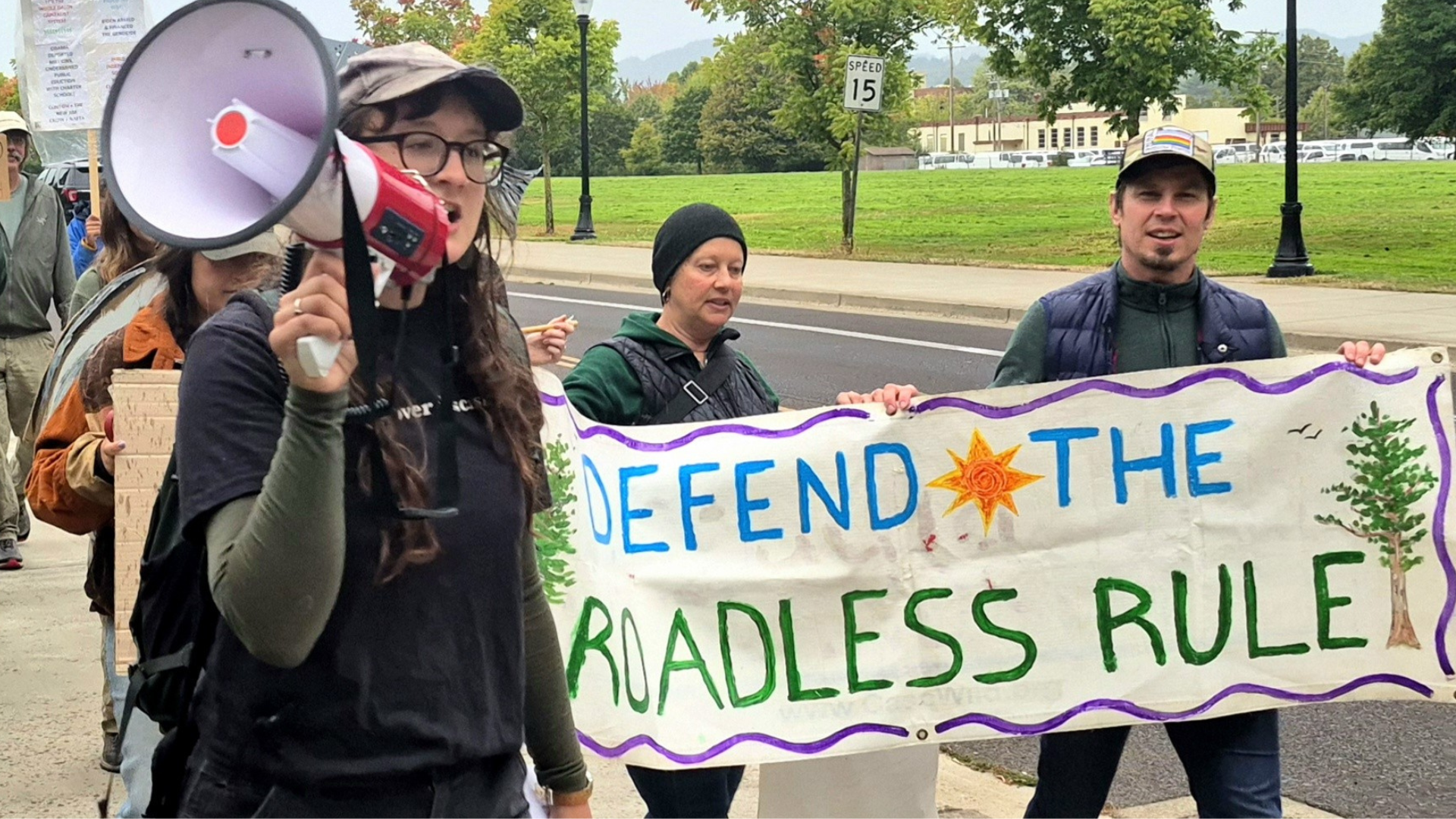
U.S. Forest Service Chief Tom Schultz visited Oregon State University Sept. 2, but protestors let him know he was as welcome as root rot.
Some 80 protestors outside the College of Forestry on Southwest Jefferson Way carried signs, sang songs and chanted slogans against the Trump appointee and the administration’s forest policies.
Schultz came to speak at OSU’s Science, Stewardship and Sustainable Forests Resource and Development Summit.

Madeline Cowen, the field and organizing manager for the environmental organization Cascadia Wildlands, said Schultz’s visit comes as the forest service plans to rescind the Roadless Area Conservation Rule
“Removing the Roadless Rule’s protections threatens nearly 45 million acres of undeveloped public backcountry forestland managed by the agency, approximately one-third of the entire national forest system,” Cowen said.
“In Oregon alone, eliminating the Roadless Rule would threaten roughly 2 million acres,” she said.
The rule, created in 2001, prohibits new road construction and reconstruction, and timber harvesting on designated undeveloped national forest lands. President Trump has called it a burdensome regulation that impedes firefighting efforts and economic development.
U.S. Secretary of Agriculture Brooke Rollins announced Aug. 18 that Schultz filed a proposal to scrap the rule
“Active forest management is not an option,” Schultz said in the wake of the announcement. “It’s essential. More than 40% of inventoried roadless areas, primarily in the West, have high or very high wildfire hazard potential. And only 5% of those areas have received hazardous fuels reduction treatments since 2014.”
Eliminating the rule reduces wildfire risks and secures the long-term health of America’s forests and neighboring communities, he said.
Forests already have enough human beings driving around and tramping about, Cowen said. They’re the ones causing the fires.
“Despite research showing that the majority of wildfires are human caused, and expanding backcountry road systems will only increase access for human-caused fires to ignite, Chief Schultz has led the agency’s efforts to repeal the rule,” she said.
“Shultz has directed the agency to use aggressive ‘fire suppression,’ overriding the scientific consensus that fire plays a critical ecological role in Western ecosystems,” she said.
Cowen questioned if forest service officials are truly interested in fighting fires.
“Schultz is carrying out Trump’s Executive Order 14225 to increase federal timber production by 25% over the next four years,” she said.
“Increasing the cut on federally managed public lands will devastate forests that are essential for wildlife, clean water and air, recreation and climate mitigation,” she added.
served as the director of the Idaho Department of Lands from 2011 to 2018 before becoming vice president of government affairs and community outreach for the Idaho Forest Group, a logging company.
He became the chief of the U.S. Forest Service last year, replacing Biden-appointee Randy Moore.
Forest service officials are accepting public comments on their proposal to rescind the rule through Monday, Sept. 21.
Cowen said the service’s own analysis of public comments reveals that people overwhelmingly support keeping the rule.
People can submit feedback on the proposal online through the Regulations.gov portal under docket No. FS-2025-0001.
Activists at Cascadia Wildlands, who organized Wednesday’s protest, say they defend and restore the region’s wild ecosystems and envision vast old-growth forests.
By Tom Henderson
Do you have a story for The Advocate? Email editor@corvallisadvocate.com