

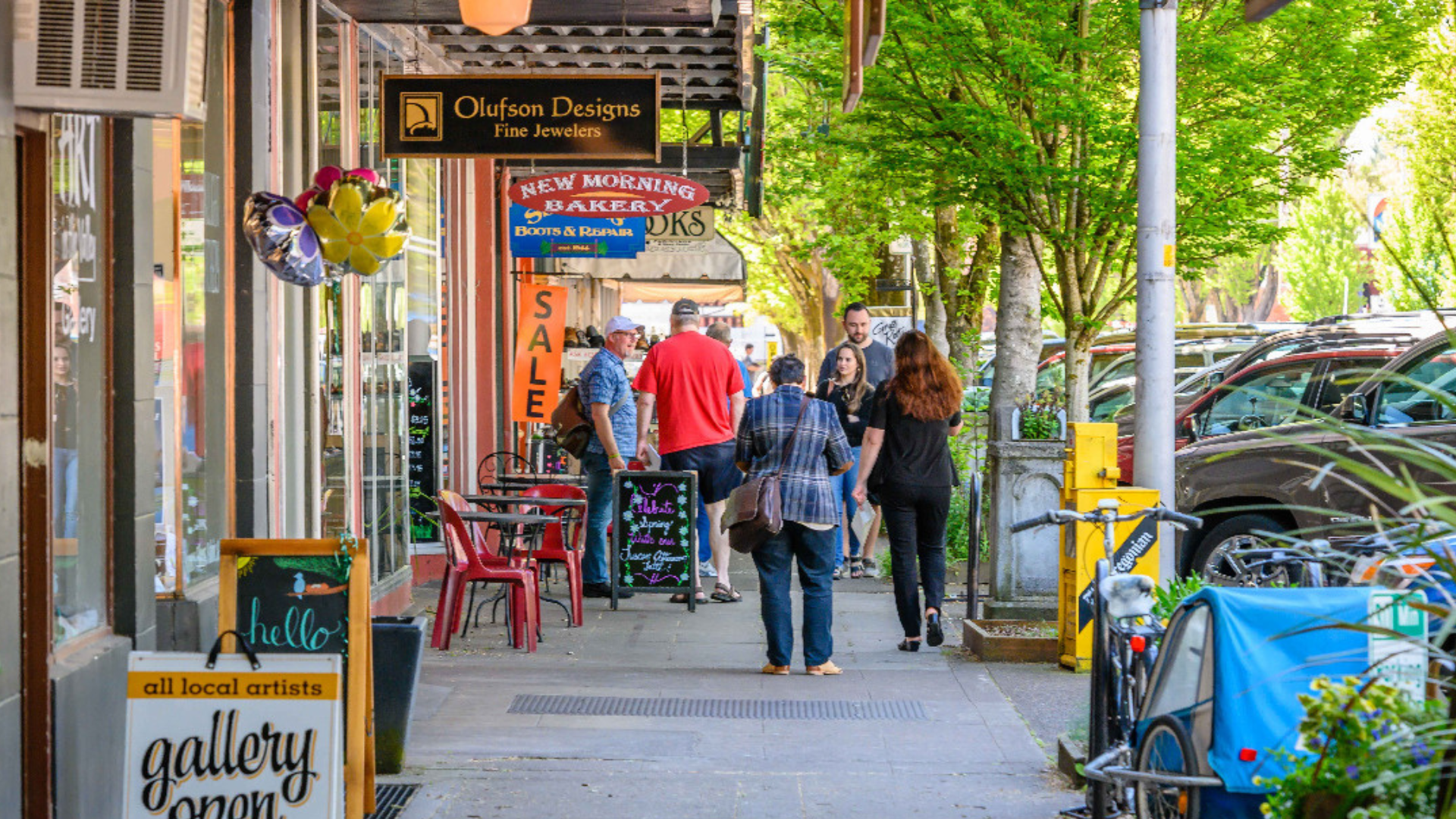
 After a year of meetings, surveys and public outreach, the Downtown Vitality Strategy Task Force is presenting its final recommendations to the Corvallis City Council on July 20, offering a roadmap the group says can help downtown match — and even exceed — the vibrancy of comparable downtowns elsewhere in Oregon and around the country.
The 40-member task force, appointed by the mayor in May 2025, spent a year studying downtown’s economy, infrastructure, safety and environment before unanimously approving its final report at a June 9 meeting. Members included downtown property and business owners, residents, all nine city councilors, and representatives from groups such as Oregon State University, the Benton County Board of Commissioners, the Corvallis School Board and the Corvallis Farmers Market.
Eight priorities, ranked by community input
The task force organized its recommendations into eight goals, listed in priority order based on what it heard from the public:
- Enhance downtown cleanliness and safety
- Foster a vibrant retail, service, office and entertainment economy
- Make connections to the Willamette River an integral part of downtown
- Emphasize ease of access, walkability and accessibility
- Provide housing opportunities that contribute to a vital downtown
- Invest in cultural and public spaces, buildings and services
- Advance downtown’s structural, environmental and economic resilience
- Develop and submit to voters an urban renewal plan, including a tax increment financing (TIF) district
Each of roughly two dozen specific actions under those goals are tagged with a suggested timeframe — “Now” for the next three years, “Next” for years four through seven, or “Later” for year eight and beyond — along with which combination of public, private and nonprofit partners might carry it out.
Safety and vacant storefronts topped community concerns
The report begins with introductory remarks from Task Force co-chairs Julie Manning and Steve Clark pointing out that the group’s recommendations were shaped by outreach that reached more than 2,000 residents through surveys, in-person meetings and written comments. Behavioral safety downtown — particularly concerns raised about nighttime conditions — and the impacts of houselessness emerged as the top concern in both statistical surveys and community conversations, according to the report. Reducing the number of vacant storefronts ranked as the next highest priority.
Other themes that surfaced repeatedly included calls for better outdoor lighting, cleaner sidewalks and public restrooms, expanded parking, stronger connections between downtown and the Willamette River, and a more walkable, bike-friendly core linked to nearby neighborhoods and the OSU campus. Residents also voiced interest in more housing diversity downtown and expressed worry about losing government jobs and services if City Hall or the Law Enforcement Building were to relocate.
Survey data included in the report show a split in how residents view downtown’s safety: 52% of respondents said they feel very safe downtown during the day, compared with just 17% who feel that way at night.
Outreach by the numbers
The task force’s engagement effort included 35 total meetings, a “Downtown Vitality – Priority Actions” survey that drew 1,634 responses ranking 29 draft action items, a separate engagement survey with 407 responses, custom questions embedded in the city’s 2025 Community Survey, roughly 2,000 postcards distributed community-wide, and participation in 18 community events, including the Mayor’s Town Hall.
In the priority-actions survey, addressing behavioral safety and social-service gaps drew the strongest support, followed by reducing storefront vacancies and promoting downtown as a destination for shopping, dining and cultural experiences.
Momentum and Tax Moves
The report says that Corvallis’ downtown has seen positive movement in recent months, including new businesses, building renovations, new housing and retail construction, and a new Van Buren Avenue bridge with safer crossings for cyclists and pedestrians.
The City Council has also authorized planning for a potential downtown Tax Increment Financing, or TIF, district, which — if approved by voters — would help fund capital projects such as riverfront and streetscape improvements, building façade upgrades and transportation infrastructure. The task force’s report recommends that a TIF plan be brought to Corvallis voters in May 2027.
A Political Challenge
While a TIF district doesn’t necessarily raise taxes on its own, it does capture usually occurring annual property tax increases into a special fund for projects within the district; in this instance, contemplated for downtown. Those would be dollars that don’t go into the City’s general fund that serves the whole of the community.
Voters have rejected similar proposals in the past. And at present, Corvallisites are learning the City is facing a projected $4.1 million annual operating deficit. That figure doesn’t included pending facilities expenditures.
What’s next
The task force will be asking the Council to formally accept their report and schedule further discussion of its findings. If that happens, they will begin identifying private-sector, government and nonprofit partners for specific actions, and continue developing the TIF district proposal for the 2027 ballot. The report is explicit that the task force did not attempt to assign responsibility for individual actions to specific agencies or organizations, or to identify funding sources — decisions the group says should be worked out collaboratively among the city, private partners and nonprofits going forward.
“We believe that downtown Corvallis has the opportunity to match and even surpass the vitality and quality of downtown city centers in many nearby and other Oregon communities,” the co-chairs wrote, while cautioning that realizing that vision will take sustained investment over years, not a single project.
 KEY FINDINGS: The community outreach gathered input on the 28 preliminary action statements being considered by the Task Force and generated overall community awareness of the work of the Task Force, while providing additional recommendations about ways to improve downtown’s vitality, economy, safety, environment and public facilities.
Among the key findings:
- Residents value a healthy downtown. There is a strong perception that, while some positive changes and investments are occurring downtown, more needs to be done to improve downtown.
- The highest priority to be addressed. In both statistical survey results and qualitative results from in-person community and stakeholder meetings, relates to concerns about behavioral safety downtown (particularly at night) and related gaps in social and supportive services for those in need.
- Vacancies. Addressing the number of vacant storefronts downtown is cited statistically as the next highest priority within community surveys, and in community engagement meetings as a priority. Relatedly, community members want to see more promotion of downtown and its assets.
- Foot and bus. Downtown should be made more accessible and walkable. While the findings state that pedestrian mobility within downtown is favored, so is improved walking, biking, transit and vehicle access to downtown from Corvallis neighborhoods and the OSU campus. Developing additional parking availability downtown is also a priority for some community members.
- Transportation safety is a priority of the public. This includes addressing downtown sidewalk issues and hazards, and improving crossings within downtown along 3rd and 4th streets. For some, 3rd and 4th streets, which are state highways, are seen as barriers separating segments of downtown and limiting opportunities for public engagement.
- Not everyone frequents downtown. While downtown is seen as a destination of choice for some community members, surveys conducted by the Task Force and city of Corvallis indicate that many members of the public do not often visit downtown. To attract more locals and visitors downtown, the Task Force’s findings favor offering activities and public spaces for youth, college students, families, and tourists to enjoy and gather. More housing – and greater housing diversity – also are perceived as important for downtown, as are investments in a modern power grid and other infrastructure that will enable new development, redevelopment of existing buildings, and renewal of older and historic buildings.
- The river. Many residents would like to see enhanced connections between downtown and the Willamette River, including improved viewing areas and recreational access.
- Infrastructure and maintenance. Beautification of streetscapes, improved downtown cleanliness, the addition of more accessible bathroom facilities, and improved nighttime lighting are seen as important priorities.
To view the full report, click here.
To contact Chris Evenson about this story, email office@corvallisadvocate.com
Do you have a story for The Advocate? Email editor@corvallisadvocate.com