

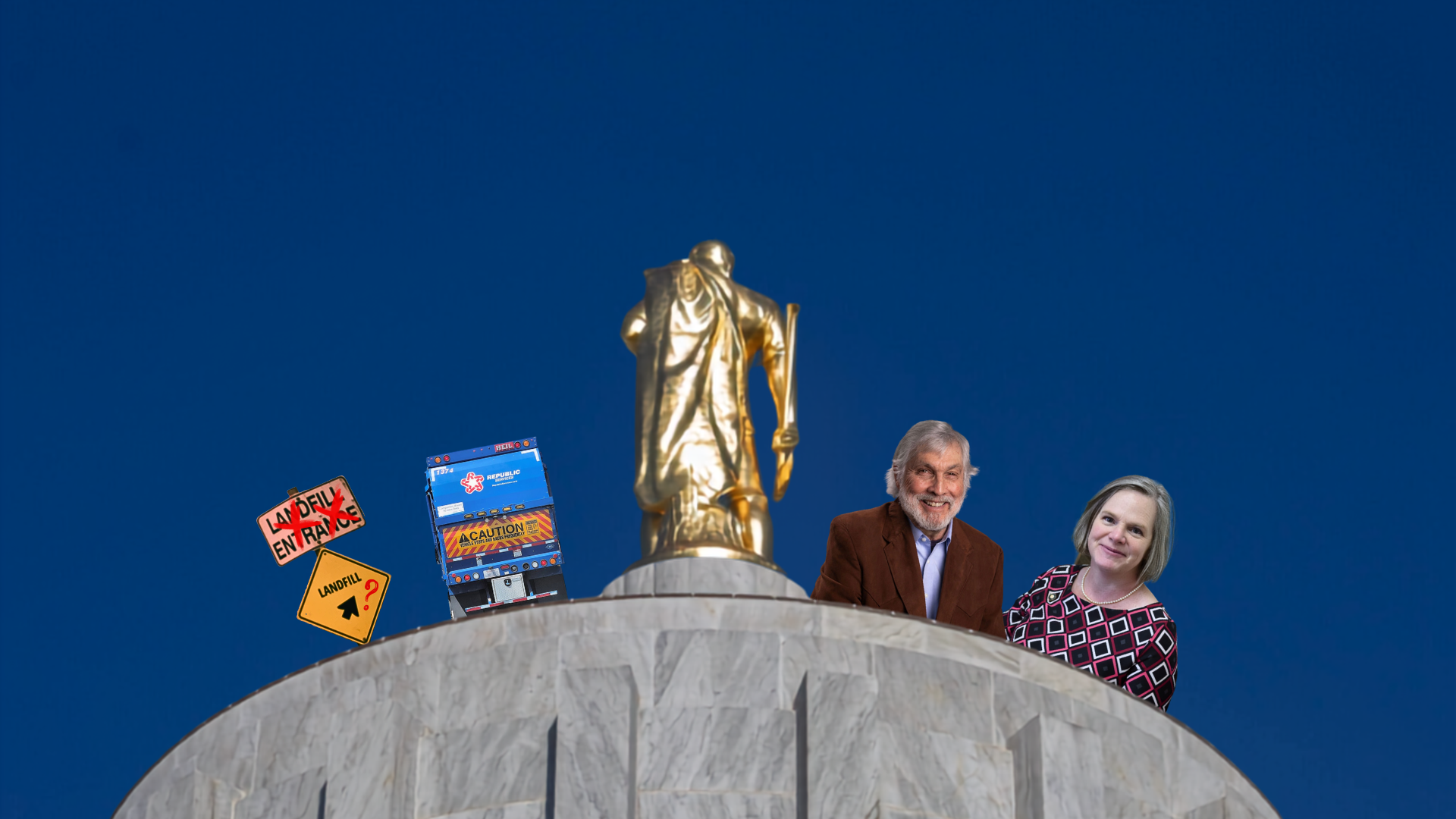
 Pat Malone voted for expanding Benton County’s Coffin Butte Landfill by 70 acres Nov. 17.
He also trashed his political career.
Malone reversed his vote on the landfill March 3, but it was too late for voters. They voted against expanding his eight-year tenure on the Benton County Board of Commissioners May 19.
They knocked him out in the Democratic primary in favor of Benton County Planning Commissioner John Wilson. “Because of the vote to approve expansion, there was a movement to make sure I didn’t serve another term,” Malone said.
He said he’s not entirely unhappy about that. “I’m looking forward to getting my life back.”
Well, to an extent. Someone still has to deal with the trash.
“THE SUBJECT MATTER EXPERT”
“For better or for worse, I’m kind of the subject matter expert as far as elected officials go in this area,” Malone said.
Malone remains the chair of the board of commissioners until January. He also chairs the Joint Task Force on Municipal Solid Waste in the Willamette Valley, bringing together state legislators and others to deal with a variety of problems.
Coffin Butte is a biggie. The proposed expansion is just one of its problems.
Malone joined fellow Commissioner Nancy Wyse in initially voting for the expansion, with Commissioner Gabe Shepherd dissenting. The decision came after years of controversy and often angry input from area residents.
Wyse and Malone reversed their votes in light of new allegations of environmental law violations that came to light almost immediately after the first vote. Executives of Republic Services, which owns the landfill, are appealing the county decision to Oregon’s Land-Use Board of Appeals.
However, expansion issues remain only the tip of the trash pile.
“WE EVEN HAVE AN ACRONYM”
Coffin Butte has only about a decade left before it reaches capacity and residents of Benton, Linn, Polk, Tillamook, Lincoln and Marion counties have to find other ways to deal with their garbage.
Task force members have held seven meetings since Dec. 16 and think they may have a plan – or the beginning of one. They call it the Waste Infrastructure Partnership Act – or WIPA.
“We now have a good road map forward, and we even have an acronym,” Malone said.
WIPA basically calls on all concerned to work and play well with others. It starts with cities and counties making rough plans and assessing their needs to create strategies for dealing with their garbage. Then they pass the collection plate to the state – asking the state to issue bonds or provide bonding assistance so local governments can bankroll their ideas.
Once these various projects are built, local governments decide whether or not to charge their residents fees for ongoing revenue. Such fees would be used to repay the state.
State Rep. Sarah Finger McDonald, D-Corvallis, said all this is voluntary. Local governments don’t have to play. The key to the plan’s success is flexibility at the community level, she told task force members at their June 10 meeting.
“It’s a plan that’s really built on carrots rather than sticks,” Finger McDonald said. “Instead of trying to build another level of government and requiring participation, we are creating a funding structure and incentives to encourage those counties and cities that are now bringing their waste to Coffin Butte Landfill.”
“WE’RE RUNNING OUT OF TIME”
However, task force members have to get a move on, she added. They have only three months before the pre-session filing deadline so the 2027 Legislature can turn the idea into a bill and, ultimately, a law.
“We’re running out of time,” Finger McDonald said. “Rather than start all together from Ground Zero, I thought it would be easier to start with a plan we could chew on and discuss and work on together.”
Although more specific details need to be ironed out, she added she’s pleased with the proposal’s basic framework.
“This concept captures our goals of building long-term infrastructure capacity, strengthening local control over the system we’ve developed, reducing environmental risk and encouraging the collaboration that we need for the efficiencies of scale to make a solid-waste system really work and pencil out both financially and practically,” she said.
One thing that needs to be figured out about the plan is how to pay for it.
“NOT AN EXPERT ON HOW THINGS ARE FUNDED”
“I’m not an expert on how things are funded,” Finger McDonald said. “This is where I think this task force could look for more information and work together to really decide what process is best, but it could be bonding, it could be matching grants.”
Task force member Courtney Flathers said the proposal is important for financially strapped cities and counties. Flathers works for Gov. Tina Kotek’s Regional Solutions team and represents the mid-coast region where money is often tight.
“Often times, we see communities that can’t get even basic water and wastewater infrastructure projects off the ground because they lack both the funding and staff capacity to do that initial planning work, let alone the actual construction and project itself,” said Flathers.
What all this boils down to is that Coffin Butte is running out of space in the next 10 years.
“The real worry is that we hit the end of Coffin Butte’s lifetime without sufficient infrastructure, and at that point, we’re facing higher fees, longer hauling distance, less ability to look at things like environmental impacts and recovery,” Finger McDonald said.
Coffin Butte may stink, Malone said, but it’s still the only game in town – as well as towns scattered across six counties.
“Most of the six counties that are involved don’t have much in the way in terms of alternatives and are sending basically 100% of their solid waste to Coffin Butte,” he said.
The task force has half a dozen more meetings to go until the 2027 Legislature convenes. Members started their work by discussing the Solid Materials Management Plan that Benton County sponsored last year.
“In some ways, this task force is the third leg of the relay race,” Malone said. “We had Benton County Talks Trash three years ago and then SMMP last year to get partners together to discuss the current situation and what’s our future.”
WHAT MAY BE NEXT
All the talk about shoring up local infrastructure aside, a lot of talk focuses on shipping the region’s waste to the Columbia Ridge Landfill Management Facility in Arlington, some 211 miles (and four hours) away from Coffin Butte.
“That’s a real possibility,” Malone said. “I don’t want to say we’ve got it all figured out, and this is how it’s going, but I can say the waste management facility in Arlington looks at this point to be the best place for our solid waste once Coffin Butte closes.”
The 620 people who live in Arlington may not be wild about having 2,500 tons of garbage per day land on them from their fellow Oregonians west of the Cascades. It’s not a pleasant prospect for western Oregon either, Malone said.
“This is a really complicated, expensive solution,” he said. “Coffin Butte is a relatively inexpensive solution. When you start shipping material 211 miles away, it gets expensive.”
Plus, even if area garbage is shipped to Arlington, mid-valley communities would still need local transfer stations where people could take their trash.
Dan Balm, Finger McDonald’s chief of staff, said transfer stations are part of the plan.
“If WIPA became law, local governments within the geographical area would be able to submit a plan on what they want,” Balm said. “The scope of the projects will be up to the local government. The idea is to score projects with regional collaboration higher and to allow the experts on the ground and the local community members to decide what they want.”
People everywhere dislike landfills and generally would prefer their trash to be out of sight and out of mind. Even when Malone leaves office next year, he said, he’ll still be thinking trashy thoughts – about solid waste disposal, that is.
“I could possibly still be involved in some of the decisions,” he said.
By Tom Henderson
Do you have a story for The Advocate? Email editor@corvallisadvocate.com