

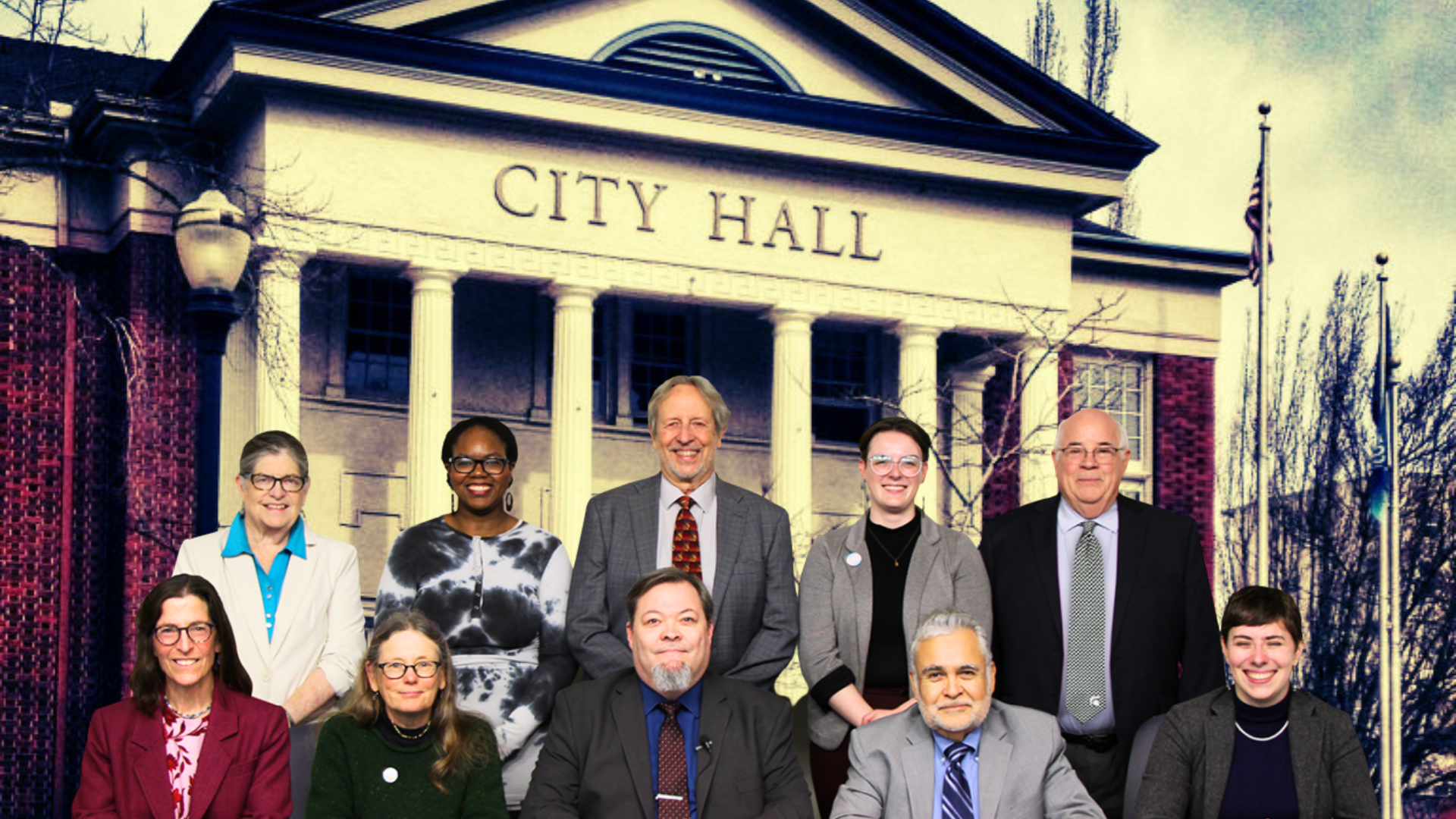
 On Monday, the Corvallis City Council will select itself a new President and Vice-president, and we think that may be a bigger deal for the community than usual. The folks occupying these roles presently have demonstrated that reality.
Over the last year, President Paul Shaffer and Vice-President Charlyn Ellis sought and received authority to pursue a third-party evaluation of City Manager Mark Shepard. And that could have been a constructive process. But for some on the Council, it quickly started looking like something else. Like the Vice-President was maybe wielding a new hatchet in a longstanding feud between her and City Manager Shepard.
Whether that perception was fair or not, the contract for a third-party evaluator never materialized, and the Council eventually voted to jettison the whole thing. This all took over five months to play out. And as no small aside, it is back on the Council’s agenda again.
Of course, all of this could be taken as the usual lighthearted palace intrigue of any podunk sized college town, and in the end, it amounted to a nonevent. But then, that is the point. We don’t need nonevents and wheelspins from the Council, we need them to address problems and opportunities. And we don’t mean just any problems or opportunities; we mean the ones that impact the lived experiences of those of us who are living here.
We need action. After years of warnings from City staff that, like most cities in Oregon, our revenues aren’t keeping pace with how inflation is impacting expenses, there has been no meaningful Council response, and now, those once distant budget shortfalls are imminent.
Council continues to regressively tax those who can least afford it. They do that with constantly increasing fees and levies. It’s a strategy that is both implicitly unfair and plain mean and is not a sustainable plan; the fees and levies don’t stand a chance at bridging the coming budget gaps on their own.
There has been some effort at economic development, which could mean an increased and broadened base of tax revenues to shore up future budgets.
The City already partners with the County on a small economic development office. And the Council has formed a Downtown Vitality Committee. Which is fine, but not likely broad enough. After all, there is the rest of Corvallis too.
Also striking, somehow, there does not appear to have been a formalized pursuit of economic partnership opportunities with OSU and LBCC. Though finally it’s being discussed, but not as a Council item. It’s now a stated goal of City Manager Mark Shepard for this next year.
These are all foundational matters; they determine our community’s resources and constraints in dealing with issues like the housing crisis, public safety, transportation, and yes, even potholes. Naturally, the list could go on.
So, with the Council’s leadership vote upon us, we thought a community-wide look at each of the Councilors may be helpful. And, we will examine what each could bring to the Council if elected President or Vice-president. In the end, we will be making our own recommendations about who the Council should put into leadership, and why.
The players
The Council’s presidency and vice-presidency are filled by Ward 7 Councilor Paul Shaffer and Ward 5 Councilor Charlyn Ellis, respectively. Scuttlebutt has it that Shaffer would prefer just being a Councilor this next year. His loyalty to Ellis makes us expect he will nominate her for the position. We have concerns about that.
Ellis has served multiple terms on the Council, she has publicly said this will be her last. People seem to either love her, or really-really don’t. Not much in between. Regardless of which camp one falls into, the perceived feud between Ellis and City Manager Shepard appears to be real. She votes with the leftmost Councilors on most issues, including homelessness proposals, and she has a laudable record on environmental matters. She has said the Council should seek voter approval of new City facilities on a building-by-building basis instead of pursuing one singular civic campus. We think that’s a more practical approach.
For Ellis to retain her VP position or move on to become President, she should commit to recuse herself from any executive role with a third-party evaluator. Doing that, she wouldn’t have the authority to negotiate with the evaluator, or design and edit their work. She would simply continue having the same input about the City Manager as any other Councilor.
Ward 1 Councilor Jan Napack approaches issues from a studied position; she is the sort that looks to confirm facts, and she will avoid snap decisions. The question about Napack is not so much whether she’s liked or not, there aren’t strong feelings either way on the Council, but she is quite popular with her constituents. More helpfully, however, most folks, even those of different views than hers, tend to respect Napack. Indeed, over the years, we’ve seen her work towards compromise and common ground where she can find it. As a Councilor she tends to vote center-left. She has championed economic development and housing. On homeless issues, some see Napack as exceptionally helpful and knowledgeable, others the precise opposite.
She has served multiple terms as a Councilor. We do not know if she is interested in serving as either President or Vice-President. Napack, in either position, would probably push for deeper and more nuanced policy considerations that would tend to stand up better over time. However, this doesn’t mean she suffers from analysis paralysis, she arrives at Council meetings with her homework complete; fully prepared for next steps. We see Napack as someone that would be most comfortable taking on just a few issues at a time, but then addressing those issues more fully. She appears to pick her battles carefully.
Ward 2 Councilor Briae Lewis arrives at decisions quietly and she avoids open conflict most of the time, which is not the case for many of the Councilors. She does not originate many proposals on her own, but last summer, she did motion for the City to adopt policies to Boycott, Divest and Sanction Israel. Even as her proposal was divisive throughout town and among Councilors, she avoided saying much about it – she avoided confrontations. Because Lewis has been a quieter presence, it’s difficult to see how she has distinguished herself. She tends to vote with the leftmost Councilors, though not necessarily in lockstep.
Now in her second term, Lewis, intentionally or not, may have bumped into the subtle power that comes with quiet. This means she can be hard to read. On the other hand, there is value to the idea that one’s decisions can and should speak for themselves.
Ward 3 Councilor Jim Moorefield is a first term Councilor, but only sorta-kinda. He had served on the Council back in the 1990’s. It’s taken him a minute to catch-up with how things have changed on the Council, but he now seems to have a good grip on the present issues and dynamics. Moorefield is generally liked and respected. He seems somewhere between center-left and the leftmost factions on the Council. His voting pattern is a little difficult to suss just yet. He often pulls from his experience to make decisions.
Before his election to Council in 2024, he had long served as the Executive Director at Willamette Neighborhood Housing Services, a nonprofit that developed affordable and low-income housing in and around Corvallis. He is a champion of housing the homeless. We see Moorefield as someone accustomed to making complex things happen by a deadline, with a better grip of the dynamics around decision-making than one generally anticipates from a first termer. But like we said, he’s not really a first termer. At press time, we have no idea if he would accept a nomination.
Ward 4 City Councilor Ava Olson is probably the quietest Councilor. In her first term, she primarily votes with the leftmost faction but rarely originates or asks much. We’ve watched Olson the last year, and halfway through her term, we cannot suss how she arrives at decisions, or how she may lead as a Council President or Vice-President. Compared to other first-termers, Olson is still gaining her footing, which is not uncommon among Councilors that sometimes go on to serve several terms.
Ward 6 Councilor Alison Bowden is unafraid of saying when they don’t know something and is unabashed about asking numerous questions. Because of this, in their first term, they have learned quickly. Bowden is still learning some of the policy and procedure that comes with a Councillorship, but they seem to be learning at a better clip than most first-timers. Bowden votes with the leftmost flank of the Council and has originated more proposals than one traditionally sees from a freshmen Councilor. Scuttlebutt has it that Bowden is considering a run for leadership. If successful, we suspect they’ll embrace a process orientation that may be helpful at this point.
On the other hand, Bowden is one of the most vociferous and ideologically driven of all the current Councilors, and is sometimes distrustful of City staff, which some will see as a benefit, and others not. Bowden is seen by some on the Council and in the community as divisive and unwilling to compromise. They are seen, probably somewhat fairly, as an idealogue. Some will see that as an asset. But, on balance, we worry Bowden may prove less effective with the give and take negotiations of a leadership position.
Ward 8 Councilor Carolyn Mayers is selective about what she weighs in on and is both plainspoken about her views and generally willing to compromise. Mostly, she votes with the center-left of the Council but strives to accommodate folks with differing viewpoints. For instance, she did not feel a third-party evaluation of the City Manager was necessary but still offered a compromise, an alternative to proposal to try and get it done. Proponents had already proposed an evaluator, that was charitably speaking, deficient. So, after their proposal failed, Mayers signed on to a process to help get the next review done in a more professional manner this year.
Her prior experience as Vice-chair of the Planning Commission gives her the skills needed for a leadership position on the Council. This is also means she has a knowledge base that can help shape land use decisions wisely. Mayers champions economic development as a means of increasing the area’s tax base and serves as Liaison to the Corvallis Chamber of Commerce and the aforementioned economic development office. She seeks opportunities to unify the community and build trust. Notably, Mayers is a founding Board member of a local chapter of Braver Angels, a national organization that seeks to depolarize local and national politics. Privately, she works diligently to meet people outside her own political orbit.
Ward 9 Councilor Tony Cadena has served multiple terms and pulls from that experience and years of high-level executive and nonprofit experience as he approaches issues. He has better than average relations with both City staff and his fellow Councilors, the former of which he relies on for help in making decisions. He perceives strong and weak arguments more deeply than most, and zeros in quickly. He generally votes with the center-left. He has been supportive of downtown revitalization, but at heart, his larger goals have to do with good governance and fiscal sustainability. He has the background and temperament to help Council makes real progress.
As the Council sometimes strays, it’s most frequently been Cadena working to shepherd the flock. The leftmost flank of the Council can sometimes be skeptical of Cadena, but he is generally respected, and his points are well-taken. He has not been someone for whom grudges are an issue. Cadena is calm and focused, process oriented, and he generally believes constituents are owed a government that is efficacious, that solves problems and works toward an environment that can offer opportunities.
Here’s our take
We do not usually offer any analysis of these Council Leadership votes. But at the moment, we are looking for just about any button we can push that even remotely resembles a panic button. We, the community, need the Council’s attention. Regrettably, and probably unfairly, the Councilors serving at present are facing far larger issues than prior Councils.
There are impending budget shortfalls. The federal relationship with state and local governments has suddenly changed. State government cannot offer what it once could. Ongoing problems are worsening. New issues are arising.
And against this backdrop, the present Council has so far delivered very little work-product. Even the Mayor has said in open Council meetings that he believes the current Council should be more effective; he has been clear about his disappointment.
Who we’d vote for
Given the dearth of productivity, we believe a change would be best. We think Tony Cadena would be the best choice for Council President. He has the experience and has served on previous Councils that have been far more productive. Combine that with his work as a high-level executive and he is a compelling choice. He knows how to do the boring parts of prioritizing and making things happen, and that’s a good thing. Process matters. Cadena is the right person for the moment our community finds itself in.
For Vice-President we would choose someone in their first term, preferably Mayers or Moorefield. Both have prior experiences that have allowed them to hit the ground running as freshman. Both are deeply thoughtful. Mayers moves proactively to seek common ground and find compromises, seeking progress, not perfection. Moorefield is already broadly liked and respected.
We realize none of our selections are from the leftmost flank of the Council, and if that were a priority, we would choose Lewis. We appreciate the power that comes from a quieter presence, and Lewis offers that.
Do you have a story for The Advocate? Email editor@corvallisadvocate.com