

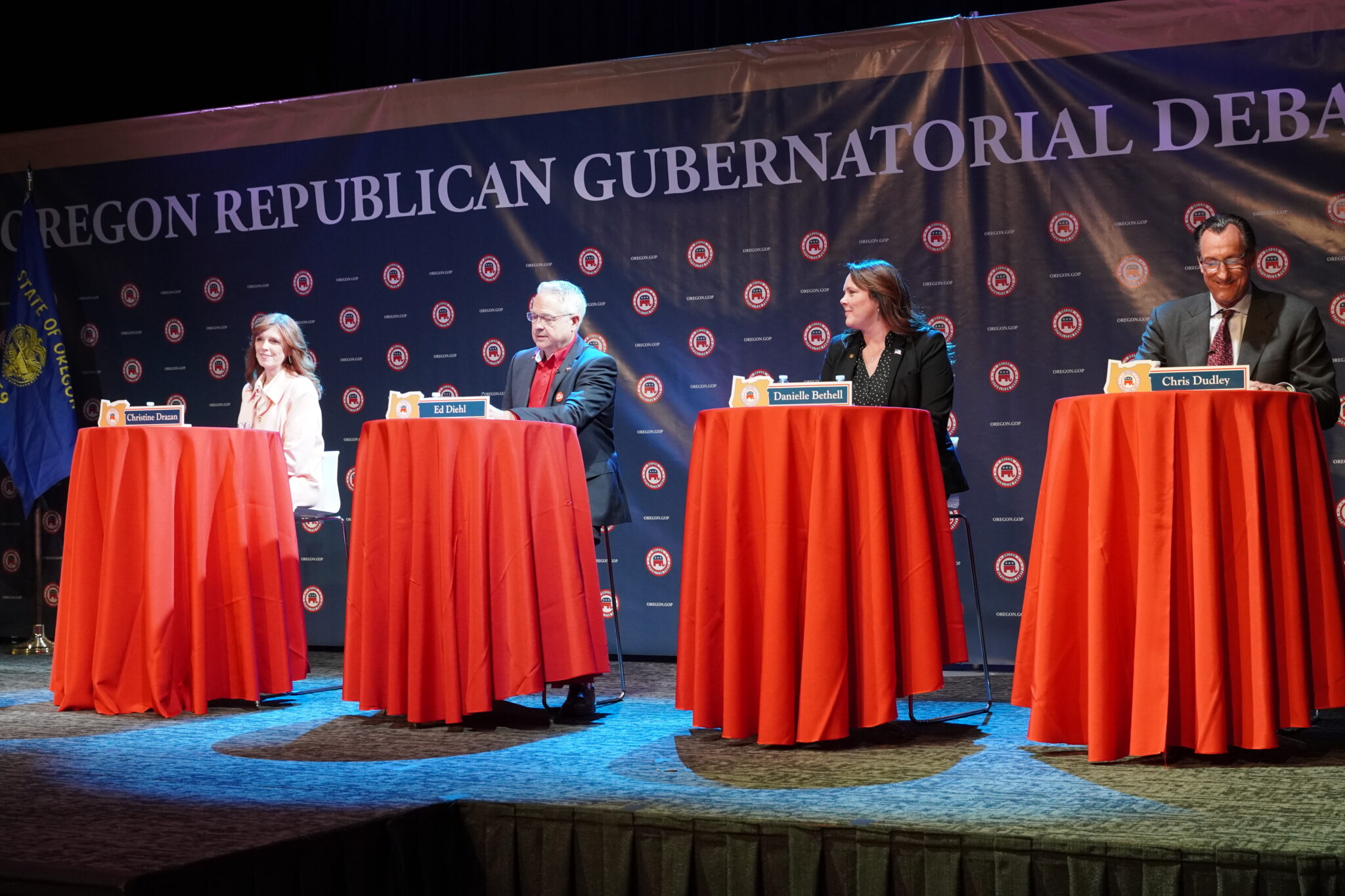
The top four GOP candidates for the Oregon governor’s race participated in their first televised debate on Monday, facing some of their toughest questions yet on issues such as election integrity, federal immigration enforcement and how they would govern the state.
Oregon hasn’t elected a Republican governor since the 1980s, and this year’s election is likely to prove challenging for a Republican candidate seeking to upset incumbent Democratic Gov. Tina Kotek in part because of the unpopularity of a GOP-controlled Congress and President Donald Trump. Republicans in the state say they can seize on momentum from the May anti-transportation tax referendum and discontent with a lack of progress on the state’s homelessness crisis, education and economic development to win the governor’s mansion.
Monday’s debate featured Marion County Commissioner Danielle Bethell, state Rep. Ed Diehl, R-Scio, 2022 GOP gubernatorial nominee and state Sen. Christine Drazan, R-Canby, and ex-NBA player and 2010 GOP gubernatorial nominee Chris Dudley. Much of the hour debate was a reiteration of common arguments from the candidates, who all largely all support cutting taxes, auditing state agencies, improving accountability for funding for schools and working to improve the state’s business climate.

But the event also revealed key differences between the candidates, who are unique in their styles and political profiles. Two polls conducted in April showed Drazan in the lead with over 30% of Republican voters in her corner, though a significant percentage of the electorate remained undecided.
Here are five key issues that stood out after Monday’s debate hosted by KOIN and the City Club of Portland.
Candidates largely dodge questions on national politics, Trump, immigration
The Republican candidates for governor have walked a fine line when it comes to criticizing the Trump administration, which could prove politically toxic in a Republican primary despite the president’s unpopularity among the broader electorate.
On Monday, they largely steered the conversation toward Oregon’s economic and internal problems rather than challenging the federal administration when asked about the differences between the GOP nationally and locally. In response to a question about whether immigration enforcement has gone too far or not far enough, the candidates stressed the importance of collaborating with federal immigration authorities and deporting individuals without permanent legal status who commit serious crimes.
When asked if they would seek or accept the president’s endorsement upon winning the nomination, Bethell and Diehl said they aren’t seeking it. But two candidates who have been GOP nominees before, Dudley and Drazan, left the door open to accepting one.
“Tina Kotek wants nothing more than for this race to be about Donald Trump. It’s actually who she thinks she’s running against,” Drazan said. “Our governor is actually under the false notion that President Trump is on the Oregon ballot today.”
Fears that abortion could turn into a political liability
Oregon allows abortion at any point in a pregnancy and requires insurance companies to cover the procedure. The state’s general election voters have long signaled support for abortion rights, most recently rejecting a 2018 ballot measure to ban public funding for abortion on a nearly 2-to-1 margin.
But many Republican primary voters remain staunchly anti-abortion, and the issue has emerged as a flashpoint in the GOP primary. The leading anti-abortion group Oregon Right to Life put out a text in April criticizing Dudley’s 2010 position supporting limitations on abortion while allowing it to remain legal in Oregon. He soon after issued a blistering statement condemning “the media and radical politicians who are weaponizing the issue around life and antiquated labels and terms for their own political gain.”
On Monday, Dudley struck a more subdued tone and said that the issue is “incredibly personal.”
“Personally I’m pro-life (and) have been.. The governor can’t make changes unilaterally anyway. I’m opposed to late-term abortion, but I’m not running to make changes, because none of us can, but it’s something we’ve gotten too comfortable with, and I think abortion is a family decision,” he said.
Bethell said she doesn’t believe abortions should be allowed “up until the moment of breath” and that she supports doing more for prevention as a governor. Diehl said he would work with “reasonable people” on both sides of the issue to find a solution and that in the general election, Kotek will take the issue “as a bludgeon against her opponent, because she has nothing to run on.”
Drazan, who faced scrutiny over her position on the issue in her 2022 bid, said she doesn’t agree with Oregon’s lack of limits on abortion, but added that she respects “the fact that lots and lots of women arrive at a different conclusion with these very same facts.”
Split on legislative strategy
One clear area of disagreement was whether further legislative walkouts would be necessary should any of the candidates win the governor’s race. Drazan, who was House minority leader during Kotek’s final years as speaker, led multiple quorum-denying walkouts over climate change legislation, redistricting and the pace of the legislative session. She said her ability to veto legislation would prevent a need for further walkouts and that she would work with a Democratic majority.
“A walkout is when you have lost all other options, when you know that the worst possible case scenario is going to harm Oregonians across our state,” she said. “A walkout is a very significant decision, and it wasn’t one that we made lightly.”
Bethell, meanwhile, said she would support a walkout if she had to, calling for a “balanced approach” to public policy in light of Democrats’ one-party control of Salem.
“If I had to, I would support a walkout, in fact, if I had to encourage it, I would, because again, balance is super important,” Bethell said. “Right now, we have not been receiving that for far too long.”
Diehl didn’t say explicitly whether he supported walkouts, though he participated in one this past legislative session. He said his election would come with a political “earthquake” against one-party governance and that he would work across party lines to “co-chief petition bills with one guy then fight him like crazy — that same guy — on another.”
Dudley said he would not need a walkout as governor because his election would come with “a mandate” allowing him to work with legislators on the issues that he has focused on during his campaign, such as education and economic development. He later took a subtle swipe at Drazan and Diehl, the two serving legislators on the stage, for proposals that have failed to pass muster in Salem.
“While I respect their intentions, the bills that are being talked about and discussed here haven’t passed and therefore (they are) not worth the paper they were written on,” he said. “And ask yourself, why, after watching this debate, why is Oregon still falling the way it has? Why? And I’ll tell you why: It’s because we keep sending the same political leaders back to Salem.”
Candidates give differing levels of depth on response to vote-by-mail
Oregon became the first state to run elections entirely by mail more than a quarter century ago. But the state’s election system faces threats from the Trump administration, including in the form of a March executive order directing the U.S. Postal Service to deliver ballots only to voters on a preapproved list. Federal officials haven’t begun implementing the order, which is the subject of lawsuits alleging that it violates the U.S. Constitution’s provisions delegating election authority to individual states.
But each candidate offered varying levels of support for the existing system in Oregon. Drazan, Dudley and Bethell raised their hands when asked if they voted by mail in the latest election. Diehl said he dropped his ballot off at a local city hall, and Dudley then said he did the same.
Bethell took the clearest stance on the issue among the four candidates, saying she had signed an activist-backed petition to create a constitutional amendment ending the state’s vote-by-mail system in light of “insecurity” that Oregonians have with the state’s voting system. She said she doesn’t believe the state’s automatic voter registration system should exist. Since 2016, Oregonians who present proof of citizenship, like a U.S. birth certificate or passport, when obtaining or renewing a driver’s license or state identification card have automatically been registered to vote.
“We don’t fund elections well, in fact it’s an unfunded mandate for most counties if not all counties in Oregon to produce elections because the legislature doesn’t work with the secretary of state to fund elections properly,” Bethell said.
Diehl said he supports having voter identification, proof of citizenship and “full transparency” in educating Oregonians on how the vote-by-mail process works, but he didn’t go so far as to call for the end of vote-by-mail.
“If you ask the average Oregonian today, ‘do they want to eliminate vote by mail?,’ they’re gonna say no,” Diehl said. “They’re accustomed to it.”
Dudley didn’t call for any specific policy proposals on election integrity, saying that Oregon must “clean” its voter rolls and restore integrity in election. He has for weeks brushed off questions about his position on vote-by-mail on the grounds that such issues are not the focus of his campaign.
Drazan was a sponsor of unsuccessful legislation in 2025 that would have replaced the state’s longstanding vote-by-mail system with a primary method of voting in-person instead. She referred to that legislation on Monday but didn’t offer a new concrete policy she would put forth should she win the election.
She pointed to the 2024 discovery by state DMV officials that more than 1,600 individuals were incorrectly registered to vote without providing proof of citizenship.
The Secretary of State’s Office in February 2025 referred three cases to the Oregon Department of Justice for criminal investigation involving ineligible voters submitting ballots, but the cases stalled after an attorney for the state warned they were vulnerable to claims of selective prosecution.
“It’s not whether or not they cast the ballot,” Drazan said. “They were given the opportunity to cast the ballot. We shouldn’t have to second guess who receives a ballot in the state of Oregon.”
Fact-checking misleading claims
- Drazan: “Gov. Kotek is the least popular governor in the nation.” Kotek has not recently polled as the least popular governor, though polling has indicated that she is among the nation’s least popular governors overall. A February 2026 poll from Morning Consult found five governors were ranked more unpopular than Kotek.
- Drazan: “It is absolutely absurd that law enforcement in Oregon cannot communicate with federal law enforcement on criminal matters. We’re talking about judicial warrants. They should be able to communicate on judicial warrants.” Oregon’s sanctuary law prevents state and local law enforcement from assisting federal immigration enforcement. But it contains an exception for instances when federal authorities have obtained a judicial warrant signed by a judge, rather than administrative warrants signed by immigration officials.
- Dudley: “We have to clean the voter rolls. It shouldn’t take Judicial Watch pushing it to remove 800,000 names from our ballots. Whether they were gonna vote or not doesn’t matter, they shouldn’t have been there.” Dudley appears to be referring to the recent settlement between the conservative foundation Judicial Watch with Oregon officials ensuring that 800,000 individuals who are not eligible to vote, do not receive ballots and are considered “inactive,” are removed from the state’s voter rolls. The state has maintained that their removal is part of an ongoing process to ensure that voter rolls are up to date.
- Bethell: “The 2021 Promise Act is causing a conflict between federal and state law for county commissioners who oversee public safety. Right now we have 19 subpoenas in Marion County forced on us by the federal administration because they want to deport criminals who have harmed individuals in our community.” Bethell isn’t mentioning that Marion County sued Kotek and the Trump administration making a similar argument. U.S. District Judge Michael McShane dismissed their suit in February, finding that Marion County cited no “concrete injury” resulting from its inability to comply with the federal government’s requests. Marion County has since filed for an appeal with the 9th Circuit Court of Appeals.
- Diehl: “I welcome the tax breaks, the over a billion dollars of tax breaks that were given to the Oregon people that Gov. Kotek tried to claw back, that she has clawed back. And we have another referendum that I’m running against Senate Bill 1507 to give those taxes back to Oregonians.” Diehl’s proposed referendum doesn’t deal with over $1 billion in tax breaks. It addresses tax breaks Oregon Democrats disconnected the state from when it comes to the GOP’s 2025 tax and spending law, totaling to what referendum organizers estimate to be around $300 million.
By Shaanth Kodialam Nanguneri of news partner Oregon Capital Chronicle
Do you have a story for The Advocate? Email editor@corvallisadvocate.com