

 This story contains accounts from sexual assault survivors that have come forward. For survivors seeking help, Corvallis’ Center Against Rape and Domestic Violence is available 24 hours a day, by phone at (541) 754-0110 or online at cardv.org.
Ballots are arriving in Benton County. For many voters, the judicial race may appear straightforward, looking at resumes, years of experience, and professional endorsements. Though for those who have experienced the criminal justice system firsthand, especially survivors and their families, the considerations are more complicated: how does each candidate conduct themselves in practice? How do they behave within the system they now seek to lead?
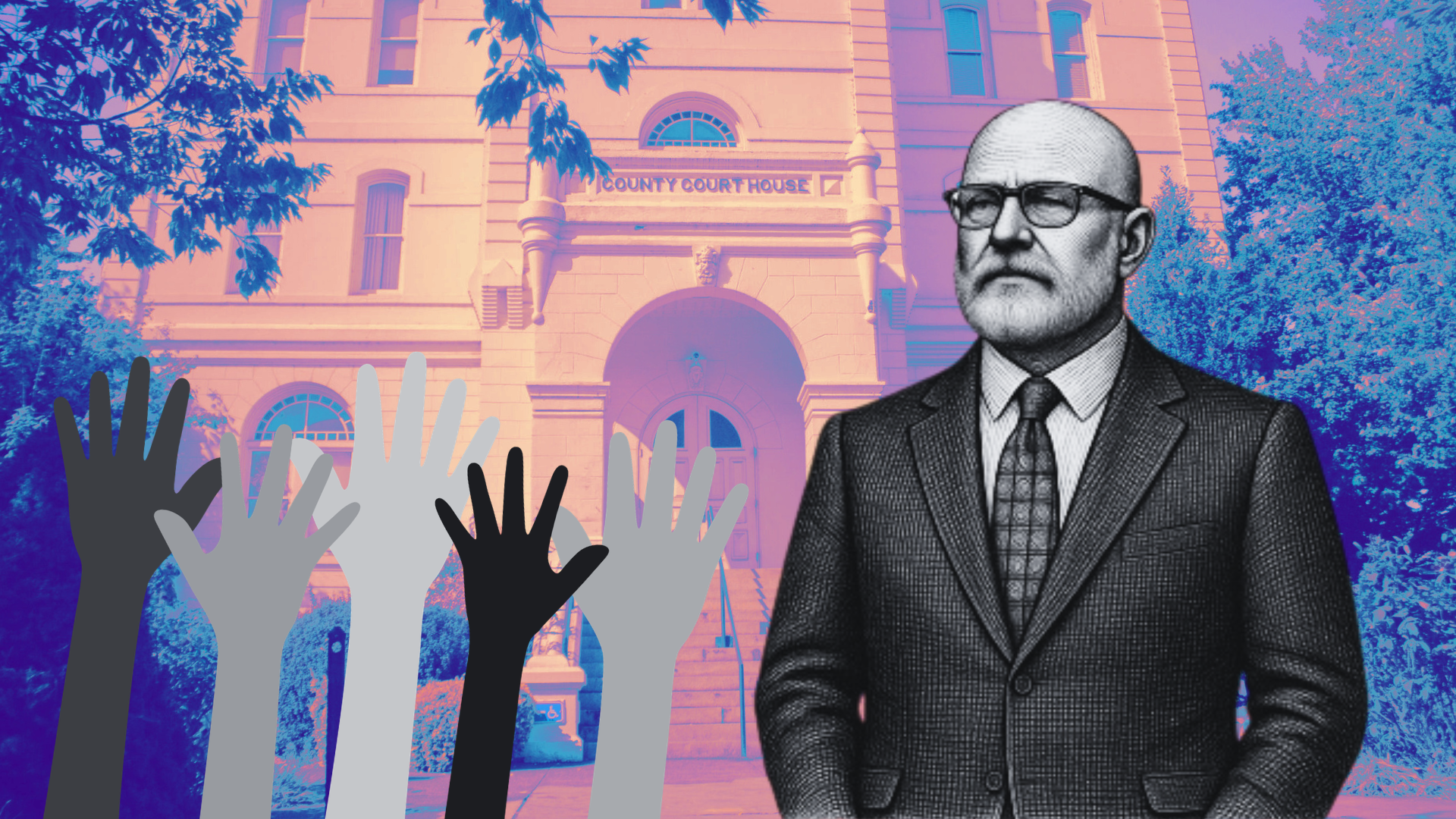
For some, those questions fuel concerns surrounding Mike Flinn, a longtime attorney now running to replace retiring Benton County Circuit Court Judge Joan Demarest. His opponents are attorneys Yema Measho and Joseph Elwood. If no candidate receives more than 50 percent of the vote in this month’s primary, the top two candidates will advance to the November election. Flinn has spent decades working as both a prosecutor and a criminal defense attorney. His campaign emphasizes courtroom experience and advocacy. For some survivors connected to past cases, though, their concerns center less on his qualifications and more on how they say they felt treated during proceedings involving him.

“I don’t think he would treat people fairly,” said Kylie Helms, a survivor who testified in a multi-victim sexual abuse case that took years to reach sentencing.
On May 17, 2024, a jury found Lawrence Lemaster Sr. guilty of 19 offenses, including two counts of first-degree sodomy, 15 counts of first-degree sexual abuse, and two counts of second-degree unlawful sexual penetration. Helms said that, early in this legal process, nothing felt obviously improper, just uncomfortable. There were subpoenas, delays, and repeated court appearances. Then, she said, things escalated. During the case, Helms was served legal papers at her workplace, and her counseling records were subpoenaed.
“It felt horribly invasive,” she said. “Like nothing was mine.”
Flinn, in an email, said the records request was legally appropriate.
“As a lawyer, I am ethically required to zealously advocate for my clients, including exploring all appropriate ways to gather information,” Flinn said. “During my investigation, I determined that Ms. Helms had engaged in counseling and that she may have made statements about my client to her counselor. Ethically, I had an obligation to ask the court to allow me to see records only related to Mr. Lemaster; I cannot and did not ask to see any other records.”
Lorena Reynolds, the attorney who represented Helms in challenging the subpoena, and an endorser of candidate Measho, said the request should never have happened.
“This was highly irregular,” Reynolds said. “We had to file a motion to quash the subpoena, which was, of course, granted, because my client’s abuser was not even entitled to know if she had sought counseling at all. He certainly was not entitled to get her records.”
Reynolds said Flinn was obligated to go through the District Attorney’s Office to seek the records and said Helms, who is not an attorney, would not have necessarily known that. As a result, Helms described what she viewed as a pattern throughout the proceedings that blurred the line between legal strategy and personal intrusion.
Court recordings from the sentencing hearing provide a broader picture of the case itself. Prosecutors described multiple victims over a span of years and sought a sentence totaling 525 months. Flinn, representing the defense, argued for significantly less prison time. He challenged the constitutionality of mandatory minimum sentencing laws and emphasized rehabilitation.
“Given his age, given his positive contributions … [he] should have that opportunity to get out of prison,” Flinn argued during sentencing.
Helms then delivered a victim impact statement describing years of trauma, financial strain, and lasting psychological harm.
“I feel sad … I feel angry … I feel confused,” she told the court. “No amount of time … is ever going to change what happened.”
The judge ultimately rejected the defense’s request for leniency and imposed consecutive sentences totaling 43 years and 9 months in prison, along with lifetime sex offender registration, post-prison supervision, and restitution. Lemaster was age 67 at the time.
“I recognize that this is a life sentence,” the judge said. “However, the lifetime sentence that has been inflicted upon the victims … is something that I hold you responsible for.”
Helms said the judge’s conduct during the case stood out to her.
“The judge in the case was exceptional,” she said. “Kind. Took time. Made it clear he believed me. I want that to be the kind of judge people encounter, especially during some of the worst times of their lives.”
A separate case involving survivor Danielle Neddeau raises additional concerns about Flinn’s time working as a prosecutor.
Jack Udean Denning Jr. was arrested in 2010 and charged with multiple sex crimes involving his daughter, Danielle Neddeau. According to court records, the abuse began when she was a child and continued for years. The case ultimately ended in a plea agreement. Denning pleaded guilty to two felony counts and received a 12-and-a-half-year prison sentence. More than 30 additional charges were dismissed as part of the agreement, and Neddeau said she initially believed the case was headed toward trial.
“We go in there for what I thought was a pre-trial hearing,” she said. “And I was told that since I was a minor, it wasn’t my choice. I wasn’t going to get a trial because the prosecutor decided to take a plea deal.”
She said learning about the agreement in court felt devastating.
“I wanted him away for life,” she said.
Neddeau also described the emotional impact of unexpectedly seeing her father in court after not seeing him for a significant period of time.
“It was really thrown together and inappropriate,” she said. “I pretty much, at 15, lost all respect for the judicial system.”
Her mother, Janette Neddeau, said the experience also left her feeling blindsided.
“It was kind of like victimizing my daughter more,” she said.
Flinn disputes that characterization and said he consulted Danielle and Janette Neddeau before finalizing the plea agreement.
“I talked with Danielle and Janette before making the final offer and gave them enough time to get back to me with their thoughts,” Flinn said.
Flinn said that, as a prosecutor, he had to weigh the possibility of an acquittal at trial, the emotional toll testimony could take on Danielle Neddeau, and the possibility that a judge could impose concurrent sentences resulting in less prison time than hoped for. According to Flinn, under the plea agreement, Denning received a 12.5-year sentence out of a possible 15 years.
Janette Neddeau said the plea agreement and process caused lasting damage to the family. She also recalled Judge David Connell expressing concern about the sentence.
“He told him, ‘You deserve a lot more time than what you’re getting,’” she said.
Connell ultimately accepted the plea agreement, citing concern about forcing a young survivor through a lengthy trial. Flinn maintains that the resolution was legally and ethically appropriate.
“I agreed to a resolution that held Mr. Denning accountable and avoided the risk of a worse result,” he said.
The race for judge in Benton County has now become a conversation about what voters believe courtroom advocacy should mean. Defense attorneys are expected to challenge evidence, question witnesses, and pursue every legal option available to protect a client’s rights. Prosecutors are expected to pursue convictions while balancing constitutional obligations and the realities of trial risk. Those responsibilities can create painful experiences for victims and survivors, even when attorneys are operating within the law.
For attorney Lorena Reynolds, the issue extends beyond professional advocacy.
“I understand that there are criminal defense attorneys who are dedicated to protecting the rights of their clients, even when they are accused of crimes like child sex abuse,” Reynolds said. “The problem is when you represent someone so zealously that you are willing to ignore the protections that victims are entitled to.”
Reynolds said survivors have rights under Oregon law and argued that attorneys seeking judicial office should be evaluated not only on legal skill, but also on judgment and temperament.
“Building a career focused on the rights of the accused at the expense of the rights and well-being of survivors calls into question whether you have the temperament needed to be a judge who will sit to hear these types of cases,” Reynolds said.
Flinn argues that his decades of legal experience make him well qualified for the bench.
“I have been a courtroom attorney for 30 years, representing and advocating for people from all walks of life,” Flinn said. “Benton County needs an experienced lawyer to be its next judge. I am that lawyer.”
Ballots are now in voters’ hands, and the reality is that anyone can one day find themselves standing in a courtroom, relying on someone else’s understanding of fairness, accountability, and justice. Who do you want that person to be?
By Taylor Pedersen
Do you have a story for The Advocate? Email editor@corvallisadvocate.com