

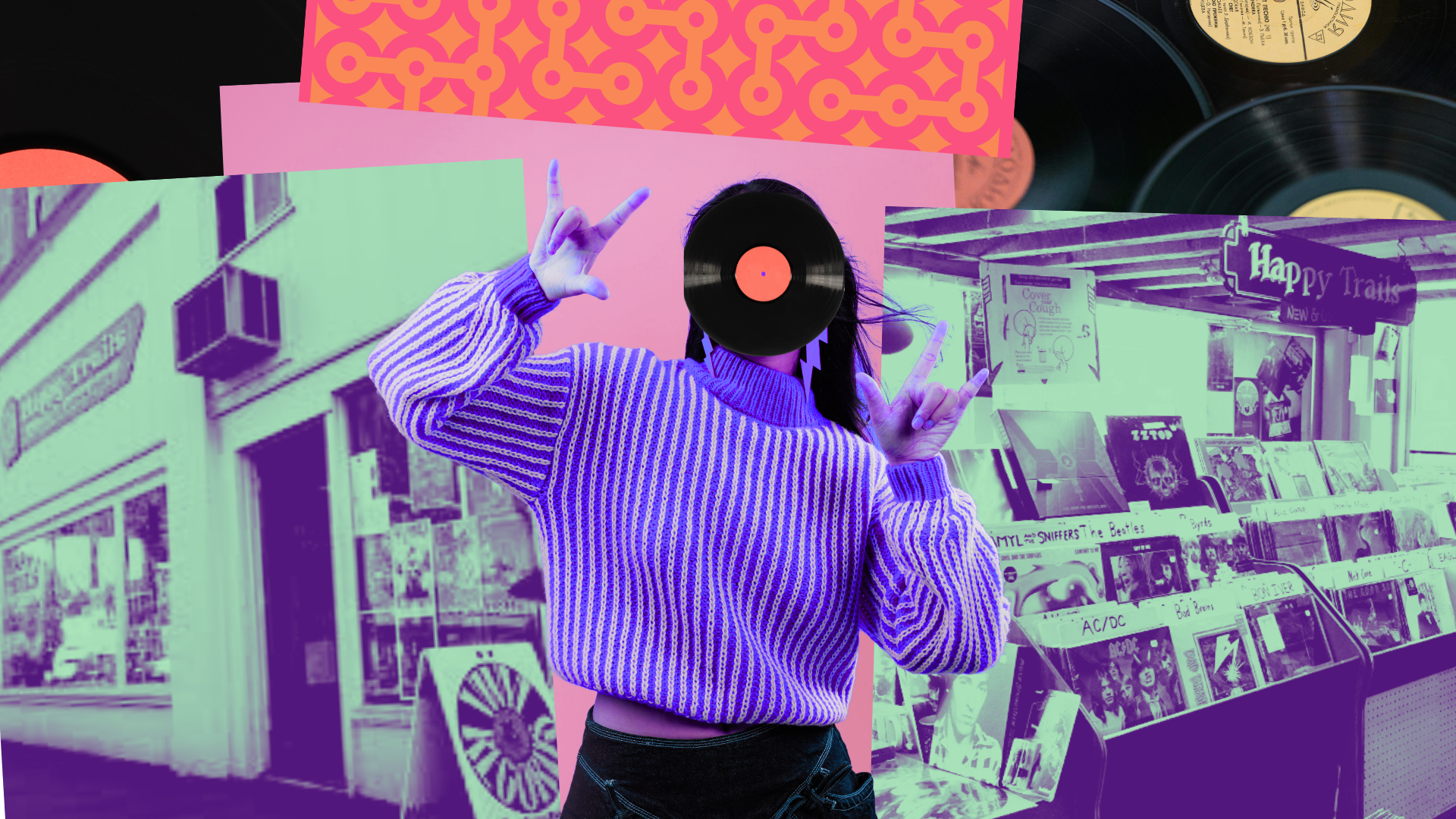
 Happy Trails Records sells you something just shy of intrusion: the chance to see inside someone else’s obsession.
Doug: The obsessionist, the archivist, the owner, has perfected the art of reading you the moment you walk in. And when he does, he doesn’t mock you. He leans in with a story. “Ah, but did you know….?” Suddenly, your music literacy feels vastly inadequate. But he can help. He’s generous with knowledge, energy, and subtle judgment; someone who has watched thousands of people hesitate in the same doorway.
The shop itself is comforting, crooked in the way old apartments are: low ceilings, narrow aisles, smelling like people, dust, and coffee. You do not leave unchanged.
Doug bought the store in 1985, shortly after graduating from college, when it was still a few blocks from its current location. It had opened in 1974, and like most small record shops, it could have easily disappeared without much resistance. Instead, it stayed. “We’re coming up on fifty-two years,” Doug said, amusingly casual. The number is less impressive to him than the fact of continuity. What he has maintained, more than anything, is sourcing and recycling inventory from Corvallis residents.
When people bring in records to sell, boxes of them, usually, Doug explains his system before he even looks inside. He will check the going rate, price it slightly lower, and offer a portion back. It is clear, direct, and notably free of theatrics. “I don’t like the haggling,” he said. “People think you’re trying to rip them off.” So he removes the possibility altogether. You either agree to sell, or you don’t. Most people do.
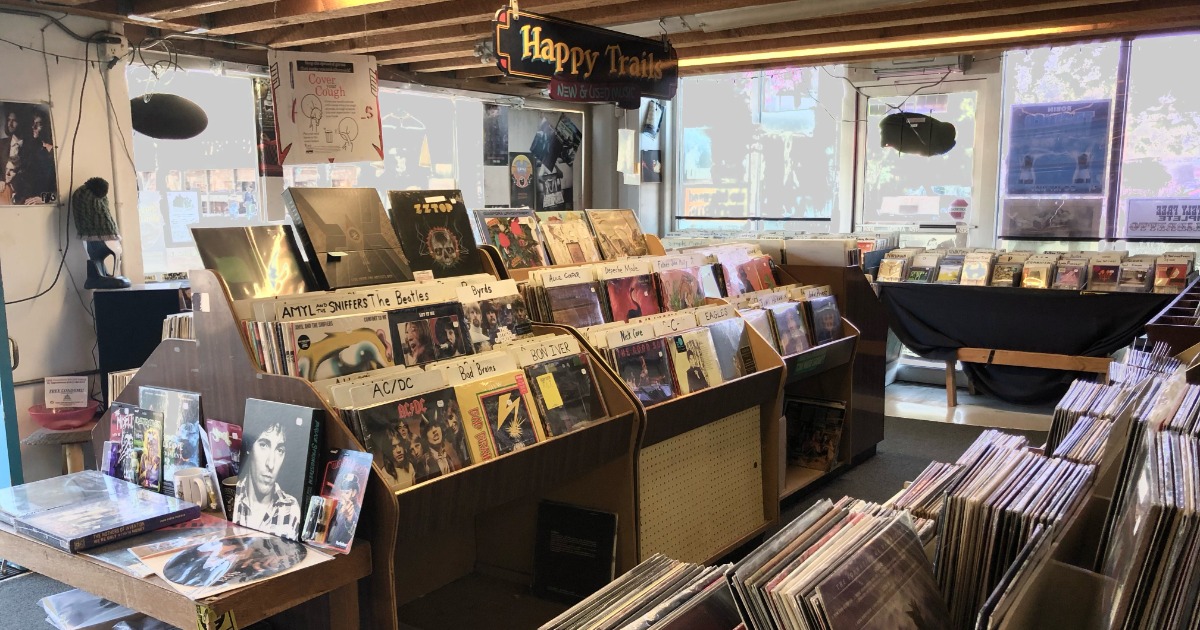 The rest of the store follows a similar logic. Nothing is hyper-performed. Searching through the bins requires effort, careful attention, and time. On the side of the store, the dollar section offers lower stakes for hesitant buyers; the records are worn, warped, and commonly unpopular. But what ends up there usually makes its way into a college apartment before long.
As knowledgeable as Doug is, he said he is still constantly surprised by young students and new fads. At sixty-five, he doesn’t pretend to track new music. “I’m not going to be plugged into what you’re listening to,” he said, without apology. Instead, he asks questions. He listens.
That instinct goes back to his own introduction to music.
He started buying records in 1968, when he was seven years old, after his parents gave him a small plastic stereo. Like many kids at the time, he gravitated toward The Beatles, not out of nostalgia but because they were everywhere; current, evolving, unavoidable. He remembers lying on his bed with Sgt. Pepper’s Lonely Hearts Club Band, studying the cover while the album played from beginning to end. The sequence mattered. The artwork mattered. The experience was immersive, not separating sound from context.
That model, of music as something you move through, rather than extract from, still forms how he talks about records now. Streaming, he acknowledged, is efficient. It gives you what you already know you like. What it doesn’t do is insist on attention. “An album builds something,” he said. “You stay with it, you move with the artist.”
For a long stretch of time, that experience was nearly erased.
In the late 1990s and early 2000s, file sharing disrupted the industry so completely that stores like Happy Trails were left without a clear purpose. Customers told Doug they didn’t need to buy CDs or vinyl anymore; they could download everything for free. Sales dropped. Stores closed. By the late 2000s, both had nearly disappeared.
Then, gradually, they returned.
Doug rebuilt the record section incrementally: one row, then another, then the store once again became filled with vinyl. By the mid-2010s, vinyl had reestablished itself as the dominant format in the shop.
What he didn’t expect was the persistence of CDs. Younger customers, people who had grown up entirely within digital systems, were still buying them. The explanation he gets is consistent for both the resurgence of CDs and vinyl. Young people want something they can hold. They yearn for something tangible.
Happy Trails meets that desire without romanticizing it. The records here are not treated as artifacts. They are handled, compared, and occasionally misjudged. A worn copy sits next to a pristine one. A classic jazz album leans against something glossy and recent. The hierarchy is unstable, shaped moment to moment by whoever is present.
Doug allows for that instability. After four decades, he has watched enough people move through the store to recognize the arc and ever-changing waves of music culture: confidence, hesitation, and adjustment. He recognizes that taste is less fixed than it seems.
“I hope people continue to let their curiosity grow within the story of albums, not the popularity of songs,” he said, almost as an aside. But it isn’t an aside.
Places like Happy Trails don’t continue by accident. They persist because someone is paying attention to the humanity inside the obsession. If you let yourself, you too can listen the way he does: hearing the vision of the artist before the voice of the algorithm.
By Taylor Pedersen
Do you have a story for The Advocate? Email editor@corvallisadvocate.com