

While the chances of being chased by a dinosaur skeleton are low, the annual Night at the Museum on campus this week will definitely be filled with magical surprises. The public is invited to explore Oregon State University’s range of natural history collections on Oct. 22 from 4:30-8:30 p.m. in Cordley and Nash Halls.
The night showcases OSU’s natural history collections through student-led interactive interpretation stations and exhibits with a spooky twist. Students representing many different science-based clubs have been working with collection curators to design and lead interpretation stations that highlight a broad range of collections from “Spooky Scavengers” to “Plants that Bite Back,” and many more.
“We have made a lot of changes this year, including expanding the oversight to three amazing student chairs and recruiting more club coordinators to oversee the design and staffing of these interpretation stations,” said Eric Cole, new student head advisor in the College of Science and one of the faculty organizers for the event.
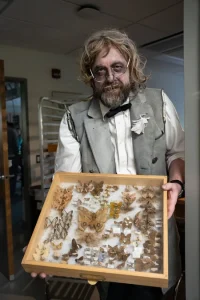
The stations each contain an activity and/or a specimen to teach scientific topics. Some stations also include a call to action or some OSU-based research on the topic. One highlight is the “Skull Buffet” that uses skeletal specimens from the J.C. Braly Natural History Collection to facilitate a guessing game to teach visitors about skull morphology.
Some stations take more inspiration from the spooky theming of the event like “The Crypt” station that will be a part of the OSAC/Bug Club section. The station showcases decomposers like death watch beetles, highlighting their importance in ecosystems as well as their spooky lifestyle.
Last year more than 700 people attended Night at the Museum.
Biology major Axel Pollard is co-president of the OSU Bug Club and a co-chair for Night at the Museum. Pollard has volunteered for several years and is excited to play a key role in this year’s planning.
“I mostly work alongside the Oregon State Arthropod Collection, for which I am also an employee. We’re very excited to show off the many insects, gastropods and arachnids we keep at the collections,” Pollard said. “We’ll be bringing back some old favorites like The Crypt and Firefly Lane as exhibits and showing off the newest members of our bug zoo.”
Pollard didn’t have much exposure to natural history collections as a child and hopes the event gives local children a better opportunity to learn about science.
“I hope this inspires a sense of wonder and discovery in our visitors for the night. There are so many things these collections can teach us about the natural world and more still that we do not yet have the answers for.”
Zoology student Anna Lyke is also a co-chair of the event. As a freshman, she attended the event and by her sophomore year she started volunteering, and now she’s a chair and volunteer coordinator.
“I love watching visitors’ reactions to the collections. Most of the biological collections involved in NATM are not open to the public at any other time, so many of the specimens we pull out to show at the event are completely new to visitors,” Lyke said. “They never thought they’d see a hippo skull or a deep-sea angler fish in real life. This event is such an amazing way to showcase the importance of collections like these for education, research and general enjoyment.”
Zoology student and co-chair Sylvia Burkhart became involved with Night at the Museum through the Integrative Biology Club. Burkhart’s role is to oversee all of the collections participating in the event. She said her favorite part is dressing up in a spooky costume and talking about science.
“My school didn’t organize field trips, and my family couldn’t afford to travel, so I only ever got the chance to go to local museums,” Burkhart said. “The only large museum close to my house was the Burke Museum, which was two hours away in Seattle. I was obsessed with ‘Walking with Dinosaurs,’ so I was always so excited to go and see the Pleistocene mammals and the dinosaurs. I hope visitors to Night at the Museum will be inspired to look at museum specimens differently. Not just as cool objects on display but as vital tools for research and education.”
Biology student Finn Kos is also a member of the Integrative Biology Club and is helping with student volunteer coordinating, as well as working with the JC Braly Natural History Collection, which houses more than 1,000 animal specimens, from hyena skulls to birds-of-paradise.
“Night at the Museum is a huge collaborative effort that spans so many clubs and countless people, each bringing their unique perspectives and ideas to the table,” Kos said. “Hours and hours of work behind the scenes make NATM so special– we really couldn’t do it without our volunteers, staff and curators.”
Kos hopes the event brings visitors a similar excitement to their own feelings as a child visiting the Denver Museum of Nature and Science.
“I never want science to be an out-of-reach concept for anyone; this planet and its treasures are all meant to be shared,” Kos said. “Through events like NATM, we’re inspiring the next generation of scientists and urging this one to preserve our natural world.”
Do you have a story for The Advocate? Email editor@corvallisadvocate.com